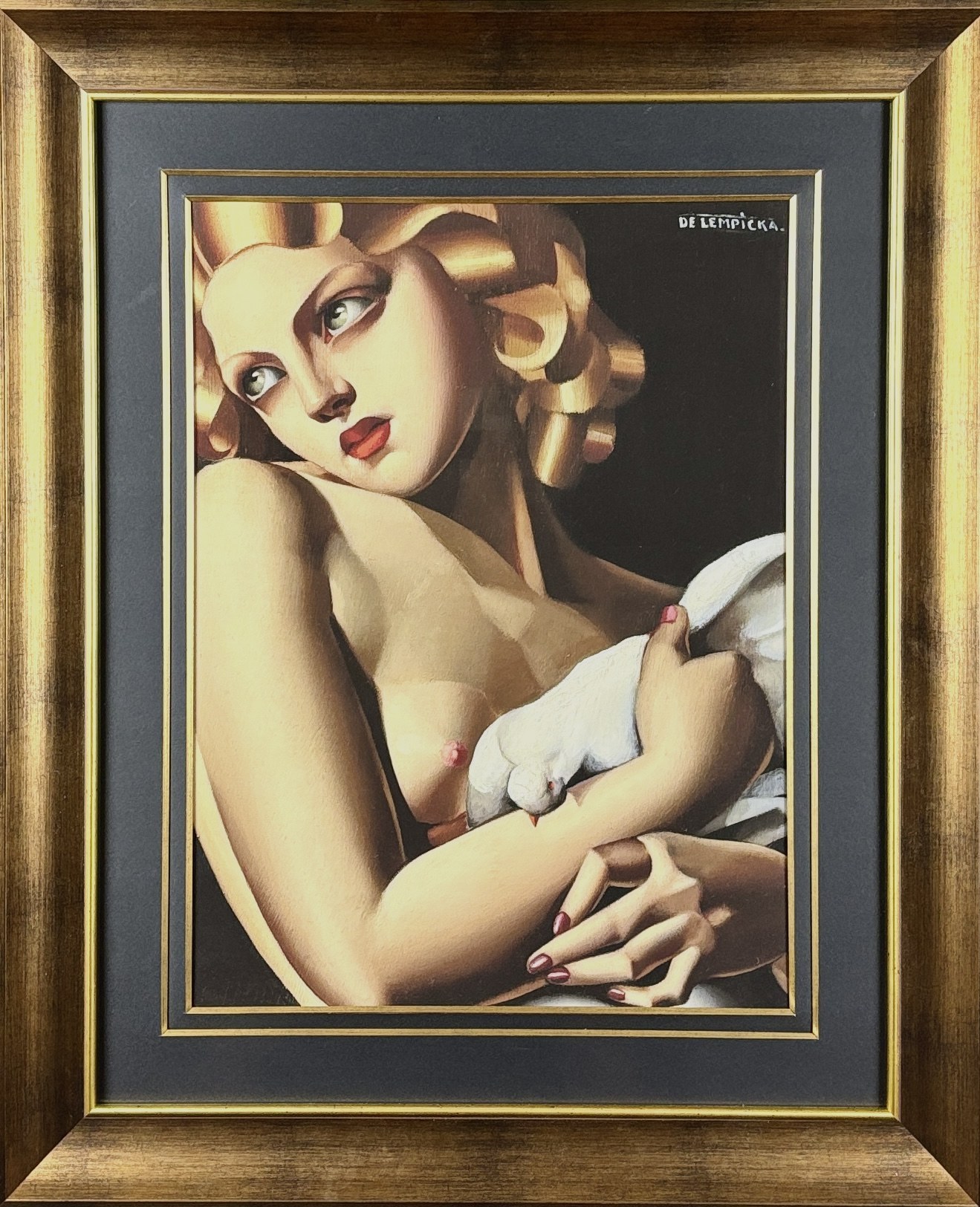
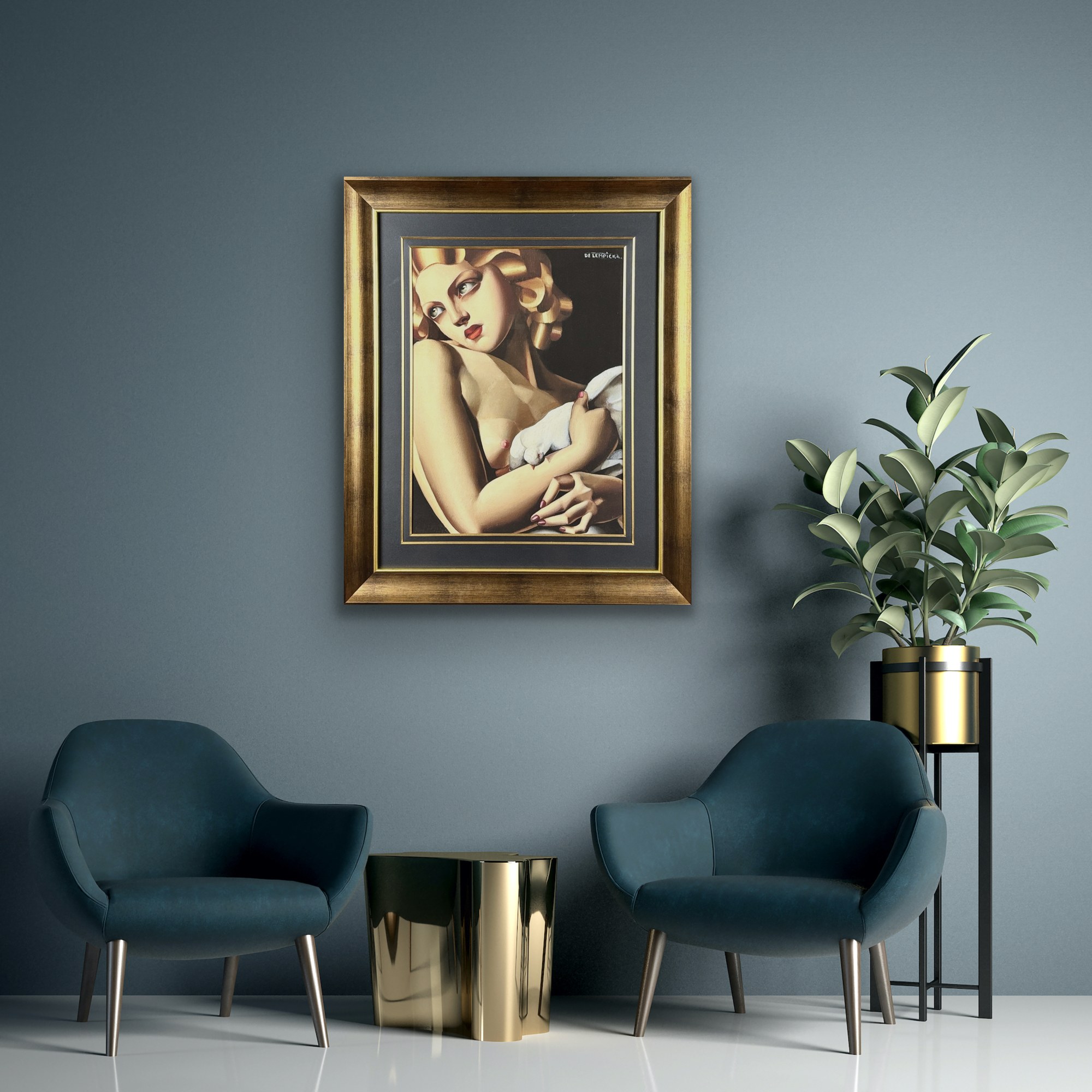
Giclée, Arches vellum paper, 77 x 60 cm (inside frame dimensions); mounted in a frame and a double passe-partout with gold mats
Signed on the plate, lower right: “LEMPICKA”
Produced by: Elite Lithoraphers, Edmonton, Canada
License: Tamara de Lempicka Estate, LLC Canada
References: A. Blondel, Tamara de Lempicka, Catalogue Raisonné, 1921–1979, Lausanne, 1999
This is a painting for the connoisseur who seeks something more in Lempicka than mere scandal. It is a testament to her extraordinary mastery of painting—her ability to capture the softness of feathers, the warmth of skin, and the serenity of the spirit.
It is one of the most lyrical and subtle paintings in Tamara Lempicka’s entire body of work. This painting is different—it is Tamara’s “gentle face.” Instead of a defiant gaze, we find melancholy, contemplation, and delicacy here.
The model’s golden hair, painted in the form of regular, geometric waves, is the quintessence of 1920s hairstyles. Its metallic sheen, combined with the dark, deep background, makes the figure stand out.
Many scholars see in this face the features of Tamara’s daughter, Kizette, albeit in a slightly more idealized, mature form.
The original painting was in the private collection of Jack Nicholson for some time (from around 1978 onward), who is a great admirer and collector of Łempicka’s work.
“She lived by her own rules, and those were the rules of the 1920s. She was interested only in people she called ‘the best’—the aristocracy, the wealthy, and the intellectual elite. Like any talented person, my mother was convinced that she deserved everything the world had to offer—it was second nature to her to meet people who could help her or contribute to the growth of her ego. She lived on the Rive Gauche, where artists were expected to reside, and she detested anything bourgeois, ordinary, or “pretty.” She wore only luxurious clothes, seeking to dazzle the public and create an aura of mystery around her past, her age, her life in Poland and Russia, and even around her family. A Polish girl from a good family, a child bride, an emigrant, a very young mother—all these personas, like screens from a diva’s wardrobe, were overturned by her painting. In their place emerged the modern, fascinating, sophisticated, and even decadent beauty from the famous self-portrait she painted shortly thereafter for the cover of the fashion magazine *Die Dame*. “I live on the margins of society,” Tamara used to say, “for people like me, conventional rules don’t apply.” From the very beginning, my mother’s sole goal was style.”
Bibliography:
T. de Lempicka, *Annotated Photo Albums*, Houston, 1923, no. 63. (illustrated)
K. de Lempicka-Foxhall & C.L. Phillips, *Passion by Design: The Arts and Times of Tamara de Lempicka*, New York, 1987, p. 110 (illustrated).
E. Thormann, Tamara de Lempicka, Art Criticism and Women Artists in Paris, Berlin, 1993, no. 58 (illustrated, p. 189).
Tamara Łempicka— a Polish artist of international renown, an icon of Art Deco and the interwar period. She spent her early youth in Warsaw (where she was born), in Switzerland (where she attended boarding school), and in St. Petersburg (where she met her first husband, Tadeusz Łempicki). During this period, she discovered Italy and, with it, the Renaissance masters, who became an inexhaustible source of inspiration. In 1918, she moved to Paris. In the French capital, she began studying painting and discovered Cubism, which became a defining element of her work. With the outbreak of World War II, she moved to the United States and subsequently spent the rest of her life in Mexico. It was there that she was “buried”; in accordance with the artist’s last wishes, her ashes were scattered near the Popocatepetl volcano.
“I painted kings and prostitutes. I paint those who inspire me and make me feel a certain vibration.”