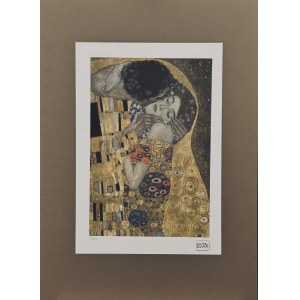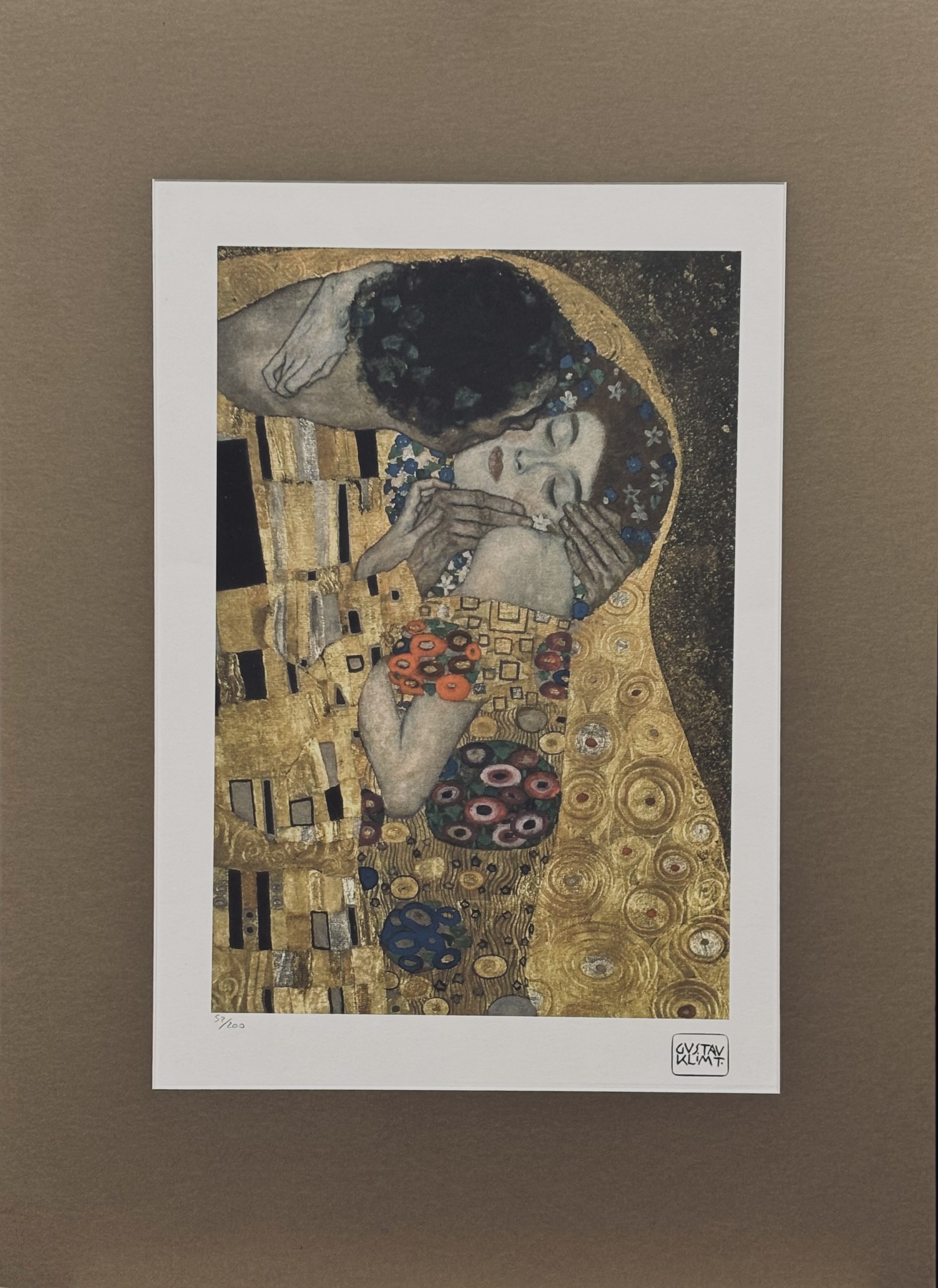
lithograph, paper, 44 x 30 cm
Color lithograph, heavy weight velin paper;
44 x 30 cm (composition), 70 x 50 cm (sheet);
Signed on the plate under the composition p. d. "Gustav Klimt" and numbered in pencil "52/200".
Publisher's dry-erase stamp l.d.: "trec, Edizioni Pregiate" and hologram "verification of authenticity" on the reverse.
Original certificate.
The kiss was painted with oil paints on canvas, measuring 180x180 cm. The author also used gold flakes to create the work. The painting depicts a pair of lovers lost in a loving embrace on the slope of a flower meadow. The lovers, clad in golden robes, are captured in a pose suggesting an impending kiss.
At first glance, the image forms a shimmering patch of gold. Only after a moment does a woman's face, faint with delight, emerge in the upper part, her naked arm protruding from a multicolored tight dress, and a tiny hand resting on the man's neck. The woman kneeling on the flowery ground is embraced by a stocky barbaric brunet with a dark complexion. Only the profile of his face is visible. He holds his partner's head with his hands to place a kiss on her cheek.The lovers sink into their geometrically stylized robes. Her yellow dress is decorated with bunches of red and navy blue flowers in the shape of circles, a symbol of femininity. His golden coat - dark brown and white surrounded by brown angular rectangles. The male figure appears to protect and shield the woman. She embodies soft gentleness, but is an equal partner. Neither figure dominates.
"Golden period" in which the work was created is the period of Klimt's painterly fascination with gold. Many of the artist's paintings created during this period, have rich ornamentation made of sincere gold flakes. It is likely that the popularity of The Kiss is also due to the use of this technique. On the one hand, gold in art evokes primarily mystical and religious associations, on the other hand, it has a real value identified with a high price. During this period, the artist created work on an international scale and rose to the elite of Europe's most expensive portrait painters.
In 1908 it was purchased by the Österreichische Galerie Belvedere in Vienna and is still in its collection today.
Gustav Klimt - Austrian painter and printmaker, symbolist. One of the most prominent representatives of Art Nouveau, a representative of Viennese Modernism. From about 1890 Klimt began to increasingly develop his unique expressionist style, which is distinguished by characteristic flat ornaments. In 1890, he left the Künstlerhaus artists' association and, together with other artists, founded the Vienna Secession. An association that made Art Nouveau, or Art Nouveau, a departure, a separation from the prevailing norms, rules and traditions in art. In 1897, Gustav Klimt stands in the spotlight of the jupiter in an instant. As president of the Association of Austrian Artists, he is a leading figure among the so-called Secessionists, those striving for a renewal in art. The Secession Pavilion in Vienna's Charles Square becomes the exhibition building for the new movement. This is a period of the biggest art scandals to date, culminating in 1900 when Gustav Klimt completed paintings depicting allegories of the faculties of the University of Vienna. In a letter of protest over the allegories of faculties painted by Klimt for the University of Vienna, it said: "We are not fighting against naked art or against free art, only against ugly art." At the World Exhibition in Paris, Klimt is awarded the Grand Prix for his painting "Philosophy" from the series of allegories of faculties. From that moment on, Gustav Klimt enjoys fame on a European scale.