


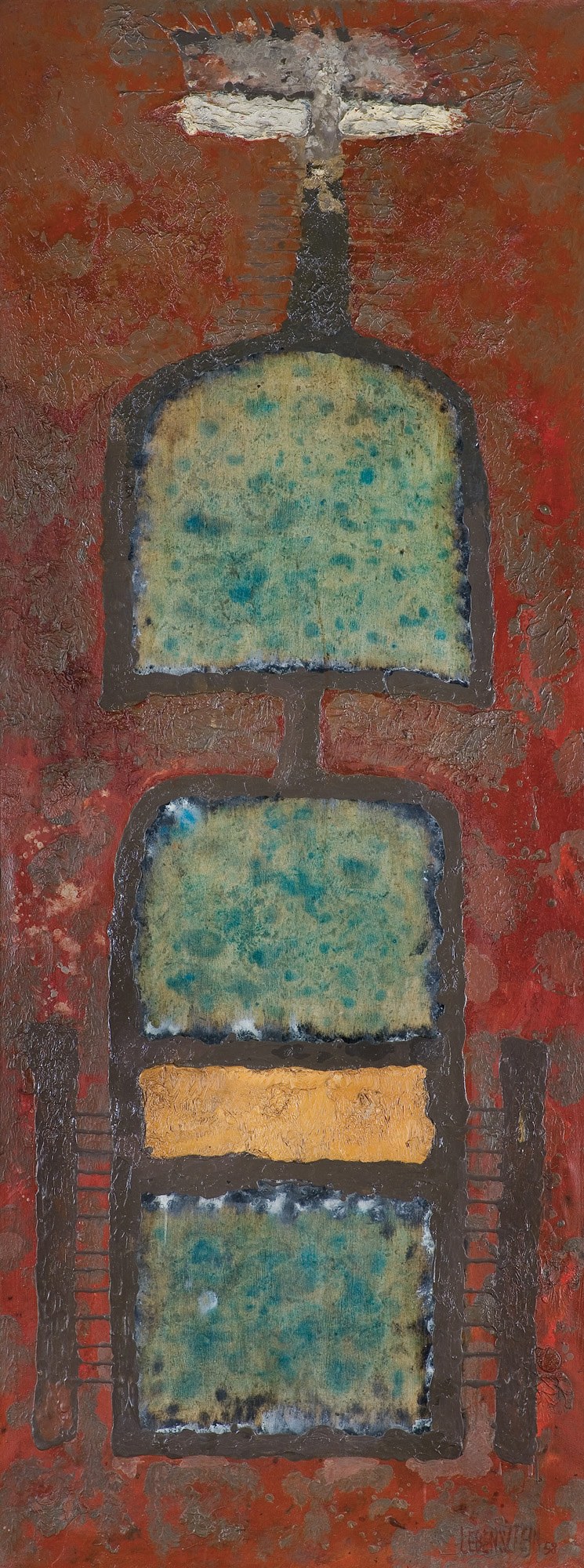
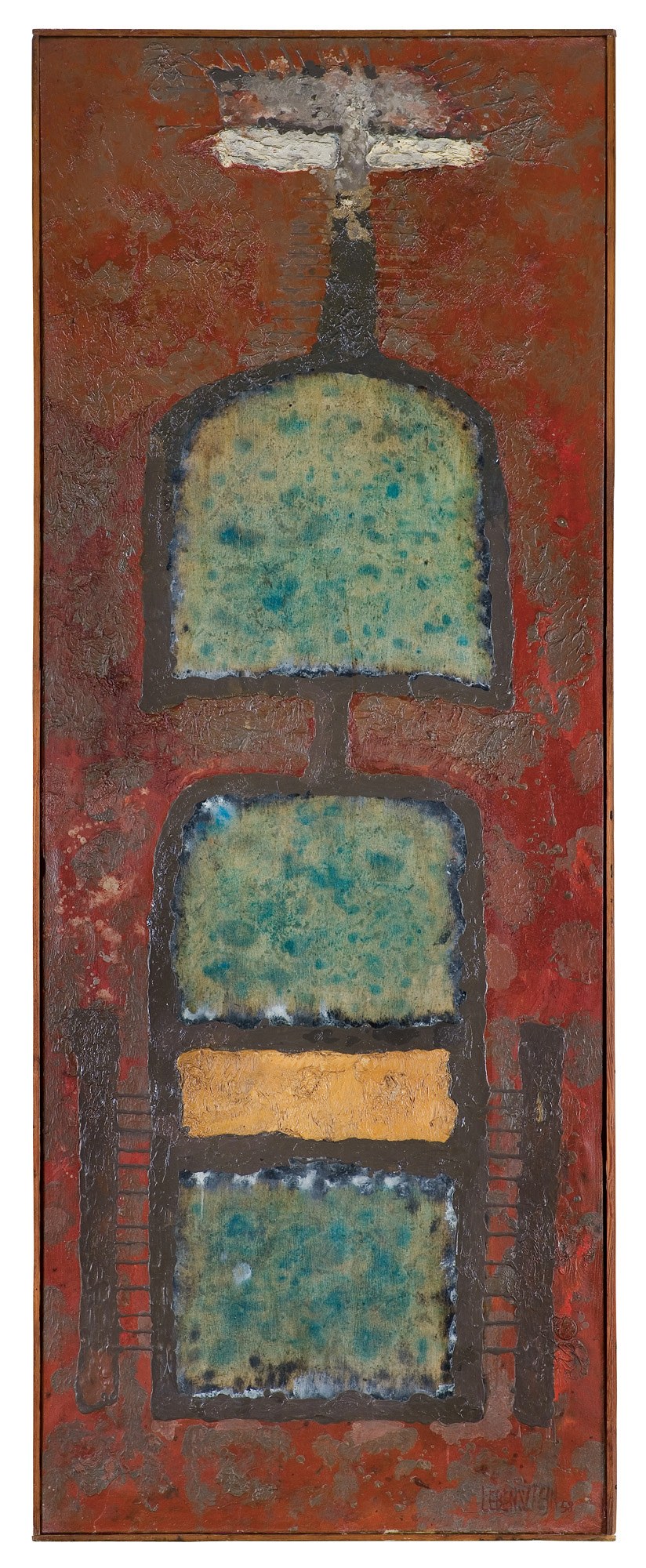
180 x 67.5cm - oil, canvas
sign. p.d.: LEBENSZTEIN
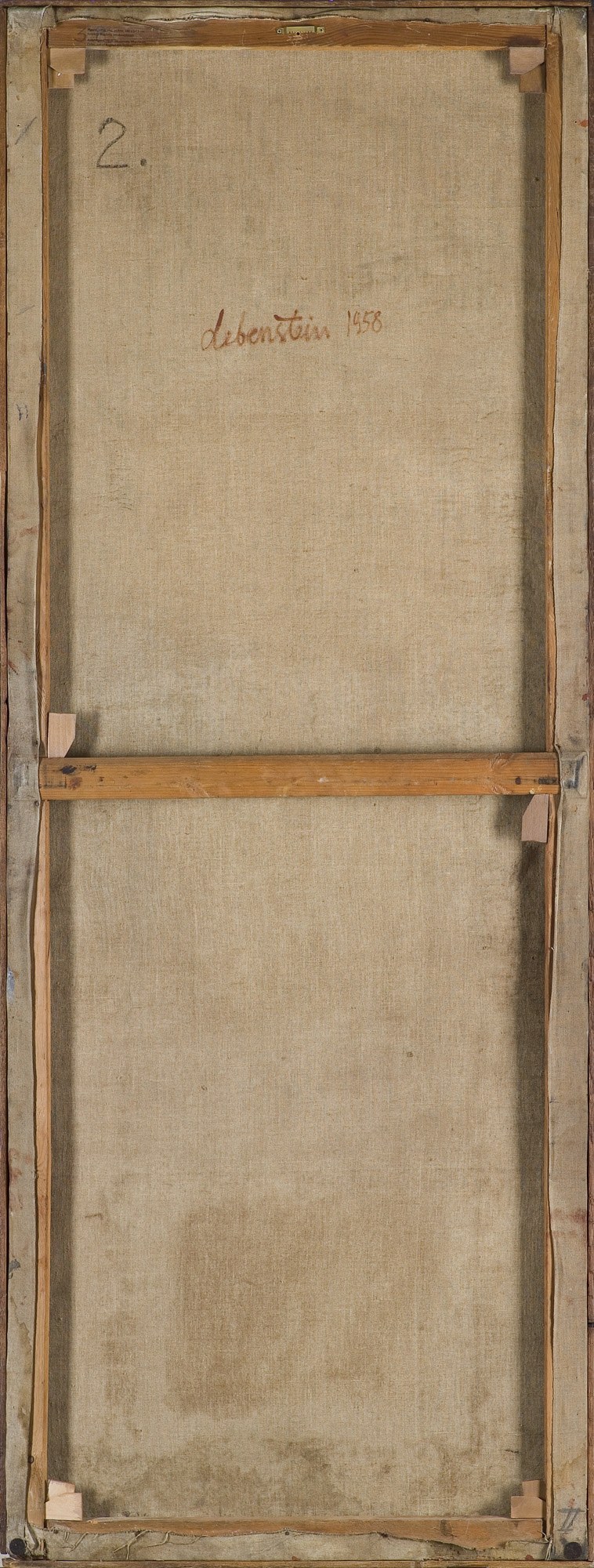
Signed on the reverse m.g.: Lebenstein 1958, l.g.: 2., p.d.: II
On g. strip: 3 P and a sticker with details of the painting and origin: Bogdan Jakubowski Collection.
Jan Lebenstein's oeuvre, situated on the border of figuration and abstraction, is one of the most original phenomena in European art of the second half of the 20th century. A special place in the artist's oeuvre is occupied by the series of Axial Figures, which brought him international recognition and opened the way to a worldwide career after his success at the 1959 Biennale of the Young in Paris. The 1958 figure on display belongs to an important period of Lebenstein's work - the moment of the birth of his mature artistic language.
The painting shows the artist's characteristic monumental anthropomorphic form, constructed from geometric segments. The vertical composition brings to mind an archaic idol, a sign or ritual object excavated from an unknown civilization. The centrally located form, fragmented into three main parts, builds associations with both the human body and an organic construction undergoing a process of biological transformation. Lebenstein does not depict humans in a realistic manner - rather, he creates a metaphor of existence, a sign of the human condition.
Lebenstein's work has often been interpreted in the context of existentialism and the post-war experience of the crisis of humanity. His figures, balancing between the human, the animal and the organic, become universal symbols of human existence - fragile, corporeal and marked by constant change.
The painting bears witness to the moment when Lebenstein created his own instantly recognizable artistic idiom - a language of organic and symbolic forms, situated between figuration and abstraction.
This is what Mariusz Hermansdorfer wrote about it in his introduction to the catalog of the Jan Lebenstein exhibition at the National Museum in Wroclaw: Contrary to the opinions of some Polish and foreign critics, otherwise fascinated by Lebenstein's artistic proposals, it must be said that his works never crossed the boundaries of abstraction. The artist stopped at the edge, at the point where reality merges with the imaginary. Lebenstein created a totem. He created it on the model of those existing in various religions and civilizations, endowed it with similar properties. Accordingly, it is mythical and real, identical with the vertebrate type and related to it only in the conceptual sphere - in the symbol, sign, slogan. Thus, the synthesis of the concrete and the abstract, the principle of the unity of opposites is fulfilled here in an ideal way. It is also fulfilled in the contrast-based balance of plastic elements: right and left sides, background and figure, line and matter, light and dark colors. Through the center of the composition runs an axis, a structure that builds the shape of the totem, determines the unity of ideas and form.
The painting exhibited, mentioned and reproduced, among others, in:: Image Exhibited:
- São Paulo Biennale 1959, cat. 35, p. 330 (title Triple Figure II);
- Jan Lebenstein. The Seal of Eros and Thanatos. Paris 1960s, Zachęta National Gallery of Art, June 25-August 28, 2010;
- Jan Lebenstein. Metamorphoses, Bolesław Biegas Museum, Warsaw 2019;
- Jan Lebenstein. Painting and Drawing, National Gallery of Art in Sopot, Sopot 13 III - 9 VIII 2020, p. 71, il. b.;
- Rain, Heat, Dreaming. Collection of Contemporary Art. Juliusz Topolski, BWA Olsztyn, Olsztyn 16 IX - 13 XI 2022, BWA, Walbrzych 16 VI - 1 X 2023.
Image described and reproduced:
- Aleksander Wojciechowski, Jan Lebensztejn, in series: Contemporary Polish Painting, Warsaw 1959, p. nlb., color il. (under title: Figura trójdzielna);
- Jan Lebenstein, Warsaw-Paris, Works from 1956-1972, exhibition catalog Jan Lebenstein. The Seal of Eros and Thanatos. Paris, 1960s, Zachęta National Gallery of Art, Warsaw 2010, p. 38, il color;
- Jan Lebenstein. Metamorphoses (exhibition cat.), Bolesław Biegas Museum, Warsaw 2019, p. 20, il color.
- Rain, heat, dreaming..., (exhibition cat., texts by Sebastian Dudzik), Warsaw 2022, p. 3, color ill.
♣ Droit de suite: ♣ An additional fee will be added to the Purchase Price based on the right of the creator and his heirs to receive remuneration in accordance with the Law of February 4, 1994 - on Copyright and Related Rights (droit de suite).
Jan Lebenstein (Brest Litovsk 1930 - Krakow 1999) studied painting at the Academy of Fine Arts in Warsaw from 1948 to 1954 under Prof. Eugeniusz Eibisch and Artur Nacht-Samborski. In 1955 he took part in an exhibition at the Warsaw Arsenal. A friend of Miron Bialoszewski during his studies, he showed his first solo exhibition in 1956 at the Tarczynska Theater. In 1959, he won the Grand Prix de la Ville de Paris at the First Biennale of the Young in Paris, and moved to Paris permanently that year. After the series of "drawn figures" (on millimeter paper) and "hieratic figures" from 1955-1958, he paints a series of "axial figures" (1958-1962), which he exhibits in Paris and the USA. At the same time, in 1960, he starts drawing "carnets," a kind of diary, which in the future will provide the motifs used in the paintings. In 1964-1965 he paints "Bestiary," a series of textured, archaic creatures reminiscent of prehistoric excavations. Immediately after, he introduces human and fantastic figures into his paintings, acting out scenes neither mythological nor from a dream, often imbued with eroticism. In 1970, he designs stained glass windows for the Centre du Dialogue in Paris. In 1971 receives French citizenship 1974 creates gouaches inspired by George Orwell's Animal Farm. In 1976-1989 he creates exclusively in gouache and pastel, taking up mythological themes and those taken from the Bible: cycles of illustrations to the Book of Job (published in 1979) and the Apocalypse (published in 1986) in new translations by Czeslaw Milosz. In 1989 he returns to oil painting (series "Pergamon"). The artist received, among others, the Alfred Jurzykowski Foundation Award in 1976, the Warsaw Archdiocese Museum Award in 1985, the Jan Cybis Award in 1987.













最近瀏覽過的
登錄以查看拍品列表
收藏
登錄以查看拍品列表