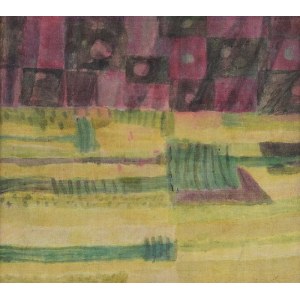
Signed and dated p. d.: 61 P. P.;
signed, dated and described on the reverse: PIOTR POTWOROWSKI / 1961 / sig. 61. P. P. and a stamp from a private collection.
In the circle of the Capists, Piotr Potworowski was one of the greatest advocates of modernity, but it was only after the war that he gradually began to move away from object painting, turning to allusive abstraction and the search for painterly synthesis. Bringing compositional rigor to Polish colorism, expressed in a stronger geometrization of the forms of the visible world, he did not give up the important role of color. He underpinned his painting with careful studies of architecture, as well as a fascination with the art of Fernand Léger and other Cubists. (Urszula Kozakowska-Zaucha) Piotr Potworowski believed that paintings are not just objects. They are messages, like books. Let's read them for ourselves, as those before us and after us will explore them, for whom the work of this perceptive, wise artist is of more than just visual value. Potworowski viewed the canvas in purely painterly terms: light (a painting should be "a powerful reception apparatus for waves of light"), color (as "the most powerful factor in painting") and space, which is defined by forms and the relations between them. Potworowski's concept of space stems from several of the most important principles he adheres to. First, breaking with the traditional method of painting from a single point, the artist viewed landscape as a sum of objective and subjective phenomena; he transformed what he saw and felt into an "accurate painting fact." In this context, he undertook a new organization of space on his canvases; spatial relations became the result of "deeper seeing." (Katarzyna Kulpinska, The Role of Space in Piotr Potworowski's Landscapes)