


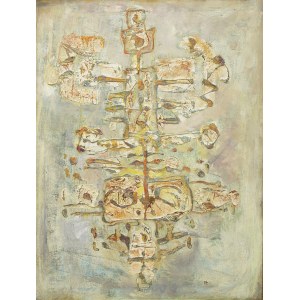
oil/canvas, 86.5 x 65.5 cm
signed p.d.: TŁ.
on the back in pencil date 1956
Axial Figure is an extremely interesting painting that should be juxtaposed with analogous paintings by Jan Lebenstein from this period. The formal proximity may be due to the artists' contacts, who studied in the same painting studio. The abstract composition is part of the current of matter painting through the search for new formal means, used to increase the expressiveness of the painting and bring it closer to everyday life through the use of materials such as sand, gravel or even gypsum. The resulting new textures were not aesthetically pleasing, but were reminiscent of scratched, peeling house walls. This made the painting closer to ordinariness, while art ceased to be something lofty, sanctified. At the same time, the hieratic nature of the painting is enhanced by its strictly symmetrical composition, built on a vertical axis. The depicted figure resembles a human figure - perhaps an orant with outstretched arms, or perhaps a dervish who is just in a state of trance? Certainly it is a shape that refers to the human figure, symbolizing its metaphysical condition.
Painter and printmaker, lived in the US since the 1960s (a professor at the University of Maryland since 1972). Studied at the Warsaw Academy of Fine Arts in the painting studio of Artur Nacht-Samborski (together with Jan Lebenstein, Stefan Gierowski or Rajmund Ziemski) and graphic arts of Józef Pakulski and Józef Tom. In 1963 he left Poland, stayed in Yugoslavia, France and Brazil before settling in the US. Above all, he is valued as a world-renowned graphic artist (he received numerous awards at international competitions and exhibitions), although his paintings from the late 1950s and early 1960s are an interesting example of the early reception of matter painting and can be compared to the works of Jan Lebenstein from that period.










最近瀏覽過的
登錄以查看拍品列表
收藏
登錄以查看拍品列表