


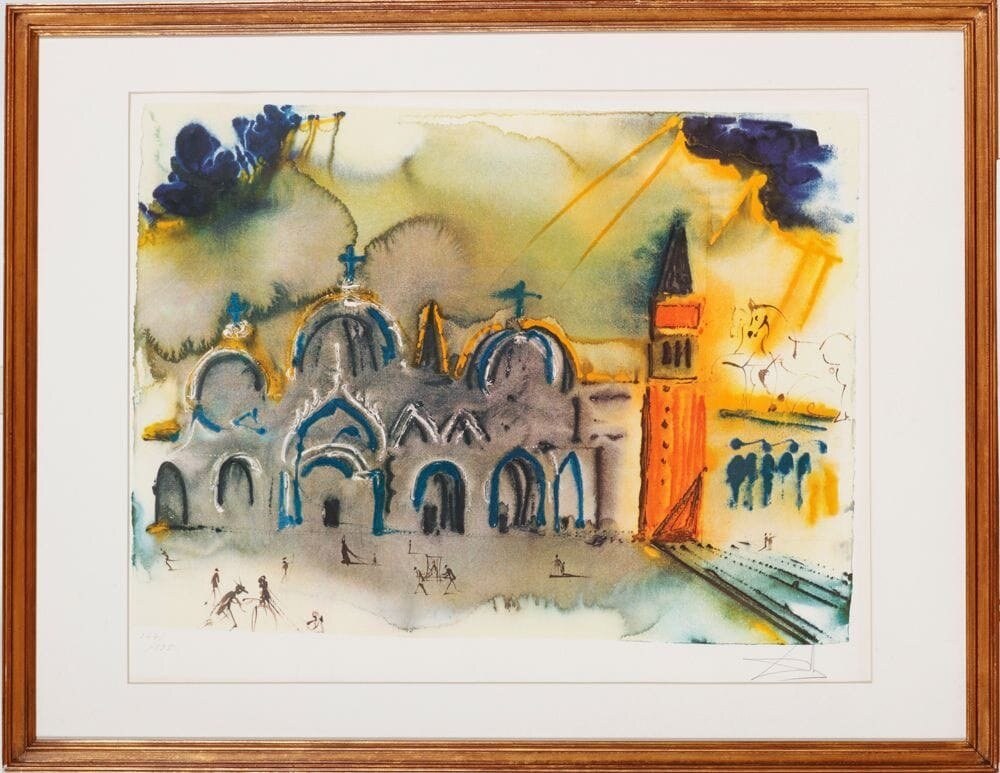
Lithograph with embossing on Arches paper
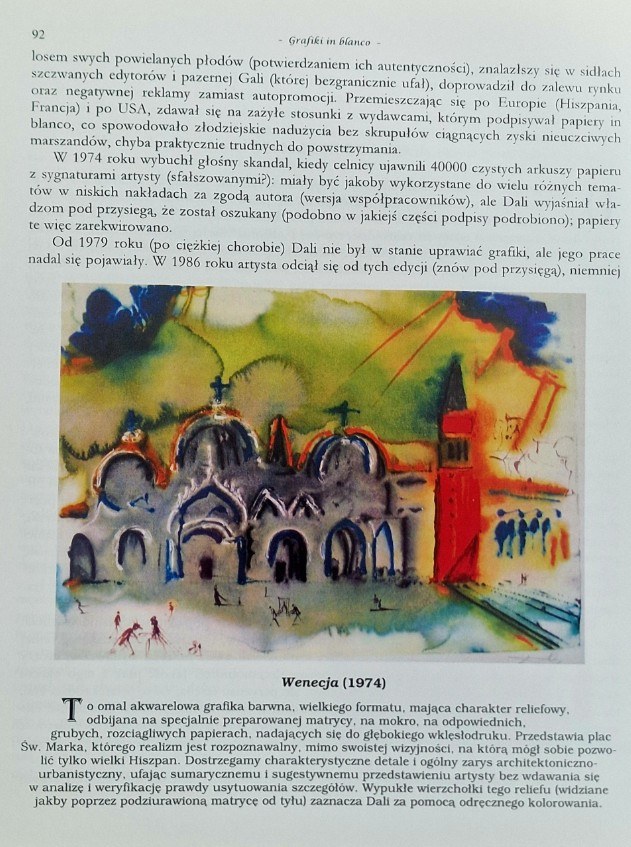
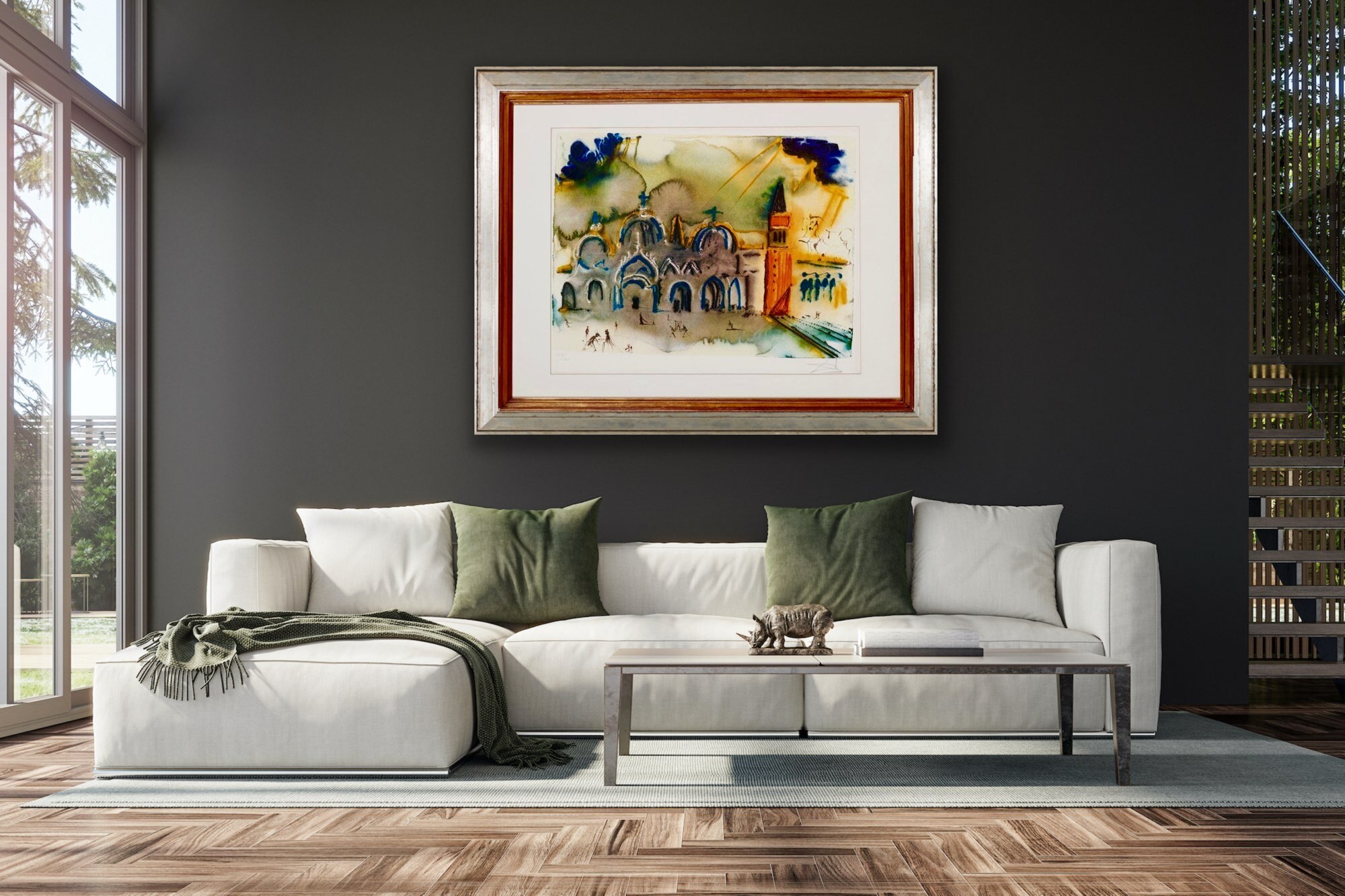
Convexembossing elements Dali colored by hand (see photo from the book); 70 x 90 cm in light passe-partout; framed in brown frame, 85 x 105 cm; (silver frame is a visualization)
Limited edition: 167/195 p.d.
Signature signed in pencil by the Artist.
Publisher Jean Lavigne, made at Atelier Mourlot in Paris (it was a renowned atelier with which Dali worked closely on most of his lithographs).
Atelier Mourlot founded in 1852 in Paris-the most important center of artistic lithography in the world. The workshop's brand guarantees the highest quality and prestige in the collecting world. It was here that such giants as Dali, Picasso, Matisse, Chagall, Miró and Braque worked. Fernand Mourlot invited artists directly to the workshop, allowing them to experiment on lithographic stone.
References:
- Michler/Lopsinger catalog raisonné: No 1551 page 174
- A. Field catalog: No 75-1 page 173
Literature:
- Z.Korus "Symbols of Dali";Gallery Plus, 2004; (reproduction and description page 92);
the author of the book writes about this work as follows: "This is an almost watercolor color print, large format, having a relief character, reflected on a specially prepared matrix, wet, on suitable thick papers."
Embossing - (stamping) inside the composition is one of the most prestigious techniques used by Dali. Embossing gives it the permanence and "eternity" of a sculptural form. Embossing inside a composition is extremely difficult to forge. It requires tremendous pressure from the printing press, which is able to "force" the paper into the grooves gouged into the metal, special, thick and moist paper (usually Arches) that will not crack under such pressure, and hand finishing. Such editions are prepared for the most demanding collectors.
Instead of a realistic landscape like Canaletto's, Dalí interprets St. Mark's Square in his characteristic surrealist style. Even if the architecture is recognizable, it is transformed according to the artist's vision. Dalí rarely depicted purely realistic views. In Dalí's approach, the image can be deformed, blurred which is typical of surrealist visions that violate the laws of physics. In the case of this print, Dalí used relief (embossing) to give texture and the illusion of three-dimensionality to the architecture, even if the form remains dreamlike and incomplete. Nevertheless, we recognize the key objects of the Square: the Basilica of St. Mark (Basilica di San Marco), the Bell Tower of St. Mark (Campanile di San Marco), the Columns (St. Mark and St. Theodore) on the Piazzetta, the famous Quadriga of St. Mark's Basilica. Bronze sculptures of horses (now replicas, the originals are in a museum) adorn the facade of the Basilica. They symbolize the power and spoils of war of Venice, especially those brought from Constantinople.
The presence of ants as small figures in the foreground is one of Dali's most iconic and personal symbols. Ants (hormigas) in Dalí's work almost always have negative, even obsessive overtones. Dalí reportedly feared ants as a child, and the motif itself became a visual counterpart to his fears and fascination with Freudian psychoanalysis. The use of ants as a crowd in St. Mark's Square in Venice may symbolize the anonymity of the human mass, which, despite its historical setting, is impersonal and immersed in a daily, "decaying" routine.
Combining the power of history (the horses of the Quadriga) with the motif of decay (the ants), Dalí puts Venice in the context of his paranoid-critical method, depicting the famous "salon of Europe" not as a postcard, but as a scene in which the subconscious exposes hidden fears of obsessions.










