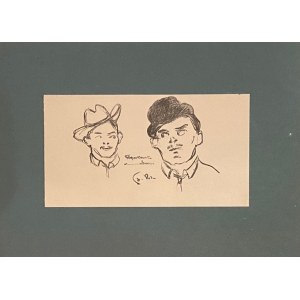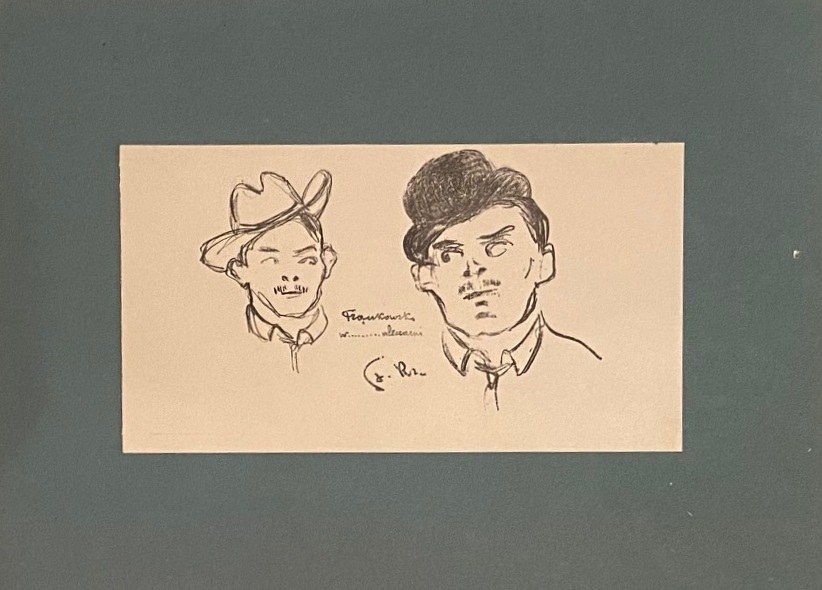
autolithography, paper, 18 x 33 cm (composition), 50 x 38 cm (dimensions of original period cardboard backing);
signed on stone medr.d. ."Frączkowski / in ..... St. Rze dairy" (on panel)
The social and artistic life of Krakow at the turn of the 19th and 20th centuries developed intensely, concentrating both in salons and at the tables of fashionable cafes. Kazimierz Sichulski, along with Karol Frycz, Stanislaw Kuczborski, Stanislaw Rzecki and Wojciech Wojtkiewicz, joined the group of Lviv mockers who, at the café table of Jan Apolini Michalik's Lviv Pastry Shop, came up with the idea of preparing a lithographic portfolio of caricatures of actresses and actors in the roles of plays being performed at the time - "The Wedding." "Eros and Psyche," "The Children of Vanyanshin," "The Neighbors' Sisters," "The Marriage of Figaro," "Kosciuszko at Raclawice," "Anastasia," "The Merchant of Venice," "The Half-Girlfriends" and "The Maiden Vows." And so, under Rzecki's guidance, the famous "Teka Melpomena" was born in 1904, printed free of charge by Zenon Pruszyński at his Artistic Lithography Works, a friend of artists and a faithful ally in their play. . Teki" included 38 autolithographs designed by prominent artists of the Young Poland period. In a distorted mirror of caricature and joke, in expert drawing and in flatly spilled spots of color and black, sometimes against a background starry with paint dusting - we observe the heads and figures of actresses, actors and collective scenes, including an enchanted dance by Chooch. Popular and favorite actors include: Jadwiga Mrozowska, Helena Sulima, Stanisława Wysocka, Jerzy and Bolesław Leszczyński, Marian Jednowski, Michał Przybyłowicz, Aleksander Zelwerowicz. "Teka Melpomeny" entertained, a little inferior, but it was very popular, and its fame has survived to this day. The lithographs from this portfolio were exhibited in 1905 at the Krywult Salon in Warsaw; many of them stuck in the portfolios of collectors, others adorned the walls of salons and rooms of lovers of graphics, Art Nouveau, theater, and fun. They also adorned the walls of the Lvivska Cukiernia Lwowska, where the idea of a portfolio was born and where the artistic cabaret Zielony Balonik (Green Balloon) was established in 1905, and the confectionery began to be called the Michalik's Den," which still operates today.
Aureliusz Pruszyński (1847 Kasinka Mała Powi. Limanowa - 1904 Kraków) was a Kraków lithographer, owner of the esteemed Aureliusz Pruszyński Artistic Lithography Workshop in Kraków established in 1873 at 17 Pijarska Street, from ca 1902 his son Zenon Pruszyński was the owner of the workshop (see SAP vol. 8 pp. 92-93). In the factory of A. Pruszyński since the end of the 19th century, the leading artists of Cracow reflected their graphic works in lithography (including posters), including the famous "Teka Melpomena".
Autolithography - a lithograph drawn by the author-artist directly on the lithographic stone.
Lit.:M. Grońska, Grafika w książce, tece i albumie, Wroclaw 1994, item 7.; Katalog zbiorów Gabinetetu Grafiki", vol. 1: "Polish Graphic Arts 1901-1939," Wrocław 1983, cat. 691, p. 208.
Stanisław Szreniawa-Rzecki graduated from gymnasium in Warsaw, and then studied at the School of Fine Arts in Kra¬kow until 1908, including under Teodor Axentowicz, Stanisław Wyspiański, Julian Fałat, and sculpture under Konstanty Laszczka. In 1904 he enjoyed a scholarship from the Mikołaj Kopernik Society for the Encouragement of Fine Arts (TZSP). He was one of the more active students of the Academy, and was active in the Fraternal Aid (he was secretary). During his studies he developed friendships with Waclaw Borowski, Wladyslaw Skoczylas and Stanislaw Kuczborski. He circulated in circles of artistic bohemians, frequented cafes and salons (including Eliza Pareńska's), and met with Wyspianski, Tadeusz Boy-Żeleński, Teofil Trzciński, Karol Frycz and Witold Wojtkiewicz. With Wojtkiewicz, Rzecki was particularly close; they lived together on St. Thomas Street, made numerous drawings for the satirical magazine "Liberum Veto" (1903 and 1904), as well as theatrical caricatures published in "Teka Melpomena" in 1904. Rzecki also collaborated with the satirical-political magazine "Hrabia Wojtek" (1905), published by "Naprzód", and later with the art weekly "Czarny Kot" (1906). Rzecki was associated with the cabaret "Zielony Balonik" from the moment it was founded in 1905: he made room decorations, puppets for nativity scenes and, above all, decorated invitations to subsequent cabaret evenings with witty drawings, drew and commented on caricatures; he also performed in 1909 at the Varsovians. Momus. In 1909-13 he studied in Paris. Upon his return, he founded the Young Art Society in Warsaw. During World War I, he fought in the Polish Legions. In 1915, he began working with Warsaw theaters as a stage designer and costume designer. He worked: with the Powszechny Theater (costumes for "The Cid", 1915), with the Polish Theater (costumes for "The Constant Prince" and decorations for "The Barber of Seville", 1918), with the Reduta (costumes for "Fircyk w zalotach", 1920 and decorations for "The Ring of the Great Lady", 1936). His designs met with recognition. J. Lorentowicz wrote that "Rzecki brought to his decorations and costumes such discretion of general tone, so much taste and harmony, that he reflected supremely from the brightness of colors of his most distinguished colleagues." Rzecki was active in artistic life. In 1922 he was one of the founding members of the Association of Artists "Rhythm", and in 1925 he was one of the co-founders of the "Rhythm" group. At that time he was particularly interested in woodcuts.
After World War II, he completed a few more stage design projects: at the Słowacki Theater in Krakow (Fantazy, 1946), and in Warsaw at the Chamber Theater ("Clever Widow," 1950) and the National Theater ("School of Wives," 1959). However, he was primarily a sculptor, painter and graphic artist. He had a number of exhibitions at home and abroad (Paris, Brussels, Berlin, Rome, New York, Venice). He was a member of various art groups, the founder of the Institute of Visual Arts in Warsaw and its director (from 1926 to 1937); he was also a teacher for many years.


![Stanisław RZECKI-SZRENIAWA - RZECZNIK (1888-1972), Gęsi na wodzie [Pensjonat]](https://img1.one.bid/img/8291/2474739_1w.webp?1751552502)