




Dimensions: 46.5 x 59.5 cm
Signature: signed l.d.: A Wierusz Kowalski
Provenance
Warsaw, private collection
One of the most recognizable motifs in Alfred Wierusz-Kowalski's work are his famous scenes with wolves - full of tension, drama and the moody chill of winter landscapes. The artist reached for this theme as early as the 1880s, during a period of growing popularity and recognition that he was gaining both in Poland and abroad. Cooperation with illustrated magazines such as "Kłosy", "Tygodnik Ilustrowany", "Tygodnik Powszechny" and "Biesiada Literacka" played a major role in popularizing his paintings. It was in the pages of "Kłosy" in January 1880 that a woodcut reproduction of the painting "Attack of Wolves" was first published - a composition that launched a whole series of depictions with this motif and established the artist's reputation as a "painter of wolves."
Wierusz-Kowalski painted both dramatic scenes of wolf attacks on travelers and lyrical, melancholy nocturnes with a lone animal traversing a winter landscape. This motif had a personal dimension for the artist - its source was a childhood trauma. At the age of eight, while traveling with his family, young Wierusz-Kowalski experienced a wolf attack. The event was deeply etched in his memory and recurred in his art like an attempt to tame the fear. The artist studied the anatomy and movement of animals with extreme accuracy - both in nature and from models. He raised six live wolves on his family estate in Mikorzyn, and had two stuffed pieces in his Munich studio, set in dynamic poses. Barbara Nasierowska, the artist's granddaughter, recalled that in Mikorzyn "a special room and enclosures were built for the wolves. There were six wolves, including two he received as a gift from Kaiser Wilhelm" (E. Ptaszyńska, Alfred Wierusz-Kowalski, Warsaw 2011, pp. 134-135).
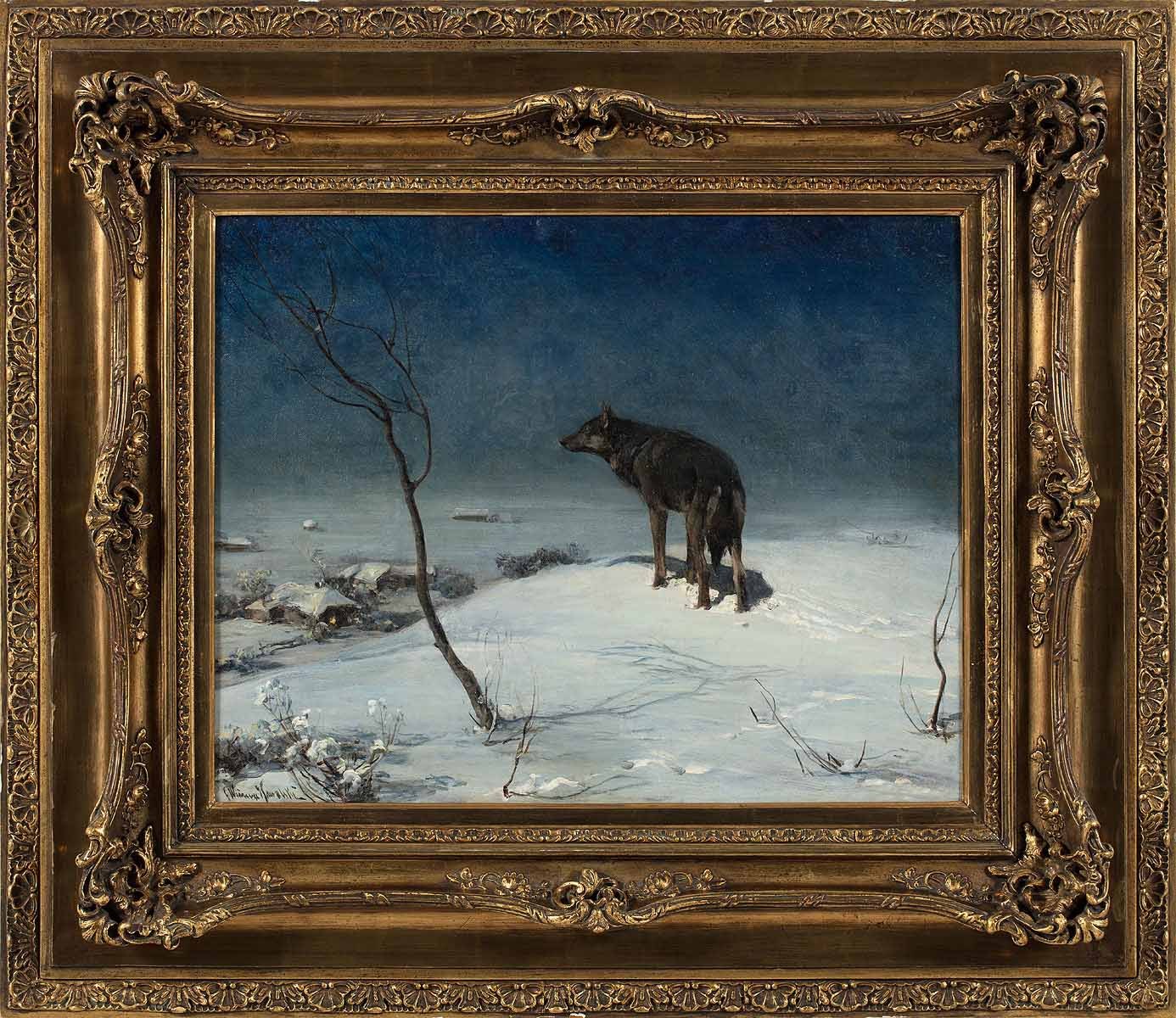
The featured painting shows a nocturnal landscape with a lone wolf standing on a snow-covered hill with rural buildings below. The scene is kept in cool tones of white, blue and gray, and its silence and tension reflect Wierusz's masterful ability to build an atmosphere - at once realistic and symbolic. In such compositions, his painting credo is particularly clearly revealed: "From nature take everything at every turn. Perceive and note every movement, every shape, even a moment in time..." (J. Puciata-Pawłowska, History of the Municipal School of Decorative Arts and Painting in Warsaw, 1939-1940, p. 31).
The subjects with wolves are among the most recognizable and sought-after in the artist's oeuvre today. Their popularity dates back to Wierusz's contemporaries - the paintings won awards at European exhibitions, including a silver medal in Paris in 1910 for his work "Wolves in the Night," and his "Melancholic" was purchased for the collection of the New Pinakothek in Munich. These poignant nocturnes, combining the drama of nature with reflections on human loneliness, remain to this day a symbol of his unique style and emotional depth.










