


138,5 x 88,0 cm - oil, canvas
Signed l.d.: H Lipinski | 882
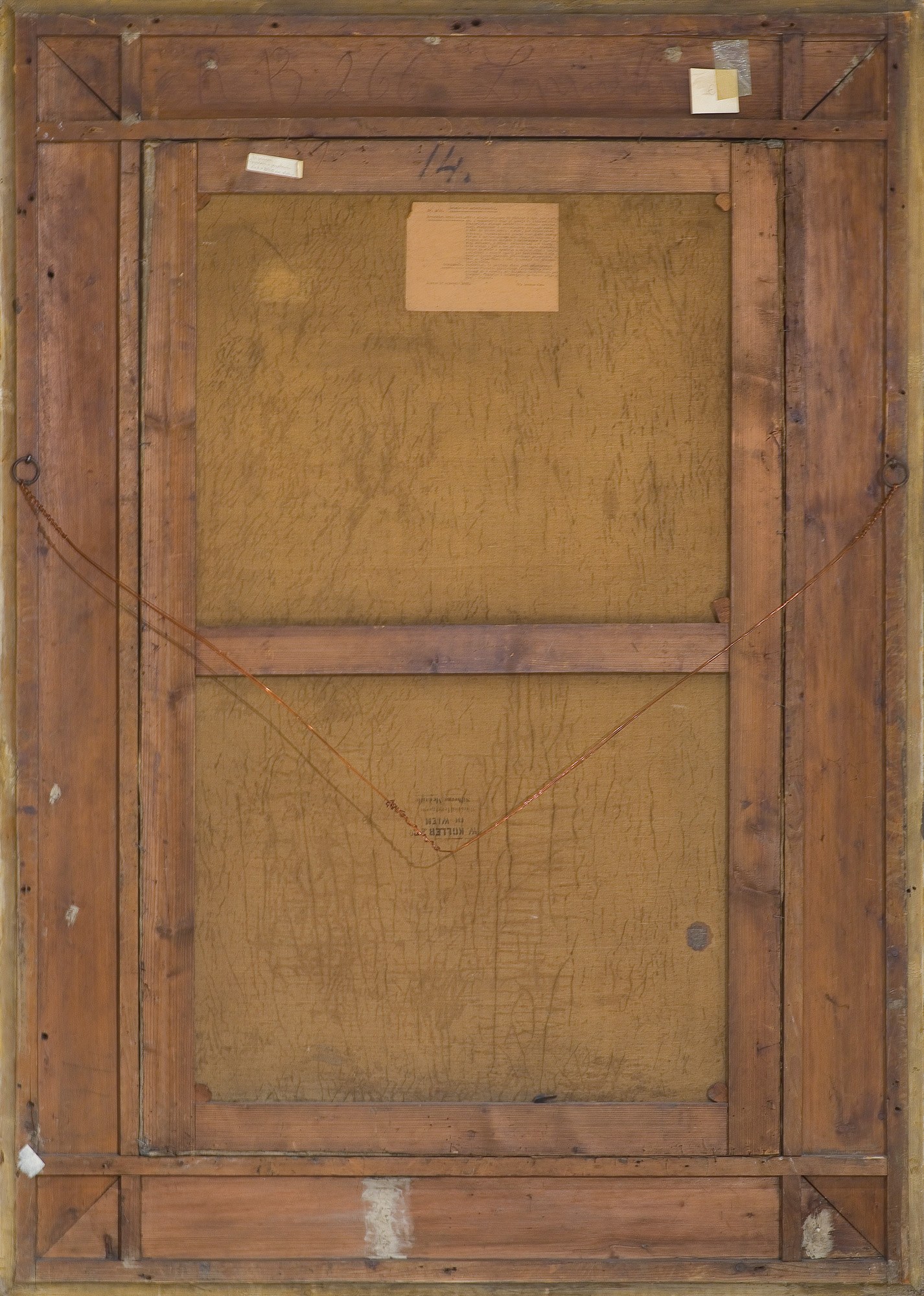
On the reverse a stamp of a Viennese company distributing painting materials: W. KOLLER & Co | IN WIEN | Mariahilferstrasse | Silberne Medaille;
along the g. edge, glued typewritten sheet with a certificate of authenticity issued by Dr. Jan Lankau in 1953;
also on the g. frame strip (in crayon): R B 266 Lipinski.
Painting exhibited and reproduced, among others:
- Exhibition of the Society of Friends of Fine Arts in Cracow, Cracow, first half of 1882;
- Report of the Directorate of the Society of Friends of Fine Arts in Cracow from Activities in the Year 1881, Cracow 1882, p. 11 (In the Garden);
- Lithograph printed at Zaklad Artystyczno-Litograficzny A. Pruszyński in Cracow, according to a drawing by H. Lipinski.
- Oesterreichischer Kunst-Verein in Wien: 322nd Ausstellung; Februar - März 1883, p. 7, cat. no. 108 (Im Garten);
- E. Szczawińska, Hipolit Lipiński, [in:] Słownik artystów polskich i obcych w Polsce działających: malarze, rzeźbiarze, graficy, T. 5: Le-M, edited by J. Derwojed, Warsaw 1993, p. 109 (W ogrodzie).
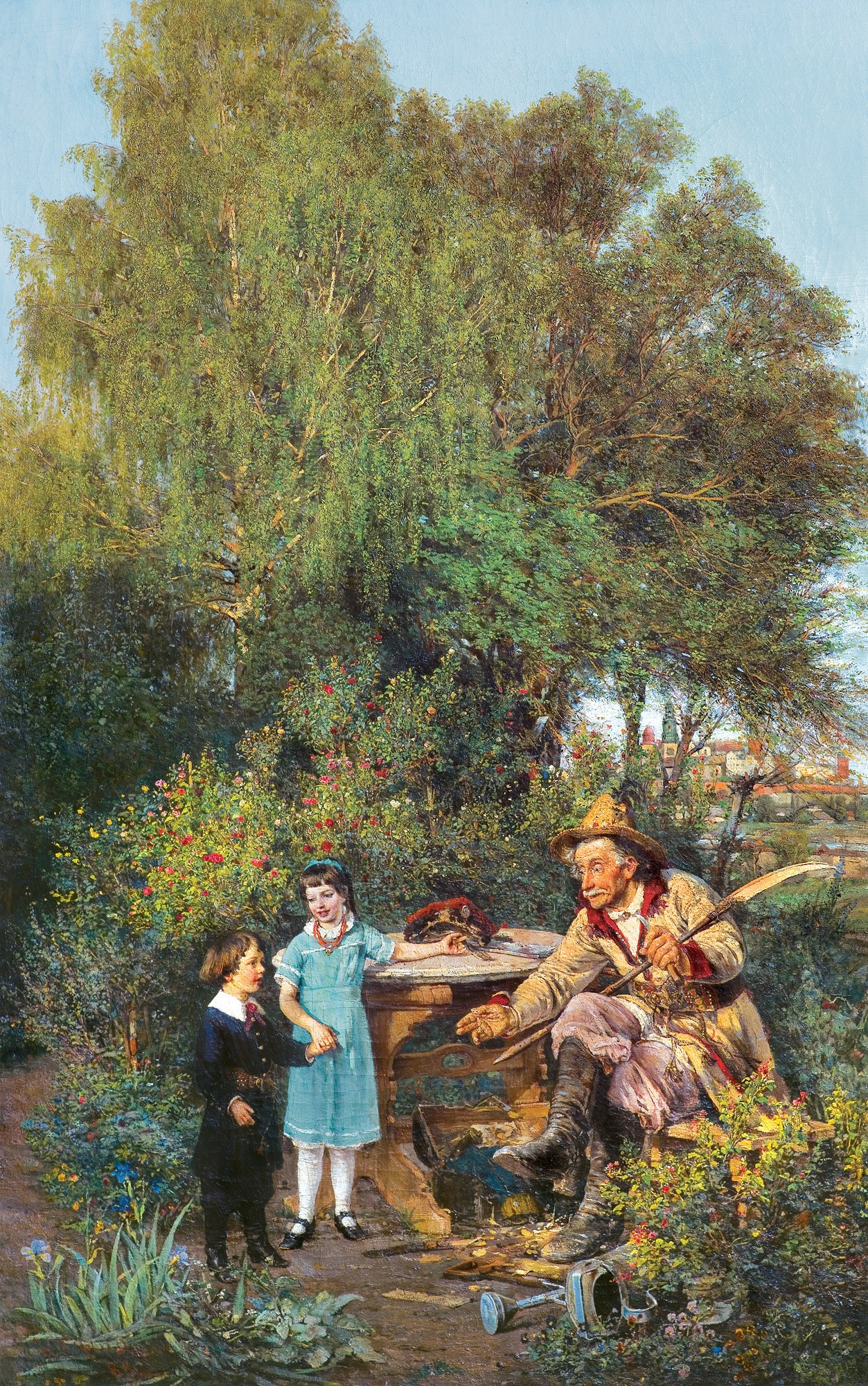
According to Dr. Lankau's expert opinion on the back of the painting, the artist depicted a fragment of the garden at his manor house in Krakow's Dębniki (cf. Dworek w Dębnikach, 1883). The scene depicts an elderly gardener, dressed in a Krakow outfit, sitting at a table. He is accompanied by two children and a number of mementos from the old days. The boy and girl depicted are Staś and Helena, the painter's children. Placing them in this scene gives a particularly personal touch and authenticity. Between the trees, in the distance, you can see Wawel Hill. In this garden, overflowing with sunshine and spring flowers, almost magical, the grandfather spins a tale of service to the fatherland and fighting alongside Kosciuszko. This is indicated both by the souvenirs in the trunk under the table and the small scythe being prepared for his grandson. The personal gesture of passing history on to the younger generation here becomes a metaphor for preserving national identity and intergenerational continuity.
In the Garden is one of the most mature and representative works of Hippolyte Lipinski - a painter belonging to the generation that combined the realist tradition with new tendencies in European painting.Realistic composition with precisely reproduced details - from clothing through plant elements to the texture of materials - and consistently built visual narrative situate the canvas in question within the framework of 19th-century genre painting, in accordance with the aesthetics shaped in the circle of Matejko's disciples. At the same time, the parts of vegetation and chiaroscuro - in the crown of the trees and in the lower parts of the garden - betray a very clear interest in Impressionist art, the first echoes of which were just beginning to reach Krakow. It is worth noting that the painting In the Garden was created exactly in the same year that Aleksander Gierymski painted his masterpiece In the Arbor - considered today as one of the first works of Polish painting, in which light becomes an equal protagonist of the composition.
Like Gierymski, Lipinski here starts from a genre scene set in a realistic landscape, but goes beyond literal description. In the gazebo, the sun penetrating the leaves creates shimmering reflections on the clothes and faces of the figures. In Lipinski's work, the elaboration of the silhouettes is not as innovative as in Gierymski's, but the garden part, painted with impastos, indicates impressionistic experiments with texture and light. The light shining through the crown of the trees creates a vibrating mosaic of colorful patches that are almost independent of the drawing. The artist operates with exceptionally light, almost flickering light, and instead of homogeneous green, he uses, tonally differentiated on the basis of delicate contrasts, a thicket of small brushstrokes superimposed on each other. This way of building up the chiaroscuro gives the crown of the trees the impression of vibrating movement, as if the leaves were gently moving in the wind. The light here does not perform only the function of illumination, but becomes an active element of the composition - it co-creates the atmosphere and gives the viewer a sense of the transience of the moment, so essential to Impressionist painting. It is this part of the painting that brings Lipinski closest to modern color solutions - it shows that the artist was interested in painting as a study of the optical phenomenon of light and movement. The parts of green, the reflections flickering among the leaves and the free, almost impressionistic guidance of color indicate the artist's conscious experimentation with new ways of building atmosphere. They are an example of the artist's independent search, in opposition to the Matejko school.
Lipinski incorporates this modern painting language into the theme of independence. It is this relationship between the realistic precision of the patriotic narrative and modern "light painting" that makes Lipinski's paintings so unique against the background of Polish painting of the 1880s, that makes In the Garden, A Tale of Uprising one of Lipinski's most interesting and moving works.
Hipolit Lipinski (Nowy Targ 1846 - Krakow 1884) began his studies at the School of Fine Arts in Krakow (1859-1870) at an early age, as a boy of thirteen. He continued his studies in Munich - privately under Theodor Dietz (1870-1872) and at the Academy under Otto Seitz and Hermann Anschütz (1871-1872). He returned to Krakow in 1872, and from 1874 studied with Jan Matejko for two more years. In 1875-1884, he himself taught drawing and painting at the Baraniecki Higher Courses for Women in Krakow, where his student was, among others, Olga Boznańska. In 1879 he was one of the organizers of Krakow's National Museum. He exhibited from 1866 - in Krakow and Lviv at TPSP, in Warsaw at TZSP, Krywult Salon and Salon of Jozef Ungra, as well as in Vienna and Munich. He painted genre scenes from the life of Cracow and the suburban countryside (Konik zwierzyniecki, Targ na Kleparzu, Palm Sunday), as well as landscapes and, less frequently, portraits.













最近瀏覽過的
登錄以查看拍品列表
收藏
登錄以查看拍品列表