


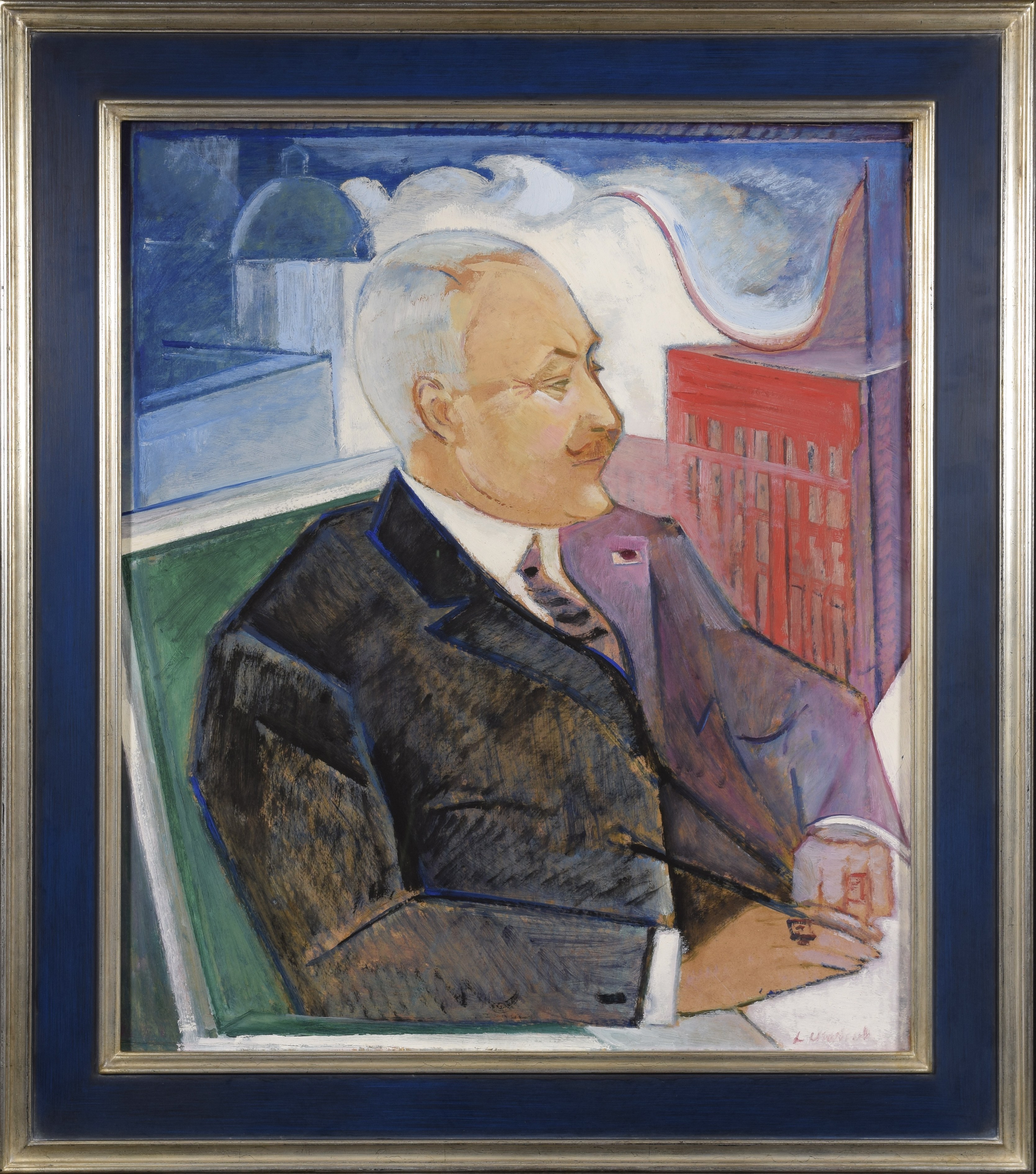
oil, cardboard; 71.5 x 60.5 cm;
Signed p. d.: L. CHWISTEK;
On the reverse: p. Humaniecka (in pencil, sic!);
Literature: painting mentioned [in:] Karol Estreicher, Leon Chwistek. Biography of the Artist (1884 - 1944), Cracow 1971, p. 384.
In the 1st half of the 20th century, modern tendencies in Polish art were born. One of them was Unism initiated by Kazimir Malevich and continued in Lodz by Katarzyna Kobro and Wladyslaw Strzeminski. The other was the Polish Expressionists, later the Formists, represented by Leon Chwistek, Tytus Czyzewski, the Pronaszko brothers and Tymon Niesiolowski, among others. It was
a time of lively discussions about the role and form of art and dialogue between its fields. Hence the oft-repeated synthesis of literary art, poetry, painting and a lively discussion resulting in the
construction of new theoretical and aesthetic thoughts. After the breakup of the Formist group in 1922, Leon Chwistek, one of its main theorists, developed his own theory - zonism. The artist used it primarily in portraits, because at the same time he had an excellent hand in faithfully rendering the image of the model. Zonism thus pertained to: "What I meant was to introduce into the painting
introduce contrasts that are violent and disturbing, and yet juxtapose them in such a way that a unified whole emerges from it... I began to think about building the human figure from the elements of the various zones through which it is conducted." Chwistek, also describes, using the Dansing painting as an example, his second feature, "Here three species of light rays, derived from three different reflectors, come to the fore. The curved rays, (...) come out of a circular reflector." Chwistek's first presentation of zonal portraits took place in 1925 at the Spring Salon of the Polish Artists' Society. In May 1927, at the Salon of Independents in Cracow, he presented more zoned portraits, including the offered image of then Minister of Education Kazimierz Kumaniecki. According to Karol Estreicher, this exhibition marks the end of the Cracow, and the best period in Leon Chwistek's painting.
(compiled. based on: Karol Estreicher, Leon Chwistek. Biografia artysty, Cracow 1971, pp. 219-237)










最近瀏覽過的
登錄以查看拍品列表
收藏
登錄以查看拍品列表