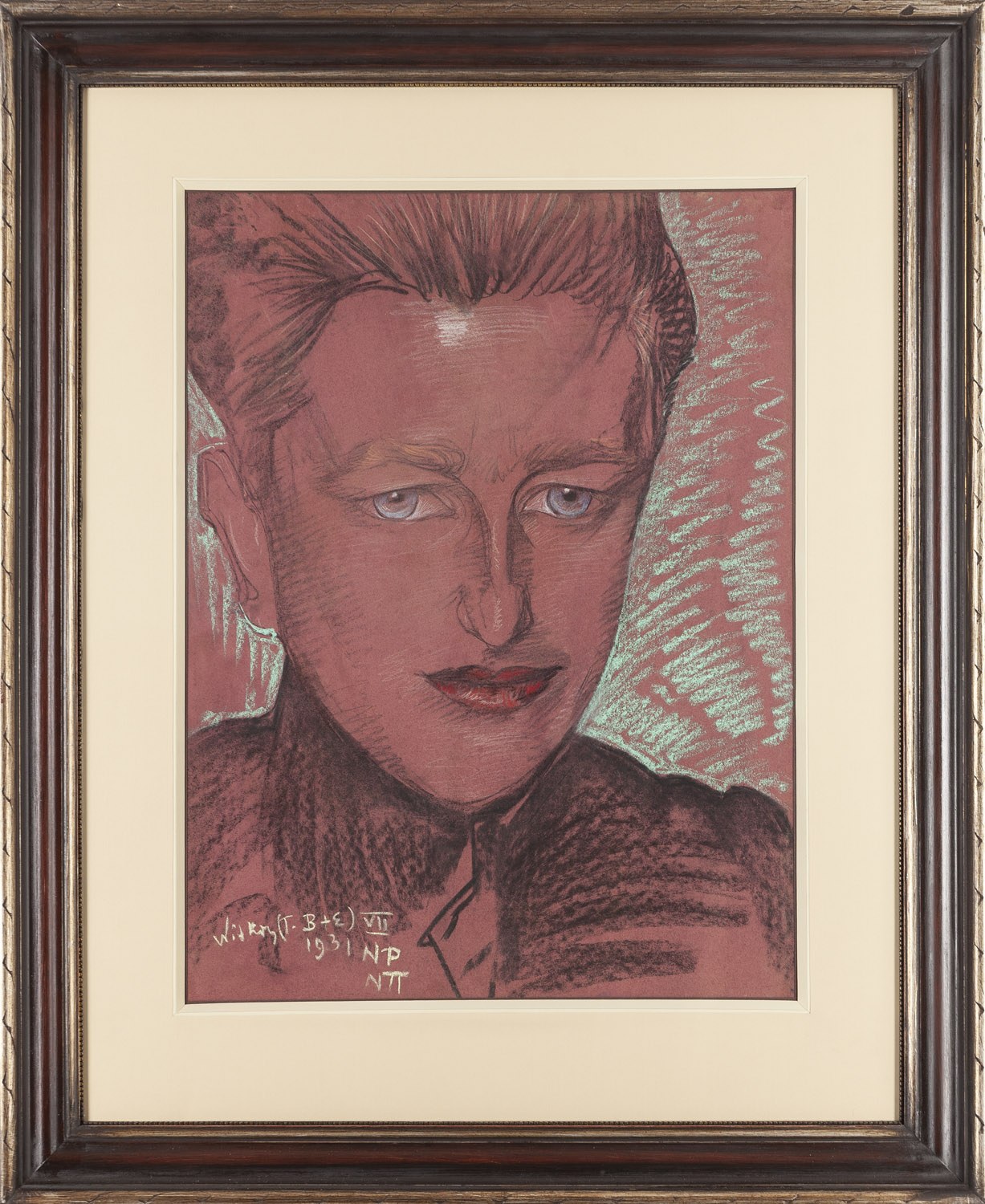

Dimensions: 63 x 47 cm
Signed, dated and inscribed l. d.: 'Witkacy (T. B. + E) VII | 1931 NP | Nπ'.
Literature
Joanna Siedlecka, Mahatma Witkac, Warsaw 1998, pp. 187-188
Paweł Iliński, The Past Doesn't Pass Without an Echo. Memories 1903-1990, pp. 146-148
M. Prus, Witkacy also visited me, Antiquarian Newspaper 1999, no. 7/8, pp. 10-12
Biography
His father was the well-known critic, painter and writer, creator of the so-called "Zakopane style" in architecture Stanislaw Witkiewicz. In 1905-10 he studied unsystematically at the Academy of Fine Arts in Cracow with Jozef Mehoffer and with Wladyslaw Slewinski in Poronin. He traveled to Italy, France and Germany. In 1914 he participated in Bronislaw Malinowski's ethnographic expedition to Australia, from where he returned to Europe on hearing of the outbreak of World War I. His early painting work was under the sign of Young Poland and the influence of P. Gauguin and Wl. Slewinski. Later he came to a kind of expressionism. In time, as a result of theoretical reflections on the form, he gave up painting. He founded a one-man "Portrait Company" and limited himself to making pastel portraits for a living, often created under the influence of stimulants that allowed him to experiment with form. Stanislaw Ignacy Witkiewicz wrote 4 novels, more than 40 dramas, numerous articles and essays on painting, literature, theater and philosophy. During the interwar period, he lived mainly in Zakopane. After the outbreak of World War II, he fled from the Germans to the eastern borderlands, where he committed suicide in the village of Jeziory in Polesia on September 18, 1939.