


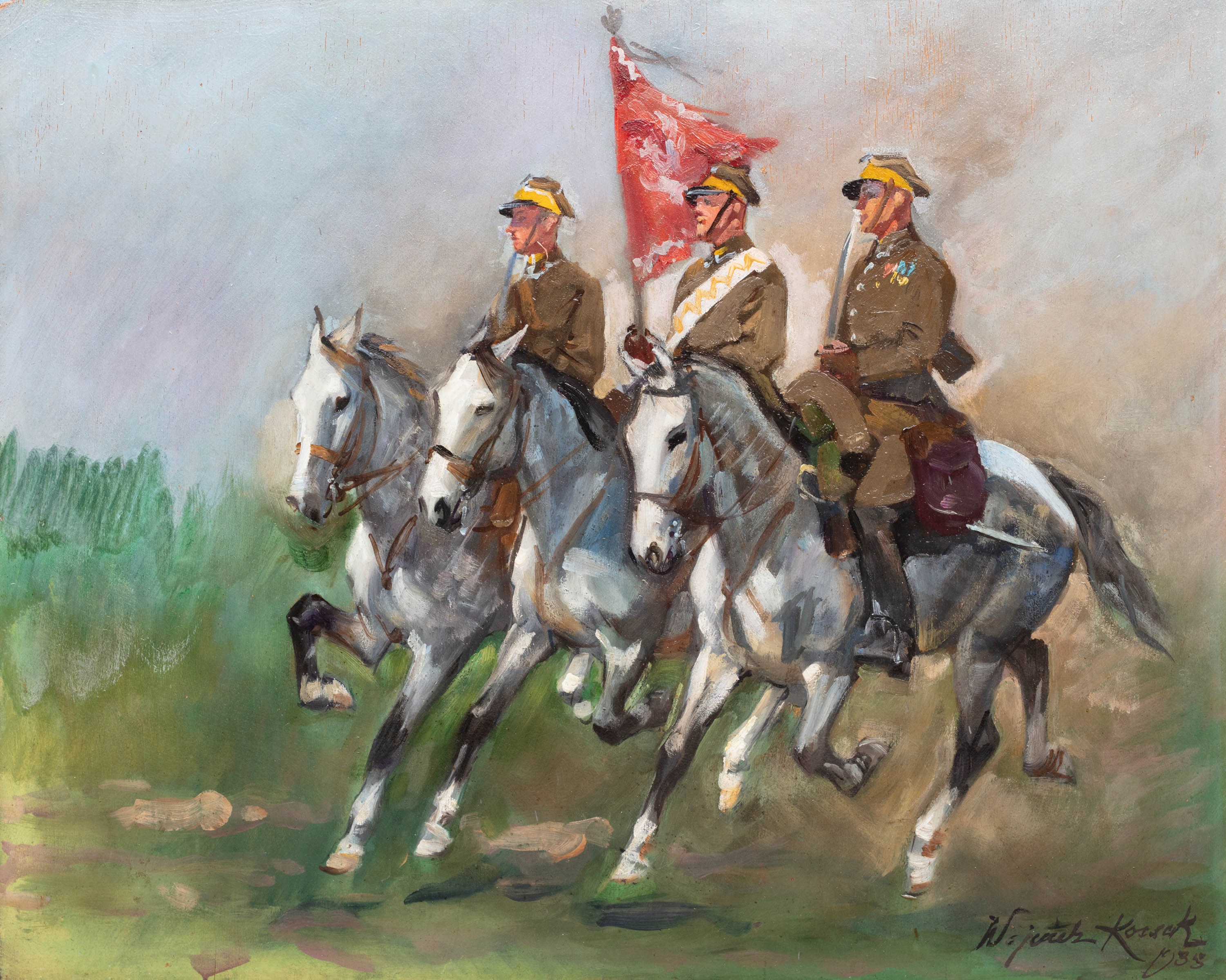
oil on plywood, 40 x 50 cm
signed and dated lower right: "Wojciech Kossak/193(3/9?)"
Drawing on the artistic legacy of his father, Juliusz, and Józef Brandt, Wojciech Kossak made battle scenes and historical-patriotic themes the central focus of his work, a direction to which he remained faithful throughout his entire artistic career. “He is undoubtedly a very Polish painter,” wrote Mieczysław Wallis of Kossak, “through his temperament and grandeur, through his bravado and verve […] through his love of life, movement, and momentum, through his reverence for the horse, and through his fondness for chivalric, military, and hunting themes.” (M. Wallis, “Wojciech Kossak’s Exhibition,” [in:] “Wiadomości literackie,” no. 32, July 26, 1936.)
The artist achieved significant success in this field of painting. Although he is most often associated as a co-creator of the “Racławice Panorama,” it was precisely this monumental undertaking that marked the beginning of his great career and paved the way for further prestigious commissions. After completing, together with Julian Fałat, the panorama depicting the Battle of the Berezina, Kossak remained in Berlin until 1902, where he worked in a studio in Charlottenburg. During this time, he worked intensively and exhibited his works at various shows, gaining increasing recognition. His work was also appreciated by Emperor Wilhelm II, who invited the artist to the autumn military maneuvers and commissioned him to paint works dedicated to the Franco-Prussian War. “Emperor Wilhelm held Kossak’s paintings in high regard; he had already described *The Berezina* as the finest panorama he had ever seen. He considered Kossak superior to German battle painters […]” (K. Olszański, “Wojciech Kossak,” Zakł. Ossolińskich, Wrocław 1982, p. 19.)
During his time in Berlin, Wojciech Kossak enjoyed considerable recognition, which translated into numerous commissions. However, the works he created did not satisfy his artistic aspirations. “My soul yearns so much for some grand Polish composition that I simply cannot help myself,” he confided to his wife. (K. Olszański, “Wojciech Kossak,” Zakł. Ossolińskich, Wrocław 1982, p. 20.) “After 12 years spent abroad […] Kossak returned to his homeland in mid-1907—to the soil suited to his talent, temperament, and the spirit of his art.” (Before returning to Kraków, he had also been working in other artistic centers abroad, including Vienna and London.), (K. Olszański, “Wojciech Kossak,” Zakł. Ossolińskich, Wrocław 1982, p. 27.)
Wojciech Kossak’s popularity and appeal as a man and a painter were also significantly influenced by his extraordinary personality and striking presence. “It was a unique figure,” his contemporaries noted, “that posture of a cavalry captain, a slender build, a broad chest, and at the same time a touch of Gypsy nonchalance, a fancifully tied tie, a Borsalino hat […] a killer gaze when he looked at a pretty woman. A renowned ‘horse lover’ and passionate motorist, a passionate bridge player and eternal seducer, extremely likable and easygoing with people, he was universally liked and welcomed everywhere—a trait he knew how to use to win over audiences for his art.” (K. Olszański, “Wojciech Kossak,” Zakł. Ossolińskich, Wrocław 1982, pp. 28–29.)










最近瀏覽過的
登錄以查看拍品列表
收藏
登錄以查看拍品列表