


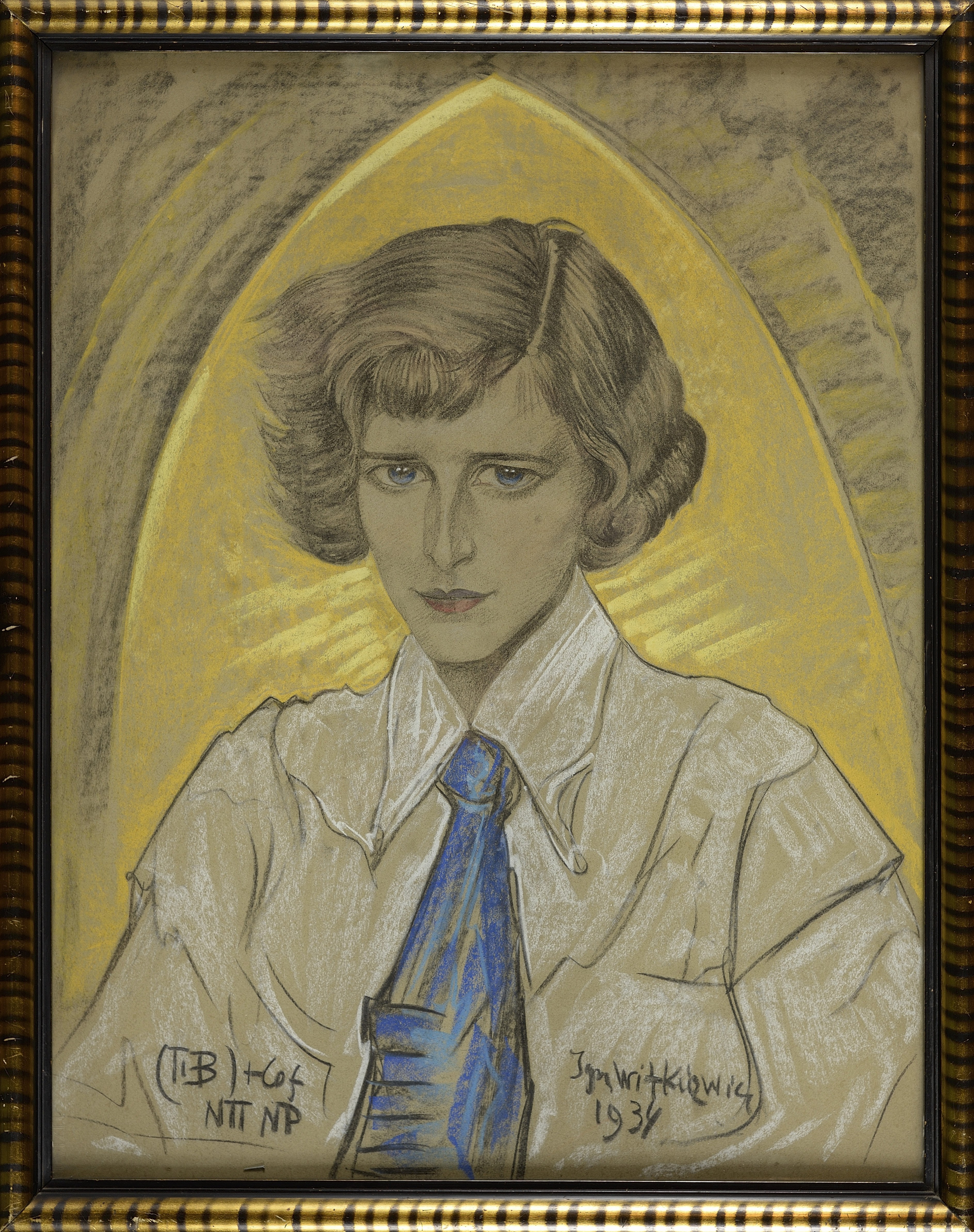
Pastel on paper, 64 x 49 cm,
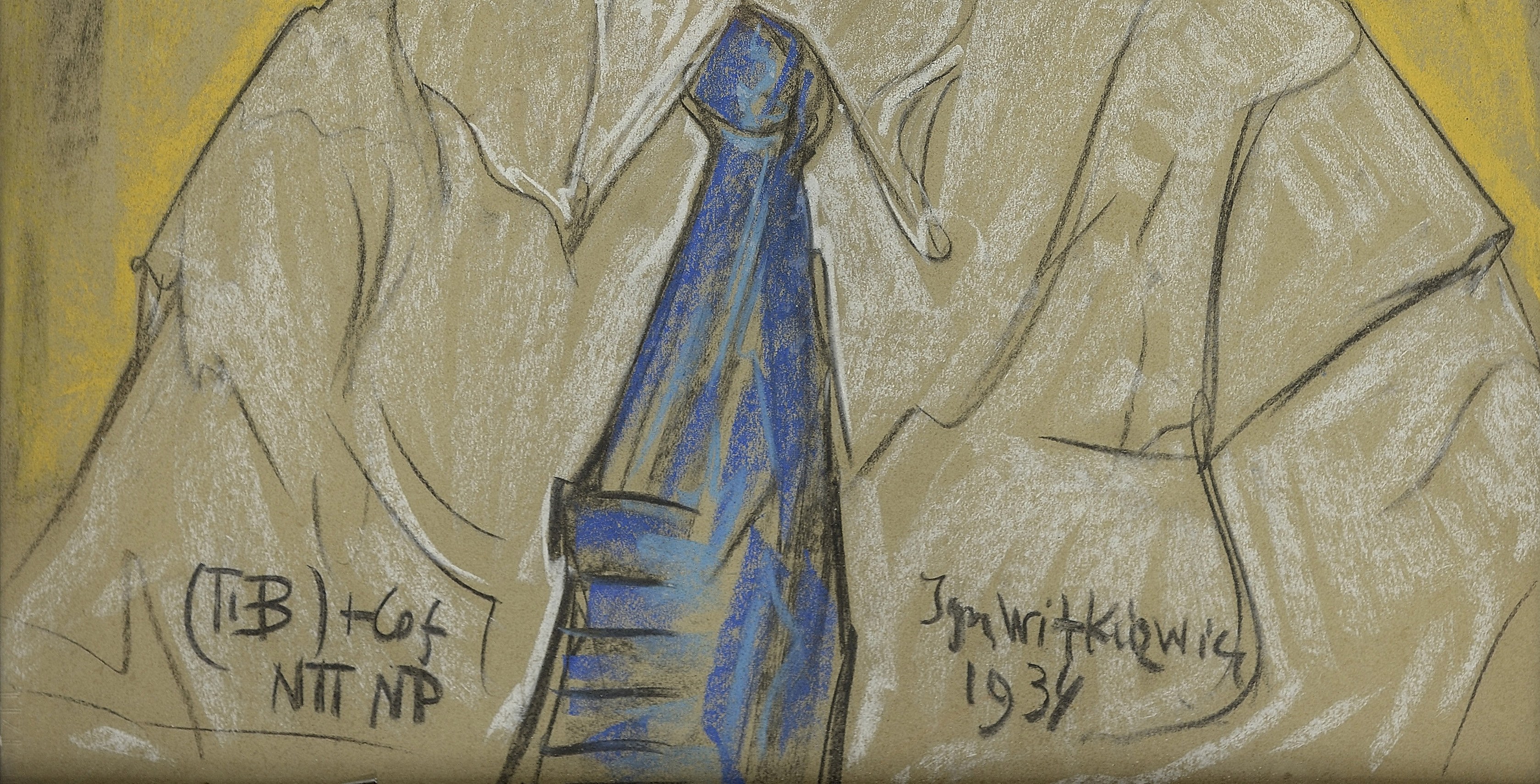
signed lower right: Ign Witkiewicz 1934, inscribed lower left: (T.B) + Cof nП nP. (Portrait type "B" + caffeine, did not drink, did not smoke), dated 1934.
The portrait depicts Antonina Czerwińska, wife of Franciszek Czerwiński (1901–1939)—an officer in the 1st Podhale Rifle Regiment and a photographer who ran a photography studio in Nowy Sącz. Franciszek Czerwiński often took photographs of people portrayed by Witkacy. The artist most likely met Franciszek Czerwiński during his first stay in Nowy Sącz, in April 1934, when he was a guest of the Maciak family. Witkacy himself mentioned Franciszek Czerwiński several times in letters addressed to the Maciak family. Antonina Czerwińska was portrayed by Witkacy on several occasions—in 1934 and 1938. The artist also painted portraits of Franciszek Czerwiński and their son, Stanisław. Antonina Czerwińska is listed in the index of subjects in the "Catalog of Paintings," compiled by Irena Jakimowicz in collaboration with Anna Żakiewicz (National Museum in Warsaw, 1990, p. 158).
Stanisław Ignacy WITKIEWICZ (WITKACY) ( 1885–1939)
Painter, playwright, novelist, philosopher, publicist, one of the most outstanding figures of Polish culture. Son of Stanisław Witkiewicz, in whose home he met with distinguished representatives of the worlds of science and art from a very young age. He did not receive formal artistic training; in 1904–1905, he studied in J. Mehoffer’s studio at the Academy of Fine Arts in Kraków. During his stay in France in 1911, he visited W. Ślewiński, under whose guidance he painted landscapes. He undertook artistic journeys to Germany, Italy, and Paris, where he encountered new trends in art. In 1914, he participated in the Australian expedition of his friend, the ethnologist Bronisław Malinowski. During World War I, he served in the Tsarist army. In 1918, he returned to Poland. In 1919, he became associated with the Formist group, though his work diverged from Formist principles. He developed an individual style based on his own experiences, reading, and the works of other artists whom he considered his inspiration. He outlined the principles of his painting in theoretical writings such as "New Forms in Painting" from 1919, which was supplemented and expanded upon by "Artistic Sketches" from 1922. The years 1925–1939 saw playwriting dominate Witkacy’s creative output; his oil paintings were not well-received and found no buyers, so to secure a steady income, the artist decided to take up portraiture and founded the one-man “S.I. Witkiewicz Portrait Firm,” for which he formulated detailed regulations. The most interesting and expensive were Type A portraits, while Type C portraits are considered the most striking. They were created in social settings, often during drug-induced sessions at the homes of friendly doctors; the designation "Co" on a Type C portrait indicated cocaine. Type C portraits were characterized by a subjective portrayal of the model; the artist did not charge for them—they were "priceless." (Lit.: B. Zgodzińska-Wojciechowska and A. Żakiewicz, "Witkacy. Stanisław Ignacy Witkiewicz," WAiF, Auriga, PWN, Warsaw 2001).










最近瀏覽過的
登錄以查看拍品列表
收藏
登錄以查看拍品列表