


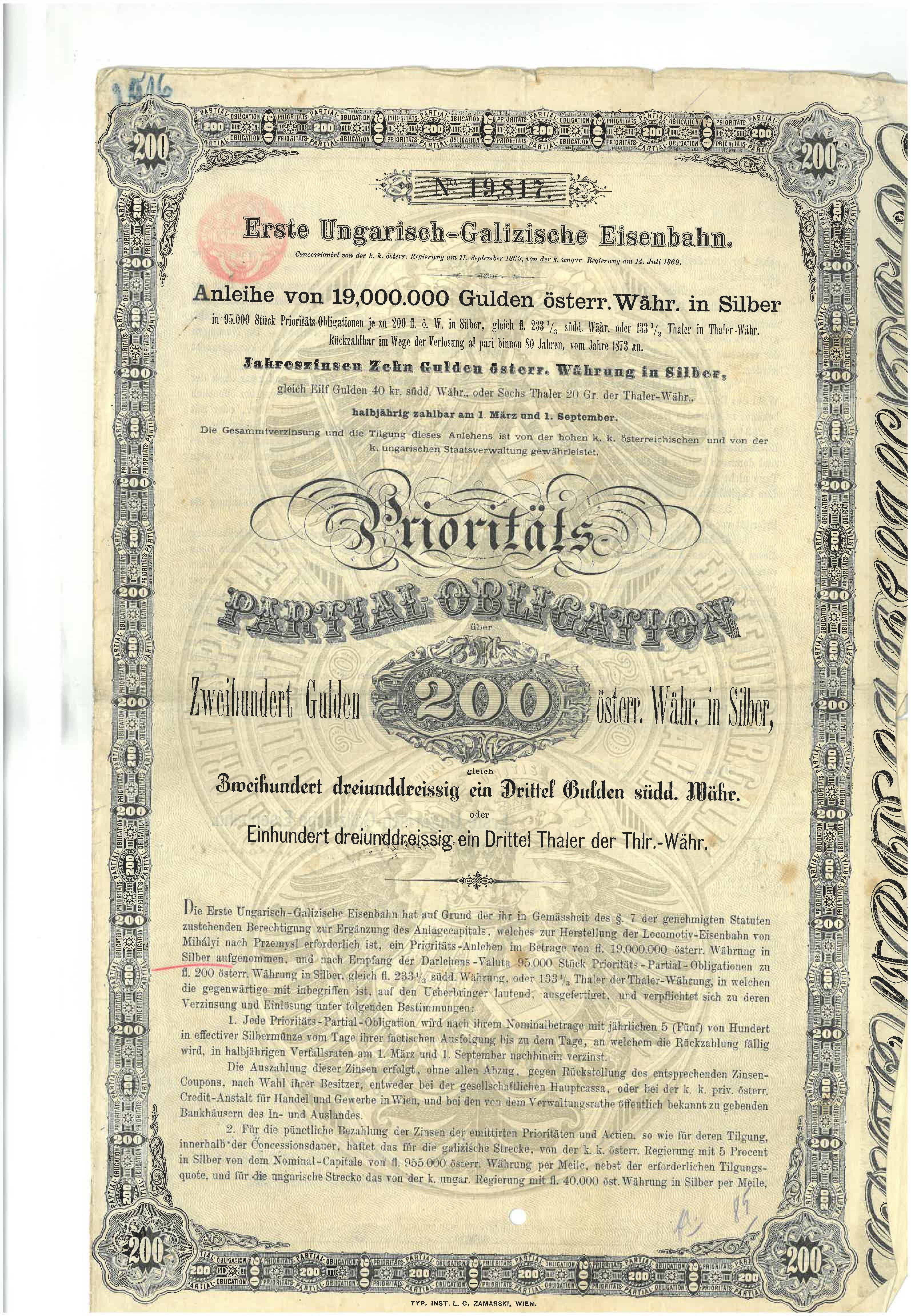
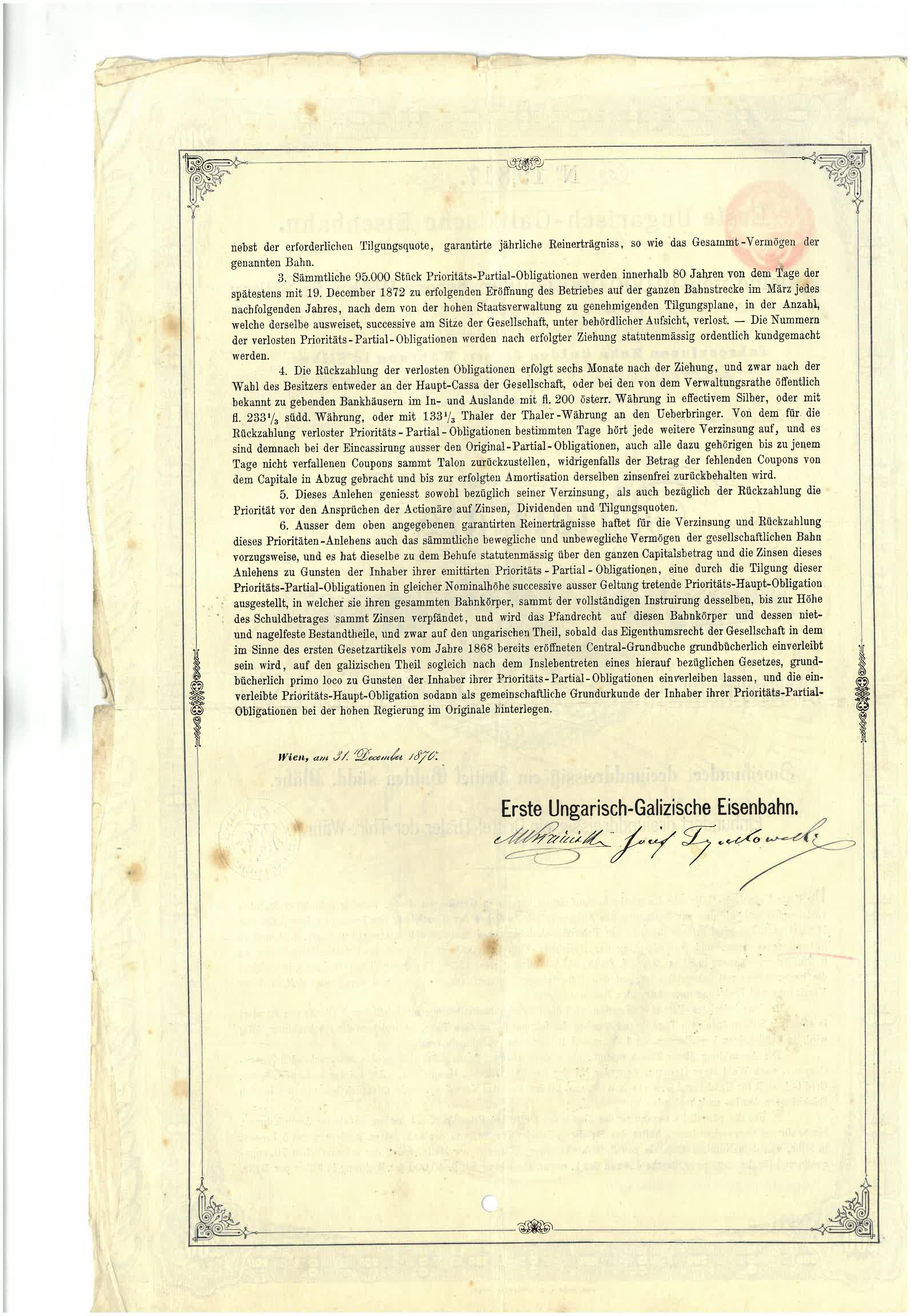
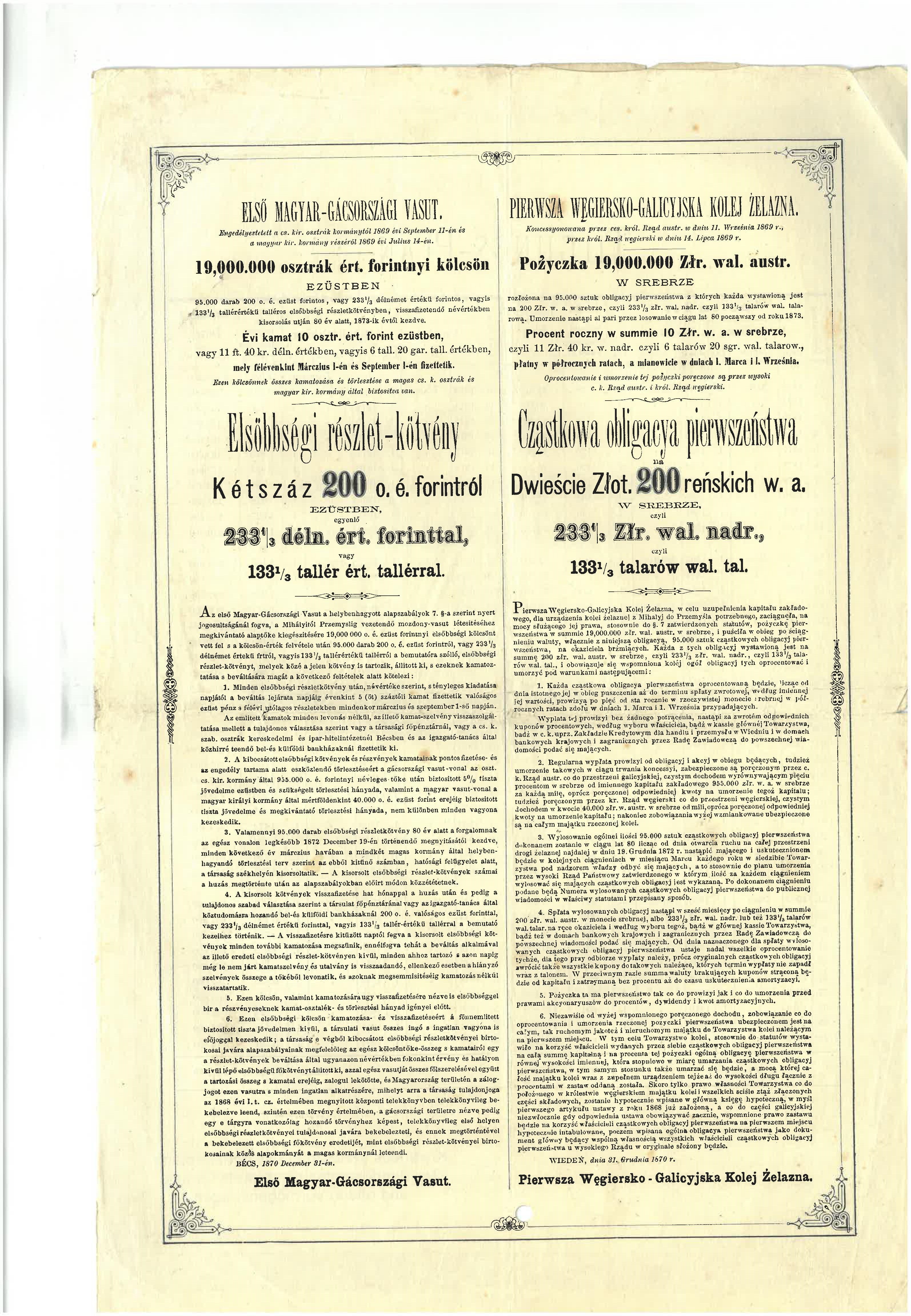
First Hungarian-Galician Iron Railway, partial bond - debt note for 200 Rhine gold of Austrian currency in silver, i.e. 233 1/3 Rhine guilders of South German currency or 233 1/3 Thaler currency. Vienna 8.09.1887.
The bond yielded 3% per year.
This is the first Transcarpathian double-track (266.3 km long) railroad line through the Lupkowska Pass of great strategic importance, connecting Galicia with Hungary, and ultimately Budapest with the Przemyśl Fortress and Lviv.
On May 20, 1869, a concession document was issued for the construction of the Przemyśl - Lupkow route. The concessionaires were Adam ks. Sapieha, Karol ks. Jabłonowski, Konstanty ks. Czartoryski, Cezary hr. Mąciński, Michał hr. Załuski, Paweł baron Sennyey, Edward hr. Karolyi and hr. Erdődy. In addition, four months later, on September 11, 1869, a second concession document covering the Lupkow-Mihályi section was issued. In this case, the concessionaire was already the Joint Stock Company of the First Hungarian-Galician Iron Railway.
The railroad was put into operation on December 25, 1872 by the Austro-Hungarian authorities, although the Lupkow tunnel itself was completed in 1874. Dr. Erazm Lobaczewski was the legal advisor on the construction of the Lupkow Railway. More important railroad stations: Sátoraljaújhely, Homonna, Łupków, Zagórz, Chyrów and Przemyśl. From the Hungarian side, it joined the existing Sátoraljaújhely - Miskolc - Budapest Keleti line. On the Galician side, it joined at Przemyśl with the existing Karol Ludwig Galician Railway, which had been in existence since 1861, providing, for the first time in history, a direct rail link between Budapest and Lviv.
The First Hungarian played a significant strategic role in World War I for supplying the Przemyśl Fortress. After 1918, due to the creation of a border in the Carpathian Mountains between independent states: Czechoslovakia and the Republic of Poland, its role definitely weakened. Implementing the findings of the Treaty of Trianon prohibiting Hungary from having double-track railroads, the second track on the Mihályi - Lupkow line was dismantled. Due to the railroad's loss of international importance and Poland's strained relations with Czechoslovakia, the second track was also removed on the Polish side. The Habsburg Empire's first-class railroad was relegated to a provincial second-class line. The importance of the railroad briefly increased during World War II. At that time, clearance settings were changed for a broad-gauge rail line needed by the Soviet army in the transshipment of military equipment from the USSR. The broad-gauge line ran from the Slovak-Polish border in Lupkow to Jaslo and Chyrov, on the Slovak side to Humenny.
Today (2010), the former First Hungarian-Galician Iron Railway is on the territory of four countries creating local connections in those countries. The line does not function as a whole, although attempts are being made to restore it - this time as a tourist attraction. These efforts are particularly visible from the Polish and Hungarian sides.
In Hungary, there is the railroad's starting station in the town of Sátoraljaújhely. The line then runs in a southerly direction through Slovak territory until it reaches the Lupkowska Pass. The railroad section from Lupkov to Zagorze in PKP nomenclature functions as railroad line No. 107, and then to the railroad station in Kroscienko as railroad line No. 108.
A more than 30-kilometer-long section of the route on the Smolnitsa - Chyriv - Nizhankovice line has been placed within Ukraine's borders. It has both standard gauge (1435 mm) and broad gauge (1520 mm). The tracks are superimposed according to the scheme: Sz1 - N1 - Sz2 - N2, where "Sz" stands for the rail belonging to the broad gauge, "N" for the rail of the normal gauge. From Malhowice, the line is again on Polish territory until it reaches Przemyśl Główny station.









