


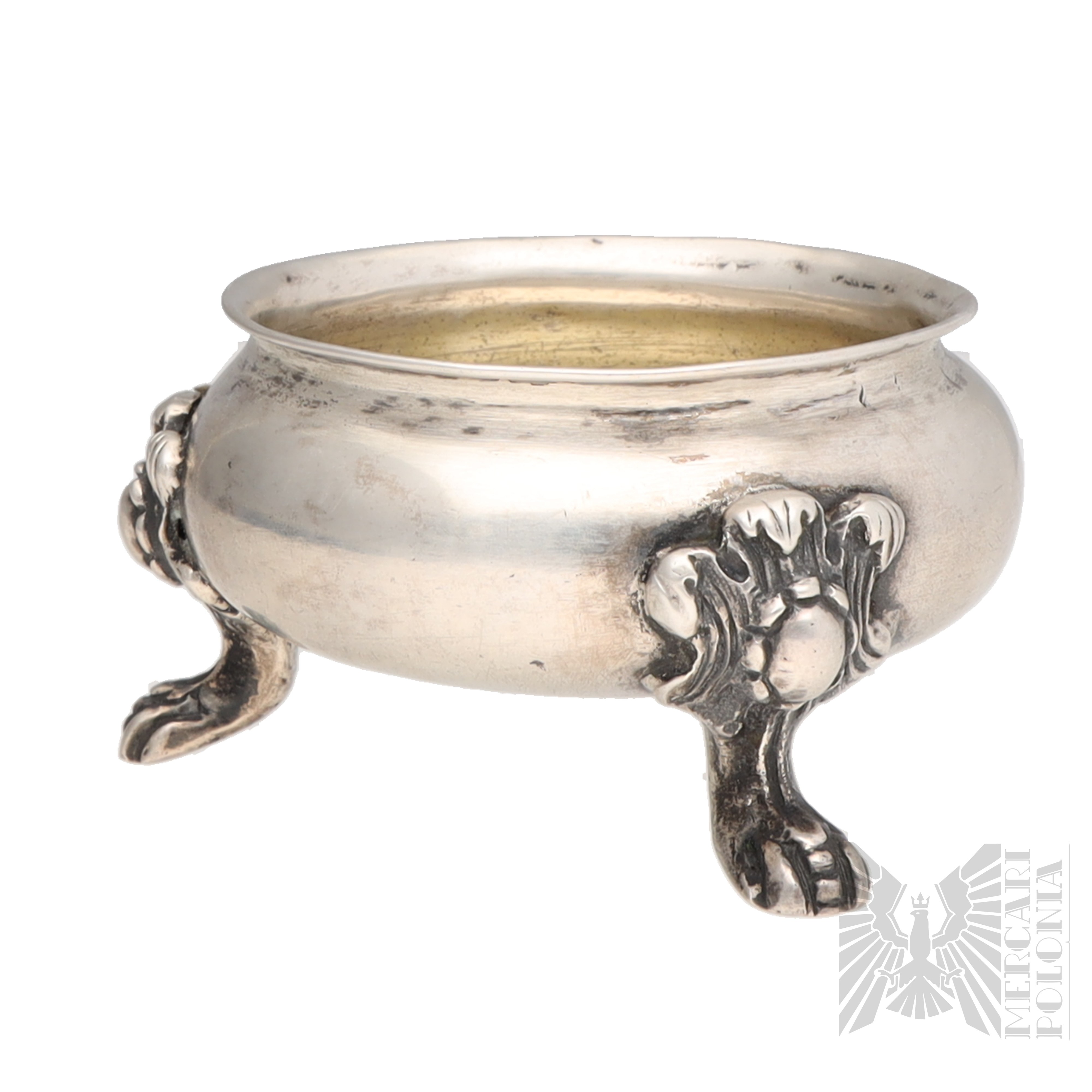
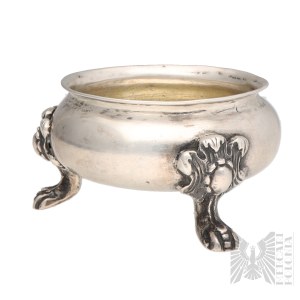
Karol Filip Malcz's workshop, silver salt shaker on three legs, Warsaw, circa mid-19th century; 84-złotnik (0.875) silver
Weight: 84 g.
Dimensions: diameter approx. 68 cm.
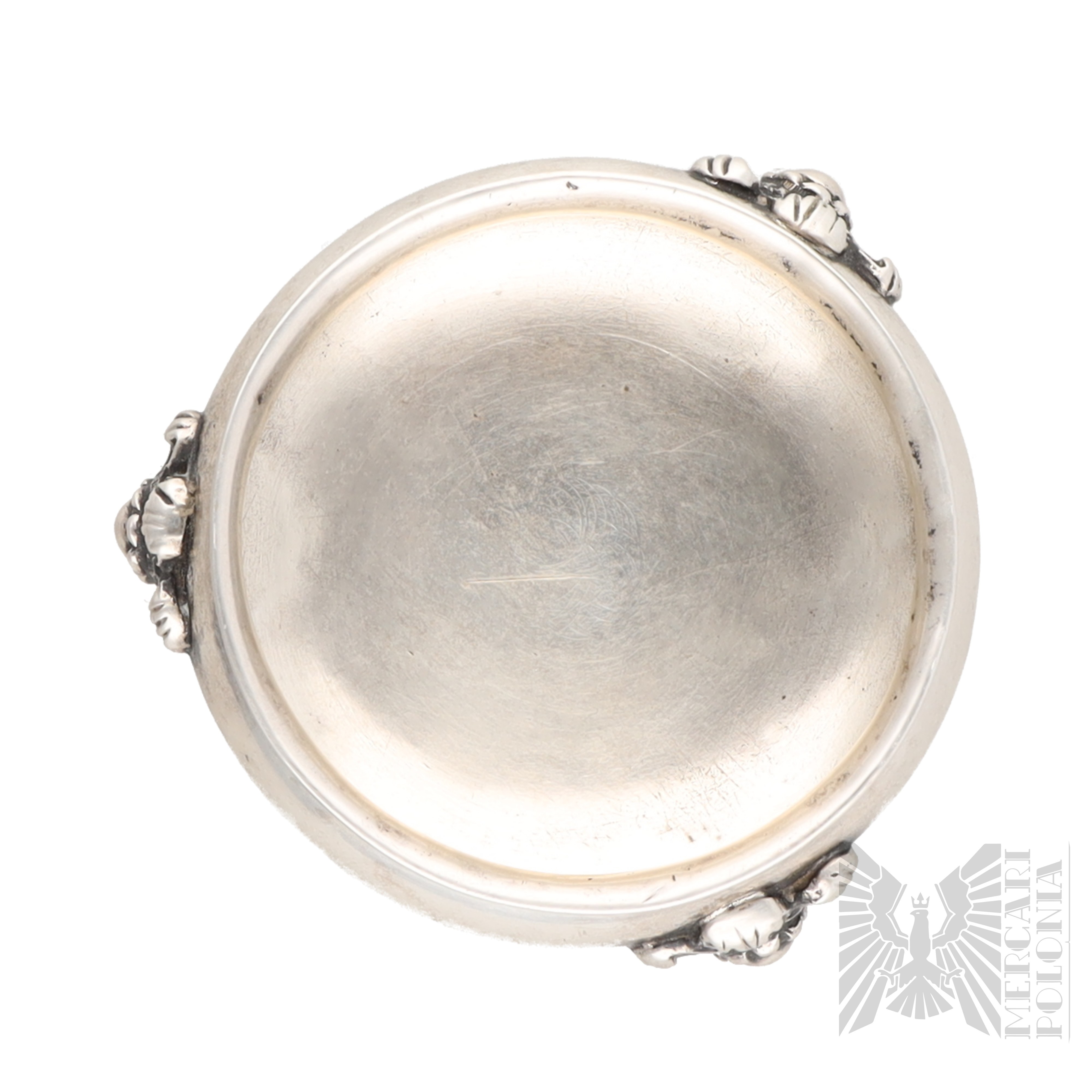
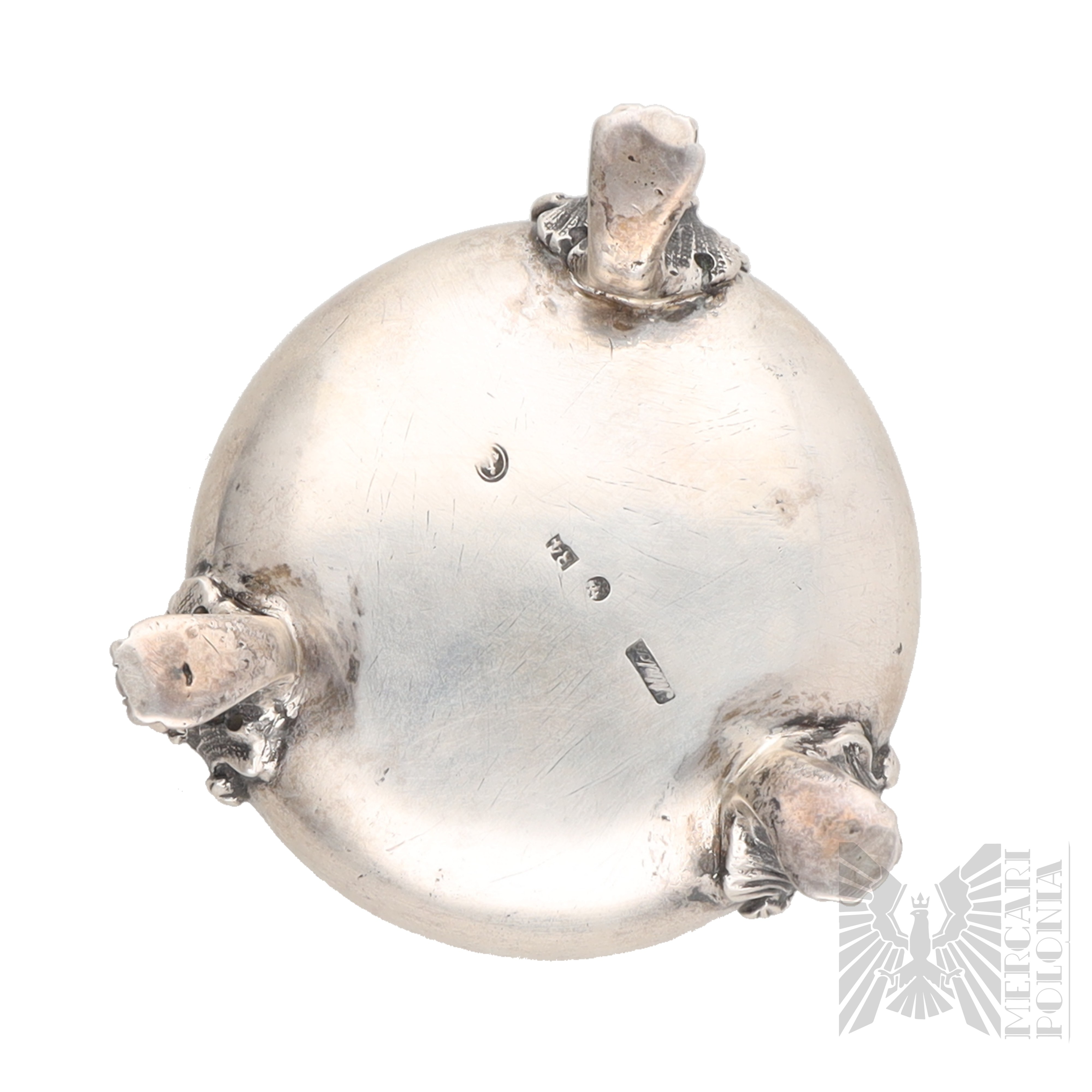
An open salt shaker with a circular, flattened, and prominently bulging bowl that tapers toward the spout. The upper edge is framed by a smooth collar that curves slightly outward. The vessel rests on three evenly spaced legs ending in stylized animal paws. Their upper sections feature decorative caps with shell motifs, volutes, and leaves, surrounding small, smooth cartouche panels. The restrained design of the body contrasts with the sculptural decoration of the legs, giving the piece a historicist character with neo-Rococo elements.
The body is made of silver sheet metal; the legs are cast, chased, and soldered to the vessel. Some gilding remains on the interior. The salt shaker is intended for serving salt directly at the table as a standalone piece of tableware.
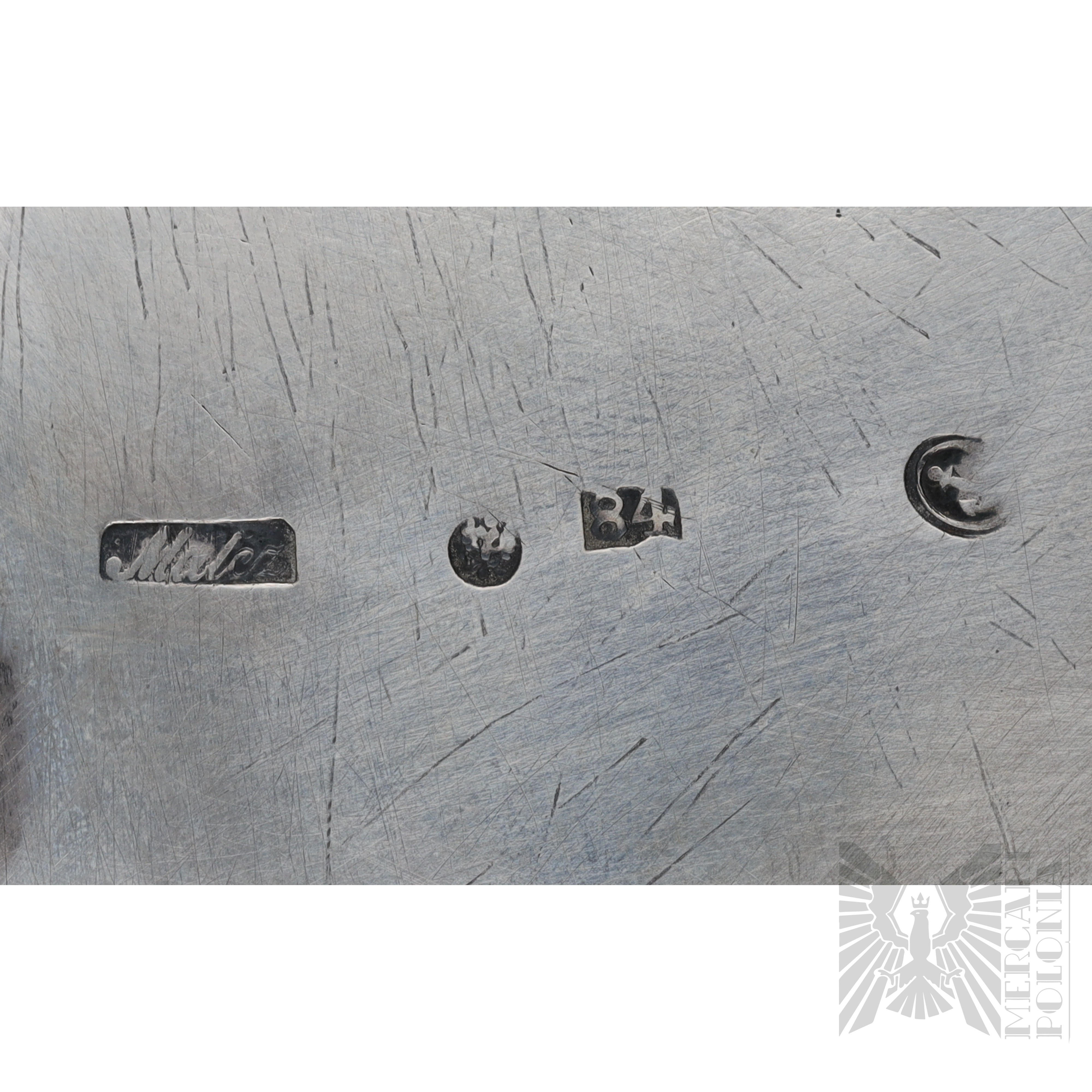
On the bottom is the signature “Malcz,” written in cursive within a rectangular field, along with the hallmark “84,” a small hallmark with a motif resembling a double-headed eagle, and a mark interpreted as an anchor in an oval field—the workshop’s trademark. A fineness of 84 zlotnik corresponds to a silver content of 875 parts per 1,000 parts of alloy. These characteristics indicate that the object was made around 1851–1860.
---------
Karol Filip Malcz (1798 Warsaw – 1867 Ozorków) was one of the most outstanding Warsaw goldsmiths of the 19th century. He was born in Warsaw into a family with strong ties to the local artisan community: his mother was Anna Dorota née Bandau, daughter of Jan Jerzy Bandau, one of the most important Warsaw goldsmiths of the Stanisław era. There is a discrepancy in the literature regarding his date of birth—the Museum of Warsaw lists July 10, 1797, while a more recent article by Halina Lileyko and the PSB biographical entry indicate August 10, 1797.
Malcz likely gained his first professional experience within the Bandau family circle and later under Jan Maciej Schwartz. In 1818, he set out on a journey of several years as a journeyman across Europe, visiting, among other places, Germany, Austria, Hungary, Italy, France, England, and the Netherlands. His time in the most important centers of artistic craftsmanship allowed him to learn modern goldsmithing techniques and become familiar with the current stylistic trends in European silversmithing.
Upon his return to Warsaw in 1827, he completed his master’s piece, and in 1828 he opened his own workshop and store on Krakowskie Przedmieście. His workshop quickly became one of Warsaw’s most prestigious silverworks. Malcz specialized in high-quality functional silverware: tableware, sugar bowls, trays, candlesticks, salt shakers, cutlery, and accessories. The Museum of Warsaw emphasizes that for 36 years he ran a large workshop whose products were distinguished by their high technical and aesthetic quality, and a significant number of his surviving works are now found in museum and private collections.
Malcz’s works represent the finest tradition of Warsaw silversmithing from the era of the Kingdom of Poland and the mid-19th century. They combine solid craftsmanship, elegant composition, and a repertoire of forms characteristic of late Classicism, Biedermeier, and Historicism. For collectors, the clear identification of the workshop is particularly important—Malcz’s hallmarks are among the most recognizable marks of 19th-century Warsaw silversmithing and significantly enhance the objects’ attribution value and market value.
In 1864, Malcz retired from professional activity, handing over the business to Teodor Werner, who was related by marriage to his wife, Rozyna Karolina Werner. He died on March 15, 1867, in Ozorków and was buried at the local Evangelical-Augsburg cemetery
Condition: as shown in the photos.








最近瀏覽過的
登錄以查看拍品列表
收藏
登錄以查看拍品列表