


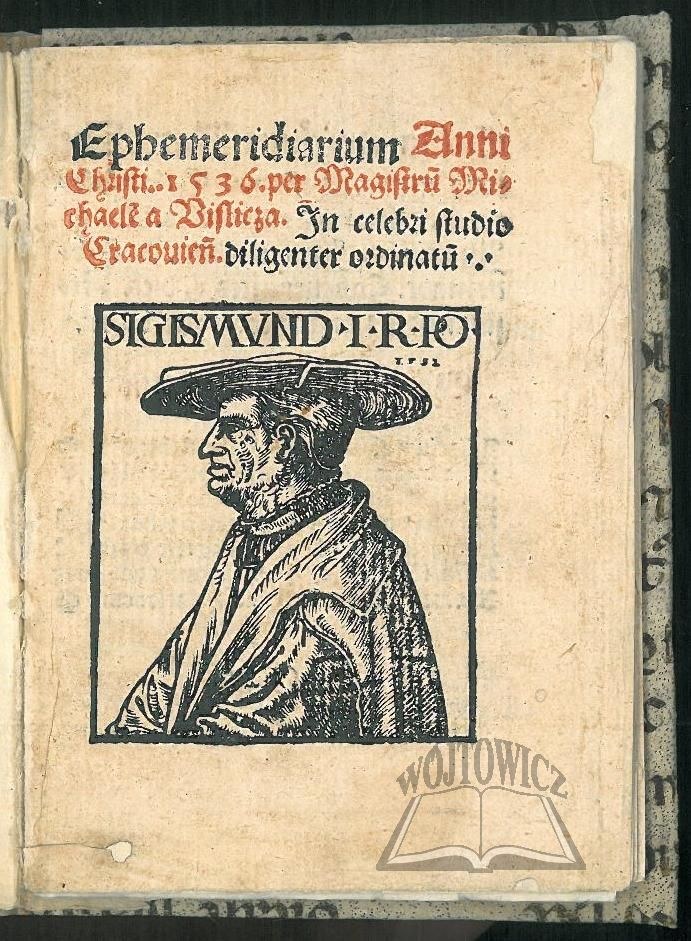
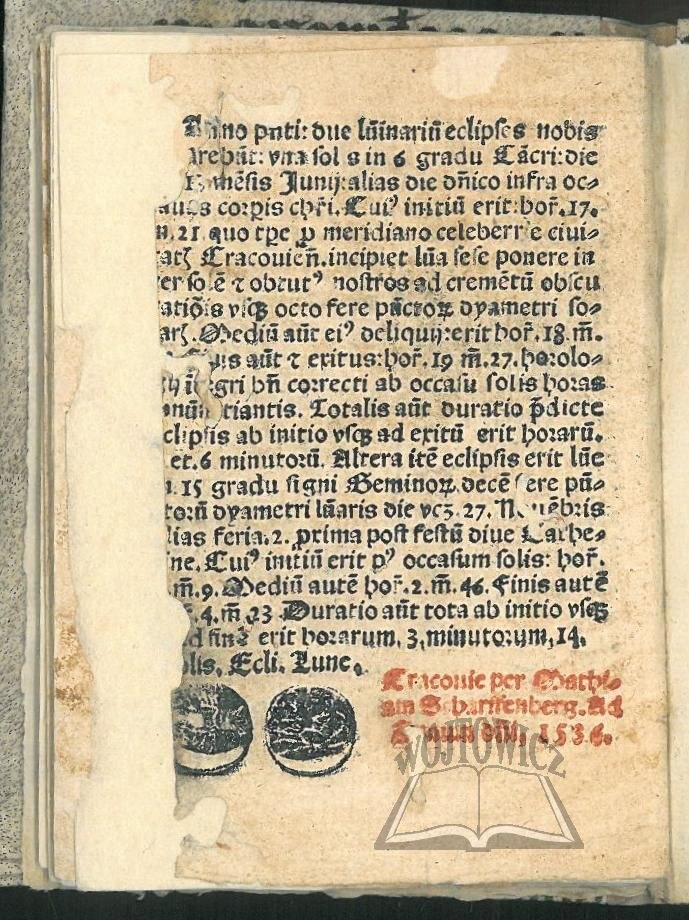
Ephemeridiarium Anni Christi 1536 by Master Michael of Wislicza, carefully compiled at the renowned university of Krakow.
Kraków 1536. Maciej Szarffenberg, [probably printed in late 1535]. (11.5 x 8 cm), pp. [32], portrait of Sigismund the Old on the title page and 12 woodcuts in the text, secondary cardboard binding.
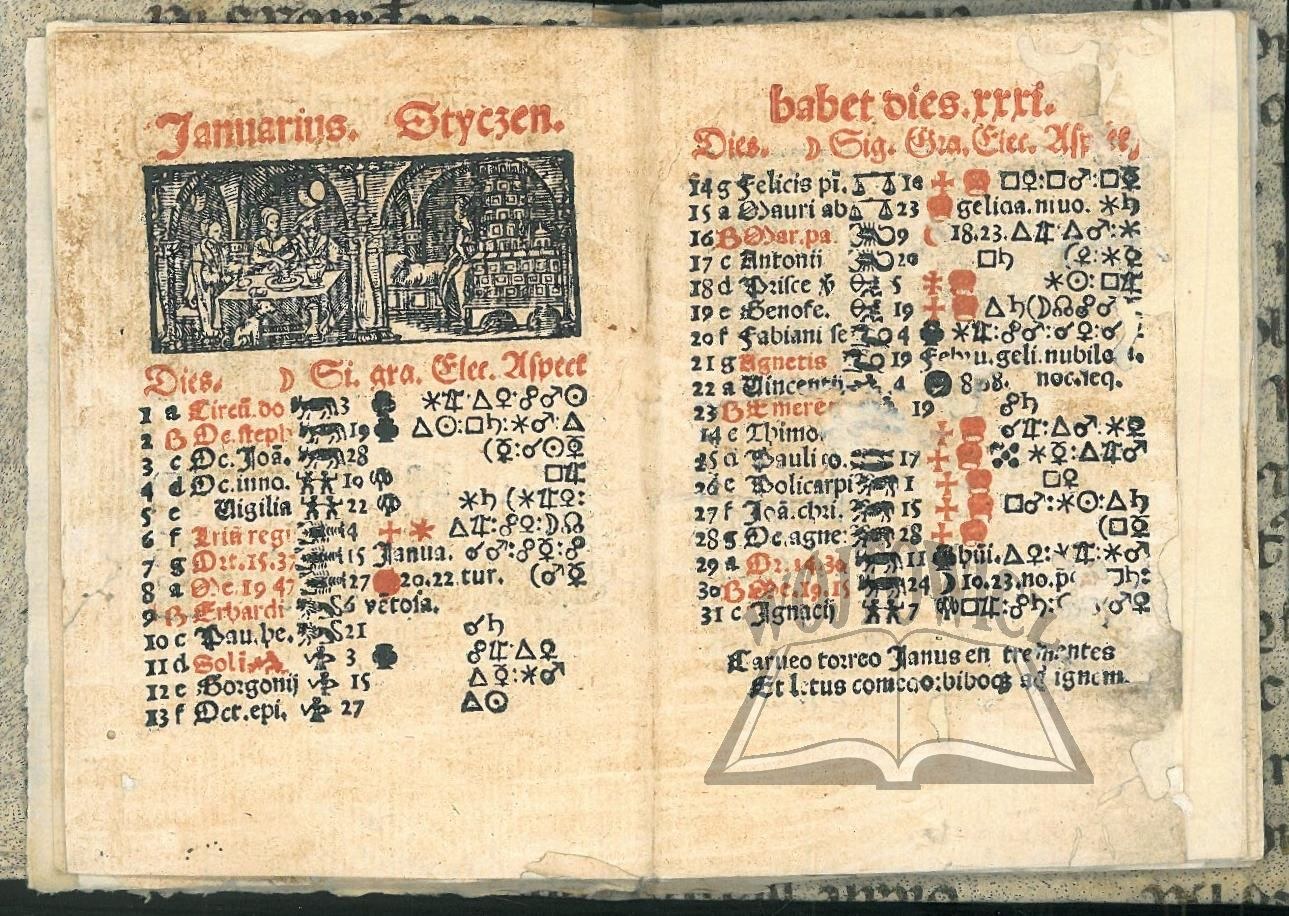
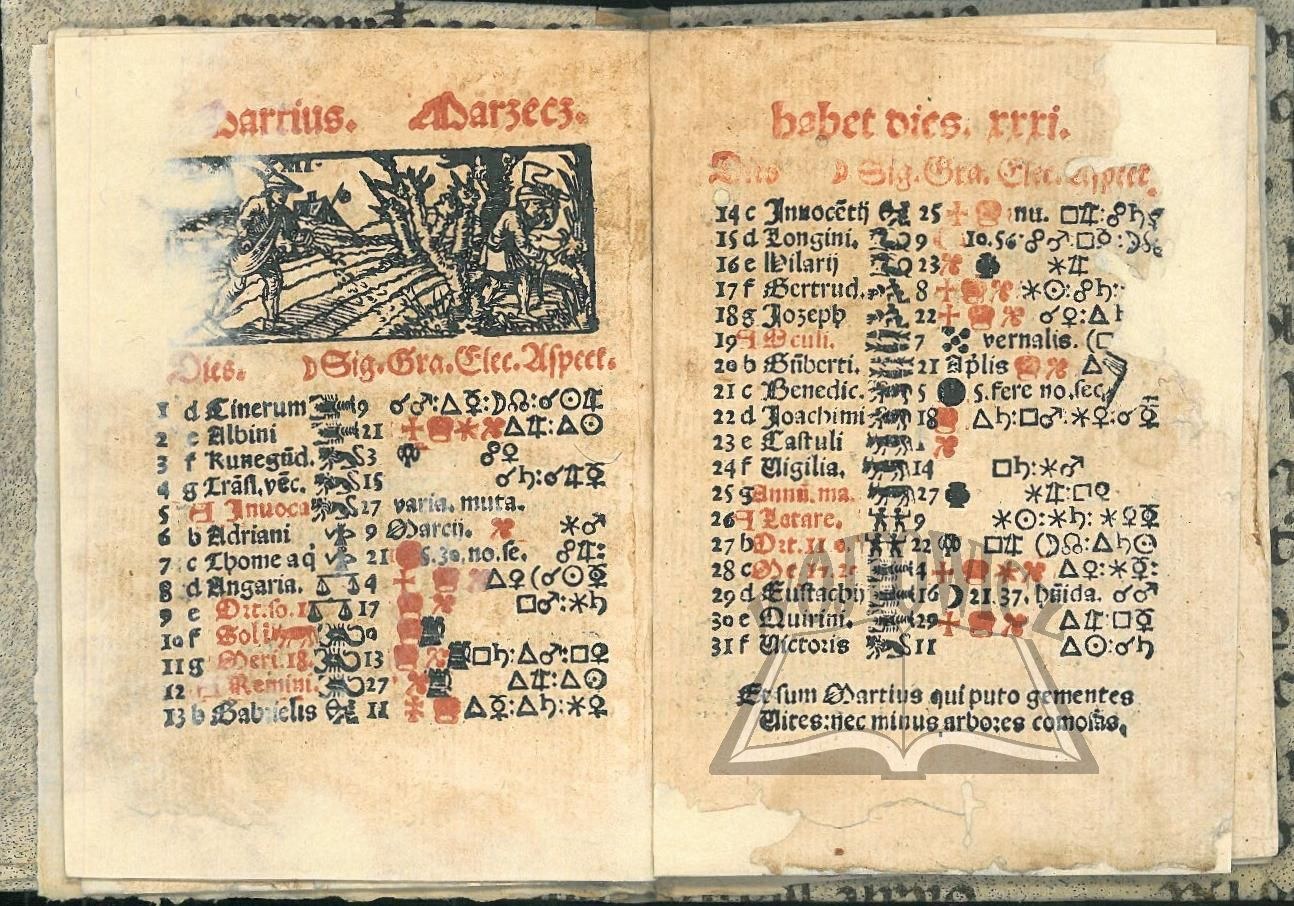
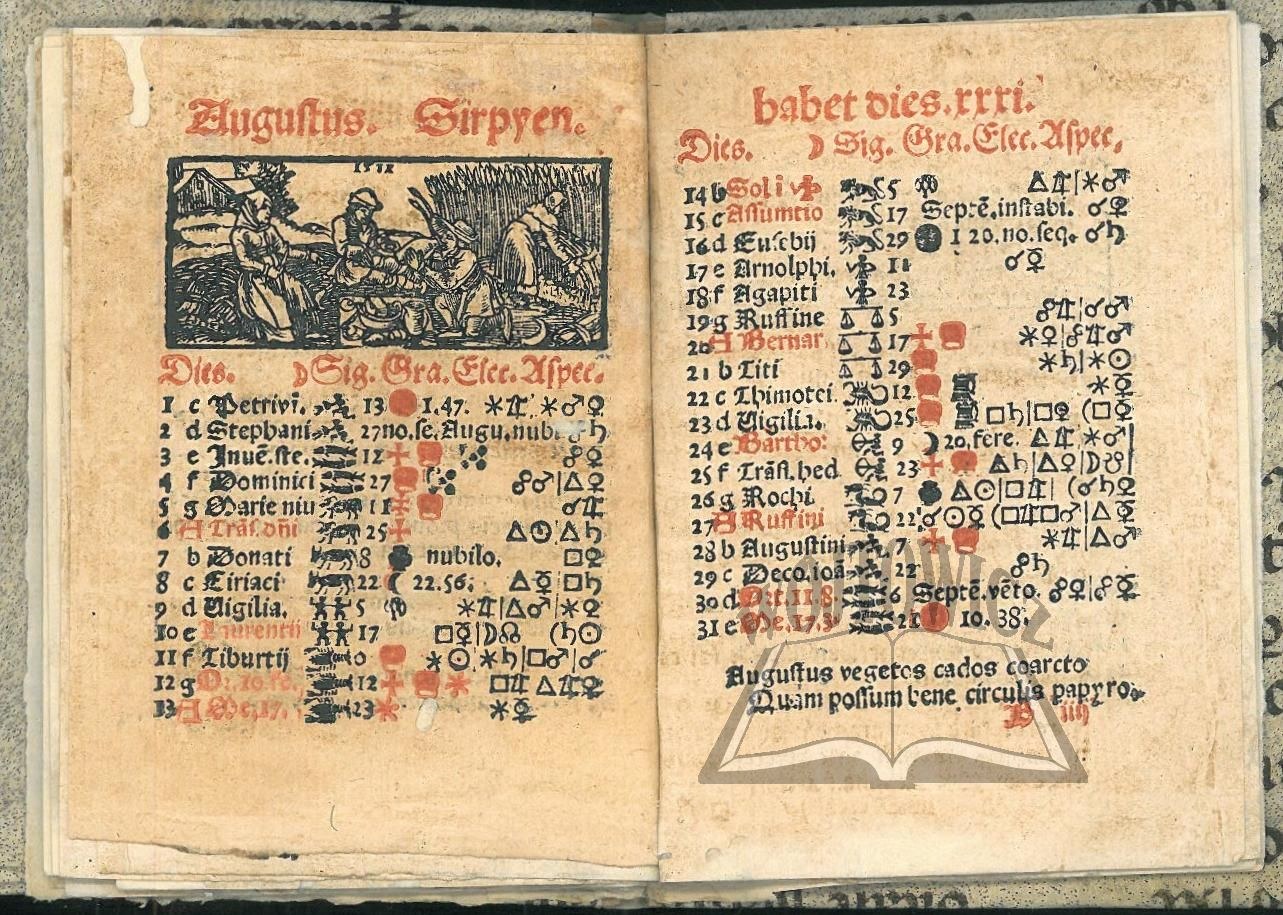
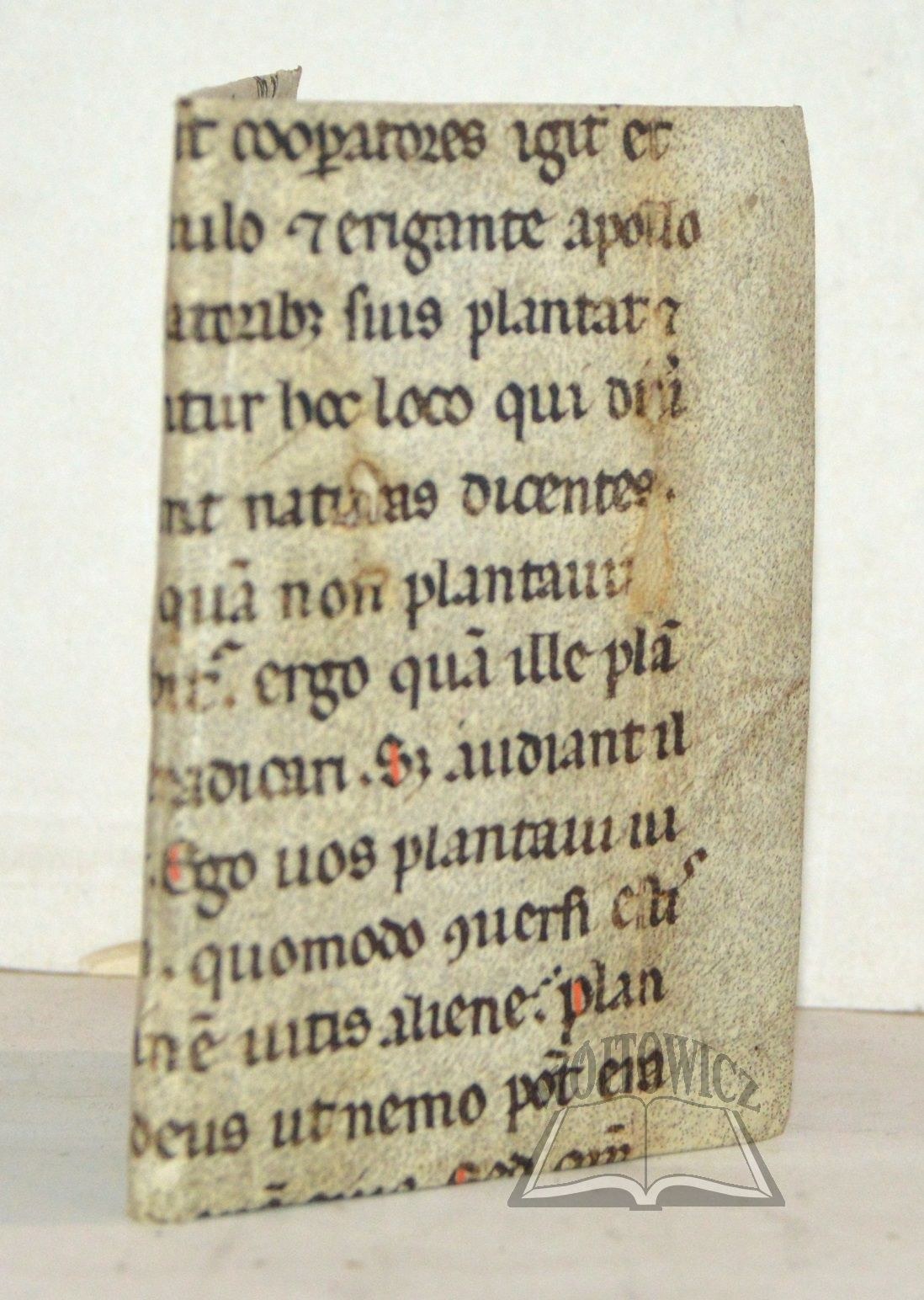
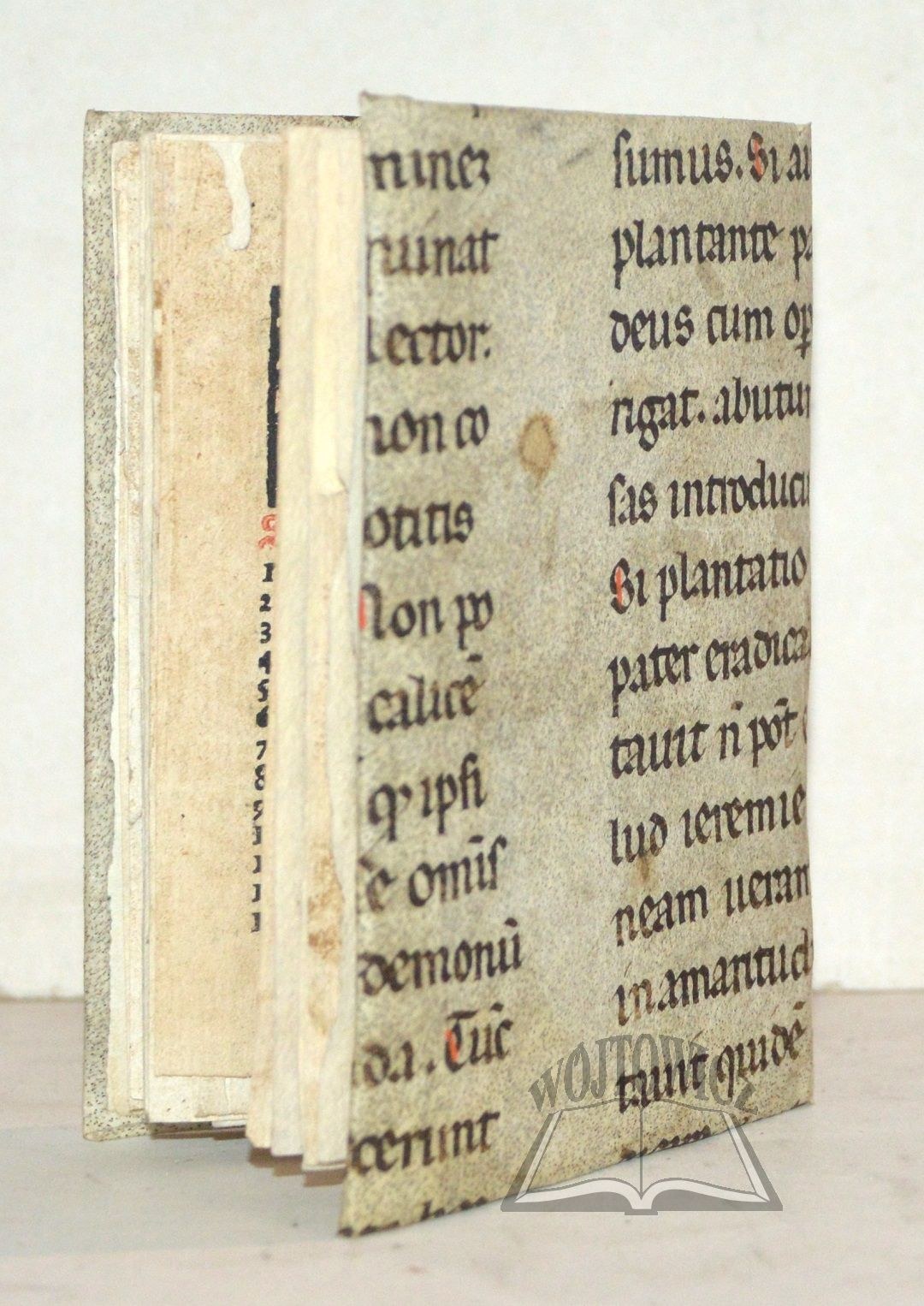
Not listed by Estreicher. Until recently, the only known piece was held at the National Library, discovered as reused leaves in a 16th-century binding. A rarissimum of 16th-century Polish typography. Extremely rare, one of the earliest surviving Polish printed calendars. The author is Michał of Wiślica, a professor of astrology, mathematics, and theology at the Krakow Academy, who headed the Department of Astrology and Mathematics from 1531. As the university’s official astrologer, he published calendars and prognostics annually. Of his extensive body of work, only a few printed works from the years 1531–1539 have survived to this day. The calendar includes a calculation of time, astronomical and astrological information, the phases of the Moon, the positions of the planets and their aspects relative to the signs of the zodiac, as well as indications of auspicious and inauspicious days. The names of the months are given in Latin and Polish (“Januarius. Styczeń,” “Februarius. Luty,” etc.), which gives the print special significance for the history of the Polish language and early calendar culture. Each month is adorned with a woodcut depicting activities typical of the season, including fieldwork, the harvest, plowing, the grape harvest, hunting, and a winter feast. The title page features a large woodcut portrait of Sigismund I the Old, with the inscription “SIGISMVND I R[EX] PO[loniae],” dated 1532. The text also includes 12 small woodcuts, also dated 1532–1533. At the end, there is information about the lunar eclipses predicted for the year 1536, as well as a colophon bearing the printer’s name. The work was printed by Maciej Szarffenberg, one of the most important Kraków printers of the first half of the 16th century. Szarffenberg specialized, among other things, in publishing calendars and prognostics by professors of the Kraków Academy . The special value of this piece lies in the fact that such early calendars were ephemeral prints, intended for current, one-year use, which is why so few have survived. The known piece of this edition, which found its way to the National Library, was discovered by chance as material used to reinforce a 16th-century book binding; after conservation, it was rebound. A rarissimum of 16th-century Polish typography. One of the rarest surviving Kraków calendars. An exceptionally valuable Polish cultural artifact, combining the history of science, astrology, and Kraków printing with the early Polish calendar tradition. The woodcut portrait of Sigismund I the Old on the title page is particularly striking. Condition: a restored piece; nearly every page has been partially or fully reinforced with paper, with minor damage to the text in a few places. Binding made from an old handwritten parchment sheet; endpapers are contemporary.








最近瀏覽過的
登錄以查看拍品列表
收藏
登錄以查看拍品列表