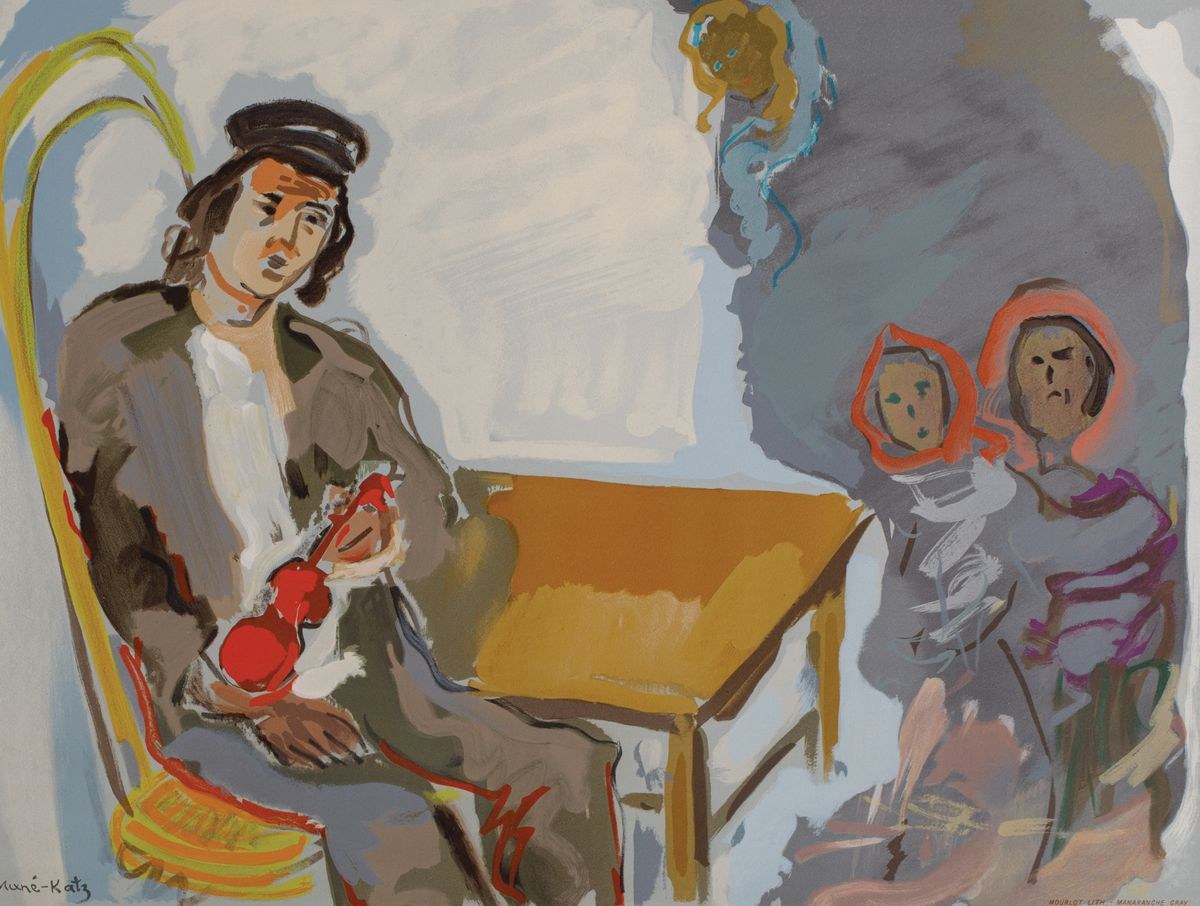
Illustration for Sholem Aleichem's novel Stempenju
Color lithograph, 49 x 65 cm (illus p-p)
Signed in stone l.d.: Mané-Katz, p.d.: Mourlot Lith. - Manaranche Grav.
Asking price 900
Estimate 1100 - 1200
Emmanuel Katz (MANÉ-KATZ)
1894 Krzemenchuk - 1962 tel Aviv
He was a native of Ukraine; in 1911-12 he attended the Drawing School in Vilna; he continued his studies at the M. Murashka School of Painting in Kyiv. In 1913, he began studying at the École des Beaux-Arts in Paris under F. Cormon. After the outbreak of World War I, he left for Petrograd. In 1917 he took a position as a professor at the Kharkiv Art Institute. In 1921, traveling through Baku, Tiflis, Moscow, Minsk and Warsaw, he returned to Paris to become associated with the École de Paris circle. He presented his works in solo exhibitions at the Percier, Granoff, Brummer, Petit and Charpentier galleries. In addition, he exhibited his art in New York at the Wildenstein Gallery. He was a member of the Polish Association of Jewish Painters and Sculptors. The shape of the artist's life was largely determined by his travels. In 1928-37 he visited Palestine, Egypt, Syria, the Czech Republic, Poland and Lithuania. He spent the period of World War II in New York. In 1945 he returned to Paris. He continued to travel a lot - to Israel (1948), South Africa (1950), Japan and India (1957). The thematic repertoire of Mané-Katz's art included episodes from the daily life of Jews, images of Hasidim, scenes from the ghetto, symbolic compositions and landscapes. The portraits produced by the artist are distinguished by the elongated, emphasized canon of the human figure.


![Emmanuel KATZ [MANÉ-KATZ] (1894-1962), Głowa Żyda](https://img1.one.bid/img/514/78982_1w.webp)