


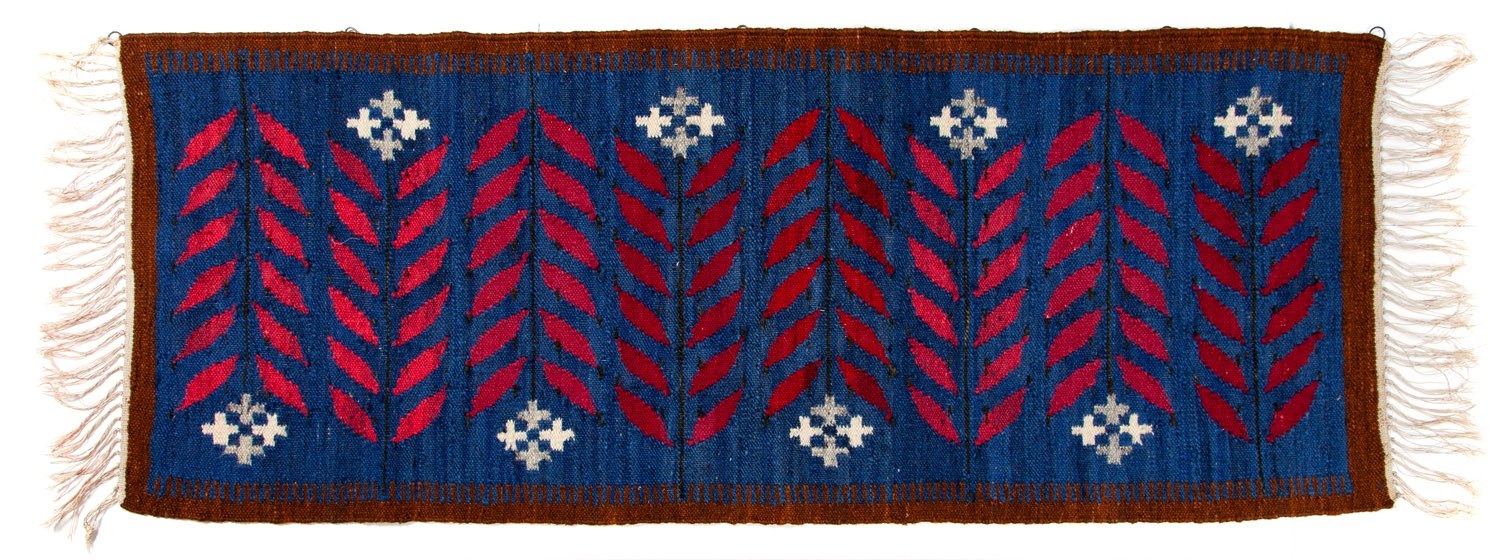
Wool on linen warp, woven by hand; 51.8 x 131.5 (150 cm with tassels)
Analogous object reproduced in: Maria Bujakowa. Things of Beauty, Museum of Opole Silesia, 2021, pp. 92-93
Maria Bujakowa, owner: Maria Janina Zofia Łomnicka-Bujakowa (born May 12, 1901 in Kolomyia, died January 22, 1985 in Koscielisko) - Polish artist specializing in artistic textiles, educator and organizer of weaving and artistic education in Podhale.
She was born on May 12, 1901 in Kolomyia, to Jaroslaw Ludomir Lomnicki and Zofia née Wasung. She lived in Lviv from 1904-1934 and was married to Jakub Bujak from June 16, 1934. After her marriage she moved to Warsaw. In 1935 she gave birth to a daughter Magdalena, and in 1938 to a son Lukasz.
During World War II, she initially stayed in Lviv, together with her two children, and from 1943 she stayed with her husband's family in the village near Tarnow. She learned of the death of her husband, who was killed in July 1945 during a mountain expedition in Cornwall, after several months.
Beginning in 1912, she studied at the 8-year-old Juliusz Słowacki private female gymnasium. In 1919, after her mother died, she took care of her two younger brothers, Zbigniew and Adam. After passing her high school diploma in 1921, from 1923 she enrolled in the Art Industry Department of the State Technical School in Lviv, graduating in 1927. Initially she was a free student, and in 1925 she enrolled. In 1926 she learned fabric dyeing at the dyeing laboratory of the Lviv Chamber of Commerce and Industry. In the same year, she attended a one-year course at the Kunstgewerbeschule in Vienna. She completed her diploma from the Academy of Fine Arts in Warsaw in 1961 in unique textiles.
Lviv University, where she studied under Kazimierz Sichulski, is where she became interested in artistic textiles, especially kilims. In 1926, after returning from Vienna, Bujakova worked at a kilim-making shop run by Irena Petzold-Dawidova. She designed textiles and dyed wool. Her works were highly regarded for their artistic qualities, ingenuity and quality of workmanship. Since 1926 she also organized school workshops and taught drawing, lace-making, embroidery and tailoring. She first worked in this capacity at the State Vocational Female School in Lviv, and from 1932 also at the Public Vocational Supplementary School. At the same time she carried out orders and designed textiles and applied graphics. Since 1930 she cooperated with the Artists' Cooperative "Ład".
In 1935 she began working at the State Female Industrial School in Warsaw. In addition, from 1934 to 1937 she was the artistic director of the Work Cooperative of Graduates of Handicraft Schools "Initiative". She took care of apprenticeships and embroidery works. From 1937 to 1939 she was the head of the State High School of Tailoring in Warsaw. In Warsaw, she continued to work with the "Ład" cooperative. As its member, she designed textiles, kilims, carpets and tapestries. In 1936, her works were shown at the "Interior Art" exhibition at the Institute of Art Propaganda in Warsaw. She also supervised the preparation of a three-part fabric Jan III Sobieski designed by Mieczyslaw Szymanowski as part of a fabric competition for the International Exhibition in Paris in 1937. The work won the Grand Prix. She continued her professional work during World War II in Lviv.
After the war, she settled in Zakopane. She was invited to the local opening of the "Ład" cooperative. She moved in August 1945, and was a teacher and from 1946-1969 director of the Zakopane Lace School, which was transformed in 1962 into the Helena Modrzejewska Artistic Weaving Technical School. Her numerous contacts allowed young people to prepare for the profession and practice. In 1962 she founded the experimental Artistic Weaving Technical School. Since 1945 she designed for the Artistic Industry Department of the Communal Cooperative "Samopomoc Chłopska" in Zakopane. From 1946 to 1984, she was associated with Zakopane Pattern Works supervised by Cepelia as artistic manager of the weaving and embroidery department. In 1950, when the plants were incorporated into a cooperative, Bujakowa took charge of a team of weavers. In 1959 she became a consultant and designer at the cooperative. Initially, in designing textiles, she collaborated with other artists, such as Michal Bylina (Olympics, 1948) and Tadeusz Brzozowski (Runners, from 1955; Olifant, 1957). Since the 1960s, she created individual works. They were dominated by color and embroidery in wool or linen. She created embroideries, lace and unique textiles - such as monumental embroidered tapestries and kilims, in which she used regional Podhale patterns.
She died on January 22, 1985 in Koscielisko. She was buried in the Cemetery of Merit on Pęksowy Brzyzek in Zakopane.
She received many artistic and national awards, including the First Degree Award of the Minister of Culture and Art for lifetime achievement (1968) and a distinction from the Polish Olympic Committee in the "Wawrzyn Olimpijski" competition for sports-themed textiles (1969).
From March 19 to July 31, 2022, the Opole Silesia Museum presented an exhibition of Maria Bujakowa's works under the title Beautiful Things. Fabrics by Maria Bujakowa. Kilims and fabrics and projects of the artist were shown. A book Maria Bujakowa was published. Things Beautiful, edited by Bogna Szafraniec. (wikipedia)











最近瀏覽過的
登錄以查看拍品列表
收藏
登錄以查看拍品列表