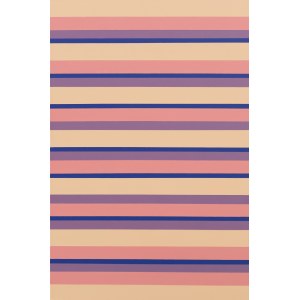
acrylic on canvas,
80 x 120 cm,
signed.
Arkadiusz Rataj (born 1984) is a graduate of the Faculty of Physics at the Adam Mickiewicz University in Poznań and the Faculty of Computer Science at the Poznań University of Technology. The scope of his artistic explorations includes painting, graphics, installations, as well as music, whose common denominator is modern technology. It is it that becomes the main tool of work, and sometimes an independent means of artistic expression, allowing the author to redefine both the creative process and the perception of art. In his work, the artist seeks harmony between art and science. Following the example of Renaissance artists, he treats them as related fields, intended to serve as a tool for human development, both spiritual and emotional.
Author's comment: Algorithmic paintings are artistic, painterly interpretations of processes occurring in digital devices. The form of the work is shaped by an algorithm, understood as a strictly defined list of actions needed to achieve the desired goal. In a sense, each of us implements algorithms. For example, in order to open a door (the goal) you need to perform the following steps (list of actions): grab the handle, press it and pull it towards you. The goals implemented by computer algorithms are carried out with much more complex steps, such as encrypting data, sorting, dividing, multiplying and others. The degree of complexity of the sequence of tasks built up from a number of activities makes it ideal for their implementation to be a computer.Algorithmic images are artistic, painterly interpretations of the processes occurring in digital devices. The form of the work is shaped by the algorithm, understood as a strictly defined list of activities needed to achieve the desired goal. In a sense, each of us implements algorithms. For example, in order to open a door (the goal) you need to perform the following steps (list of actions): grab the handle, press it and pull it towards you. The goals implemented by computer algorithms are carried out with much more complex steps, such as encrypting data, sorting, dividing, multiplying and others. The degree of complexity of a sequence of tasks built up from many activities makes a computer ideal for their implementation.