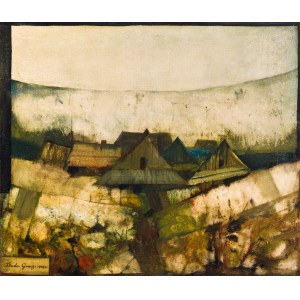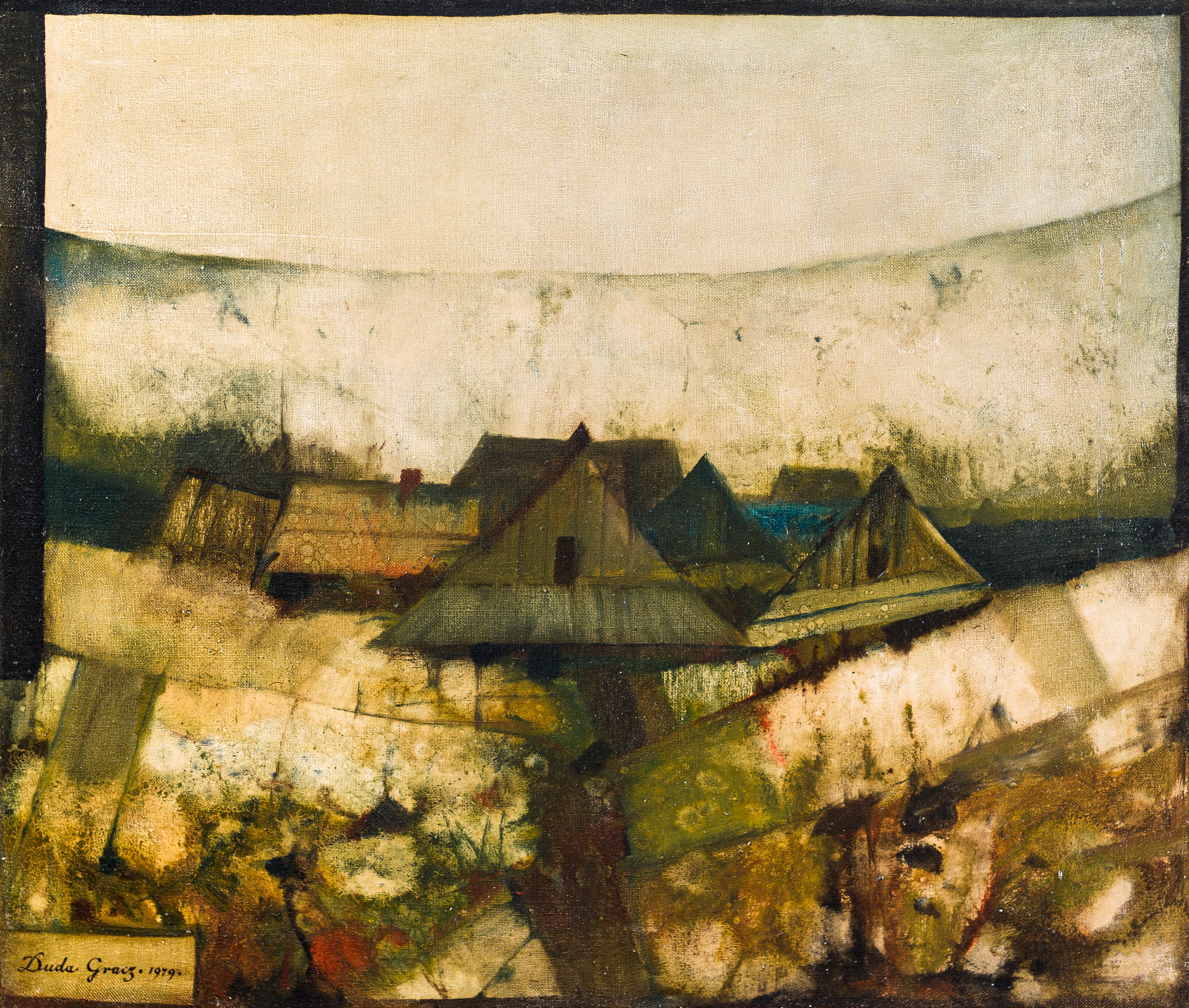
Signed and dated l. d.: Duda Gracz . 1979 .;
On the reverse, author's inscription: Goraj .
Attached to the painting is an attestation signed by Agata Duda-Gracz.
"Such is the strange geography of the places where I paint that they are arranged on the borderlands, or more nicely put, on the borderlands of Poland to the four corners of the world. I tried to paint a little in Hungary, Holland, England, Sweden, Germany, but always with poor results," Jerzy Duda-Gracz recalls.
Few of the observers of artistic life, starting from the 1970s, knew that the artist simultaneously practiced landscape painting. The artist, in order to quiet the emotions bubbling up in him, to find inspiration, from 1972 he regularly visited Brzegi - a village near Bukowina Tatrzanska, where, almost devoid of animate beings, the mountainous landscape presented the power of nature in all its glory. Pure and authentic nature, only rarely affected by human activity. Jerzy Duda-Gracz searched for such places where the lyricism of nature could be tangible.
From the Polish landscape of the borderland, peaceful countryside, the artist was able to begin his further work in the painting cycles that are so well known today, such as "Provincial-Commune Paintings" filled with figures of workers, old men, women with characteristic - often corpulent, or as Flemish painting enthusiasts would say Rubensian - build. The artist, moreover, recalls that: "There I studied for myself and painted desert landscapes for my own use - there I recovered the proportions of thought and spirit, lost in life, in the hustle and bustle of civilization, in the chaos of social and political life. The new thinking born at Jasna Gora and in the sub-Centennial 'Jurassic paintings' began to populate the landscapes from the village of Brzegi." Another place offering respite was Lagow, which, like Brzegi, became an oneiric setting for subsequent narratives. The artist also visited Roztocze, portraying the picturesque areas of Nadrzecze or Gorajec. Jerzy Duda-Gracz was discovering the so-called Poland B - the world of communal towns and small villages, one would like to say "forgotten by God." It seems that this very land, untouched by the hand of man, progressive industrialization and technization, was for the artist this true and authentic homeland. These places were repeatedly portrayed, in an extremely intimate way, as mentioned by the painter's friend Tadeusz Nyczek. The artist himself treated his landscapes extremely personally. They were born out of the need of the heart, out of memory, and are in part an expression of worship and admiration for the beauty of his native lands. Jerzy Duda-Gracz, moreover, recalled that: "There is a great deal from which I glue my painted Poland together, I am in a hurry to make time with what I lose in memory, what was (or maybe wasn't?) [...] I am in a hurry, because my Poland is melting faster and faster like last year's snow, and I want to make time to paint it, although this is absurd, because it is only in me and will die with me. But as they say: credo quia absurdum est. I believe in it, even though it's absurd."
Exceptionally resonant notes of nostalgic landscapes, this time painted with full conviction - not "for the drawer" - seem to be the works included in the series Chopin, presented in the birthplace of the outstanding pianist, now a museum in Żelazowa Wola. The evanescent, as if fantastic, misty landscapes providing the scenery for sometimes nymphotic, undefined figures, painted very skillfully, almost laser-like, may also depict the departing, blurring image of Poland. When contemplating the paintings of Jerzy Duda-Gracz, it is worth noting the poetic expression of the painterly means used, deepening the emotional reception of the canvases.





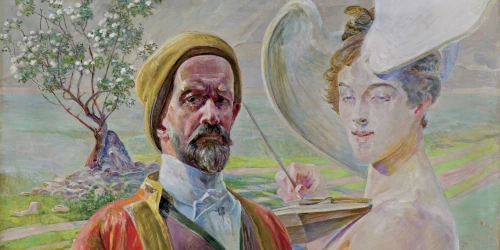
![Jerzy DUDA-GRACZ (1941-2004), Bez tytułu [Błazen i klaun, autoportret utajony]](https://img1.one.bid/img/10574/3329975_1w.webp)