


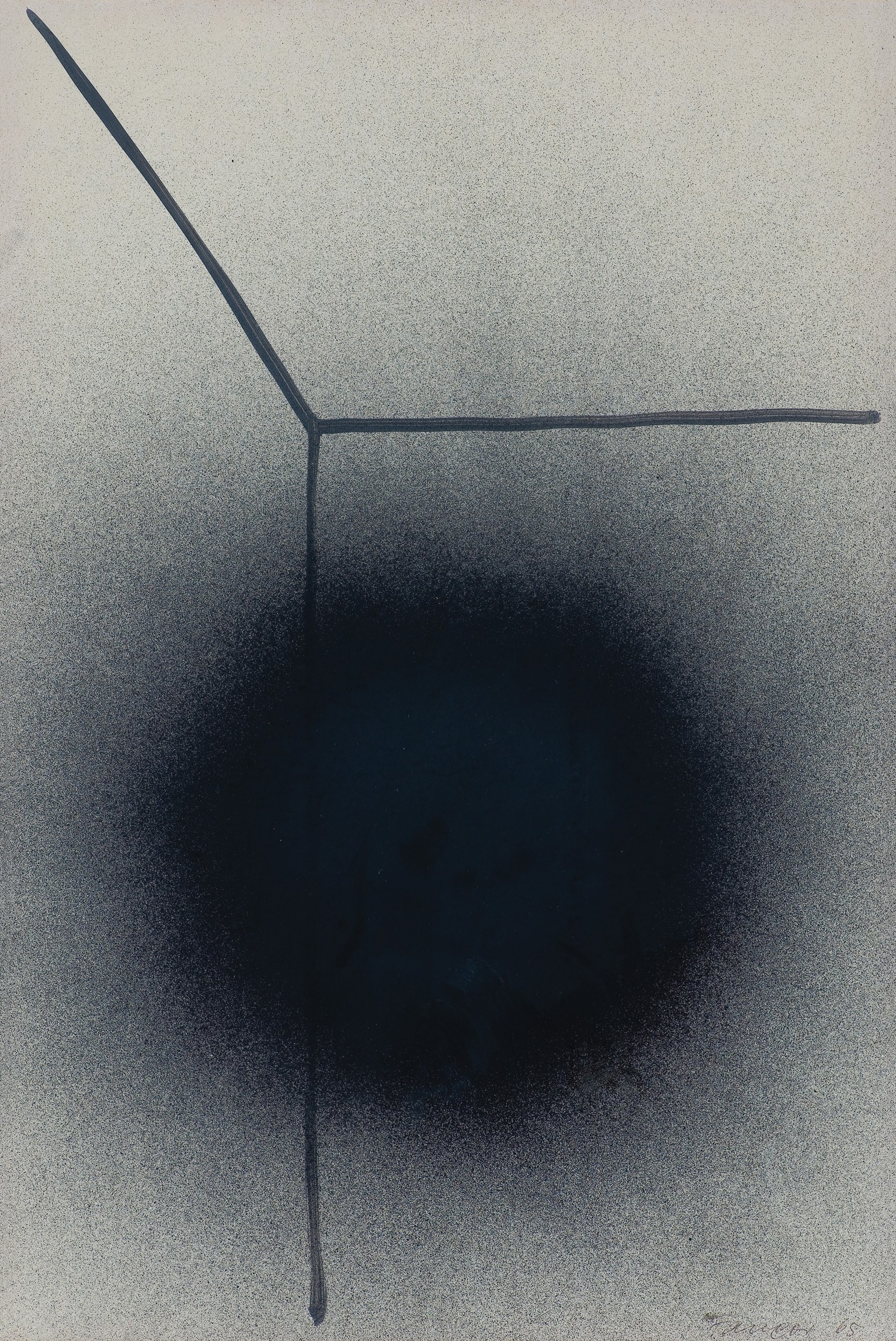
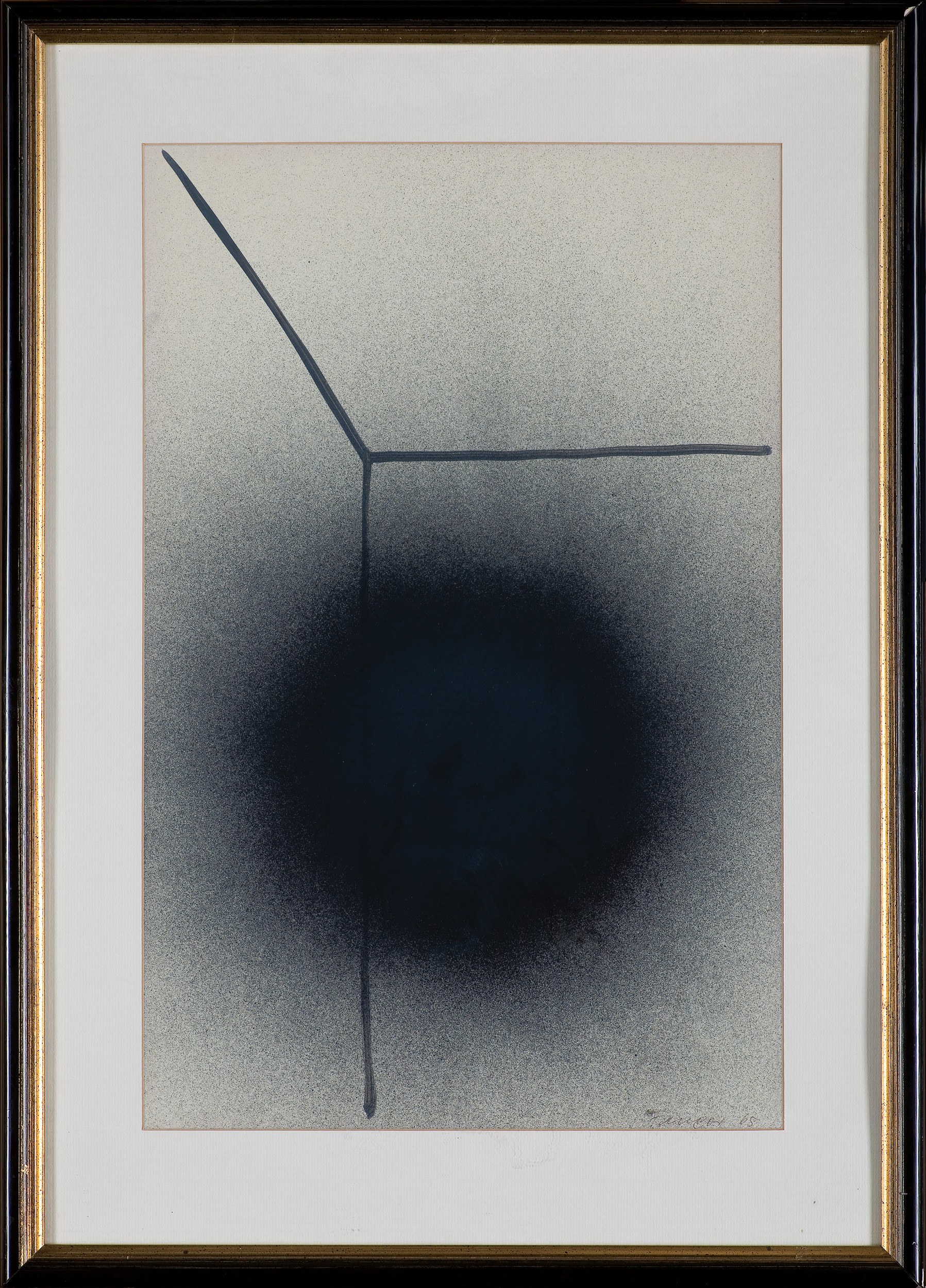

55,0 x 36,0cm - ink brush, spray, paper
sign. p.d.: Fangor 65
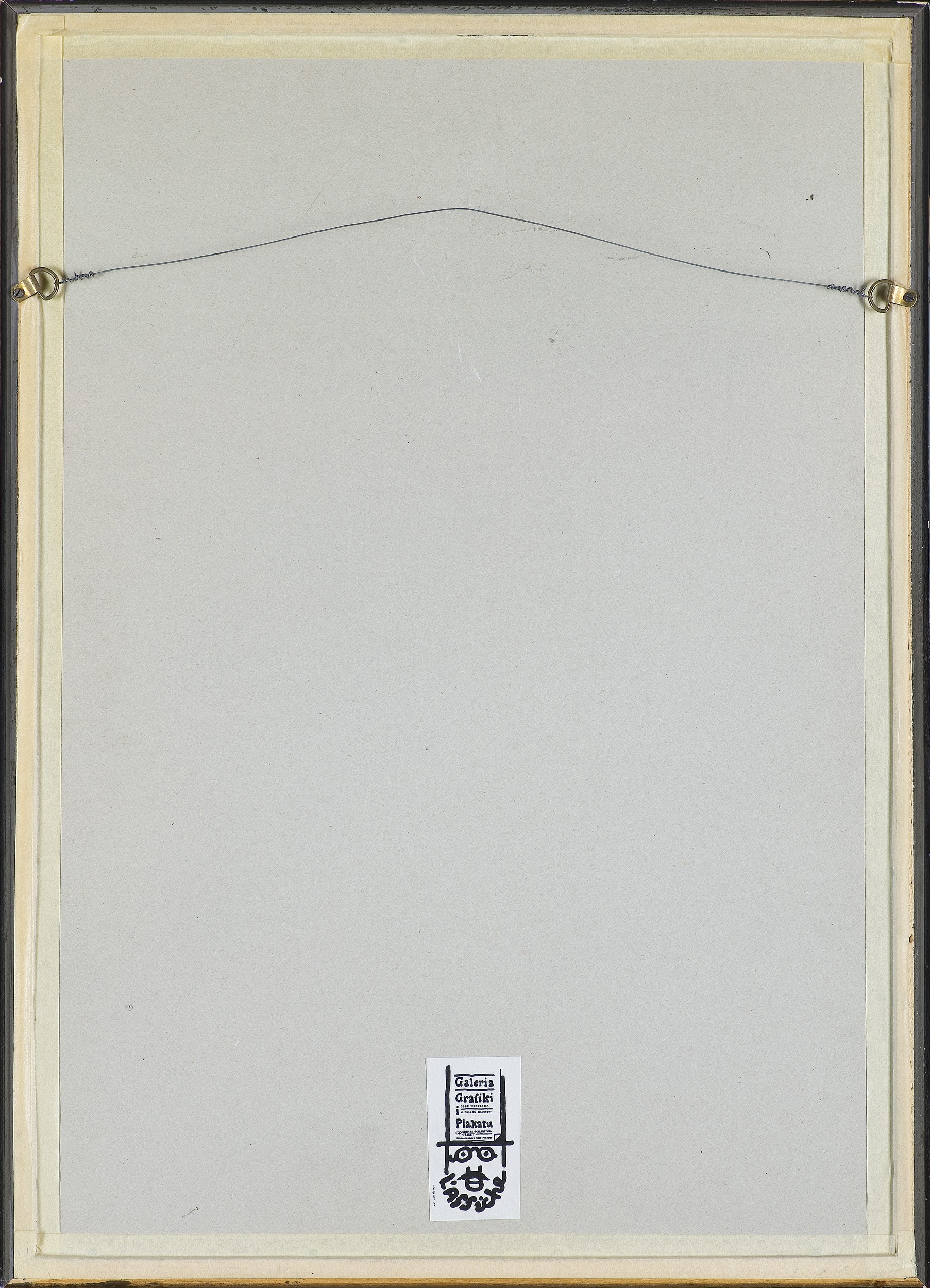
Sign. on back, on back: Fangor 65 | black spray P.I.S. | 56 x 36, p.g.: I [in circle].
On the reverse of the binding a sticker of the Gallery of Graphics and Posters in Warsaw.
The zone in front of the canvas, which is his field of action, Fangor calls "P.I.S." (English for "Positive Illusory Space"). "P.I.S." is the opposite of "N.I.S." (English: "Negative Illusory Space") from a traditional perspective, when the viewer remains relatively distant from the spatial experience that takes place either on the picture plane or behind it. IN "P.I.S." the virtual space of the art object and the real space of the perceiving object overlap. Hence, the viewer experiences an activated sensitized spatial continuum that engulfs his entire being.
Margit Rowell, Fangor, The Solomon R. Guggenheim Museum, New York, 1970, p. 12 (quoted in Wojciech Fangor. Spectra Art, Space Masters. Exhibition of works by Wojciech Fangor from the collection of Anna and Jerzy Starak, Starak Family Foundation, Spectra Art Space, Warsaw, 2015, p. nlb. (Glossary to the image IS 12)
♣ a fee will be added to the auctioned price in addition to other costs, based on the right of the artist and his heirs to receive remuneration in accordance with the Act of February 4, 1994 - on Copyright and Related Rights (droit de suite).
Wojciech Fangor (Warsaw 1922 - Warsaw 2015) studied painting with Tadeusz Pruszkowski and Felicjan Szczęsny-Kowarski (1940-44). In 1946 he received his diploma at the Academy of Fine Arts in Warsaw. In 1954-62 he was an associate professor at the Graphic Arts Department of the academy. He participated in the official artistic life of the Socialist Realist period as a painter and graphic-poster artist. In painting, he sometimes used exaggerations on the verge of intentional caricature ("Characters," 1950). In film posters, he operated with metaphor and synthetic painterly signs in a way that departed from the doctrine of Socialist Realism ("Stronger Than Night," 1955), becoming a co-founder of the so-called Polish school of posters. He also collaborated with architects, including Stanisław Zamecznik, with whom he created "Study of Space" in 1958, the first Polish environment, which was based on his optical paintings. In 1961, he left Poland, first to Vienna, then to Washington (1962), Paris (1962-1964), West Berlin (1964-1965) and England (1965-1966). In 1966 he settled permanently in the United States, where he taught at Fairleigh Dickinson University in Madison (1966-1983) and the Department of Architecture at Harvard University in Cambridge, Massachussets (1967-1968). In 1978 he received a Jurzykowski Foundation award. In 1989 he moved to Santa Fe, New Mexico, and has lived in Poland since the 1990s.
He died in Warsaw on October 25, 2015.







![Wojciech Fangor (1922-2015), Kopia obrazu Pabla Picassa Acrobate à la Boule [Akrobatka na kuli], 1954](https://img1.one.bid/img/10573/3329745_1w.webp?1790434274)





最近瀏覽過的
登錄以查看拍品列表
收藏
登錄以查看拍品列表