


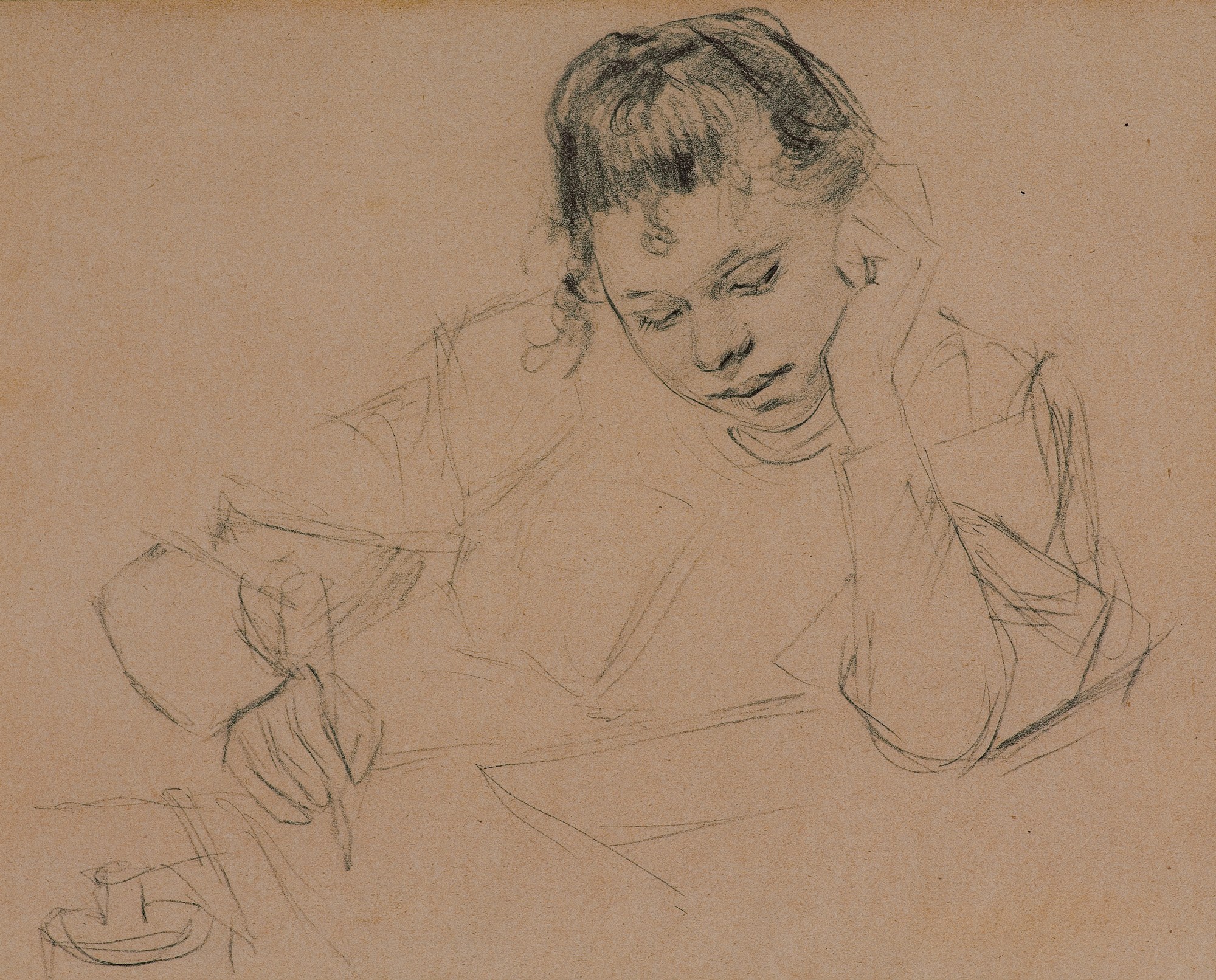
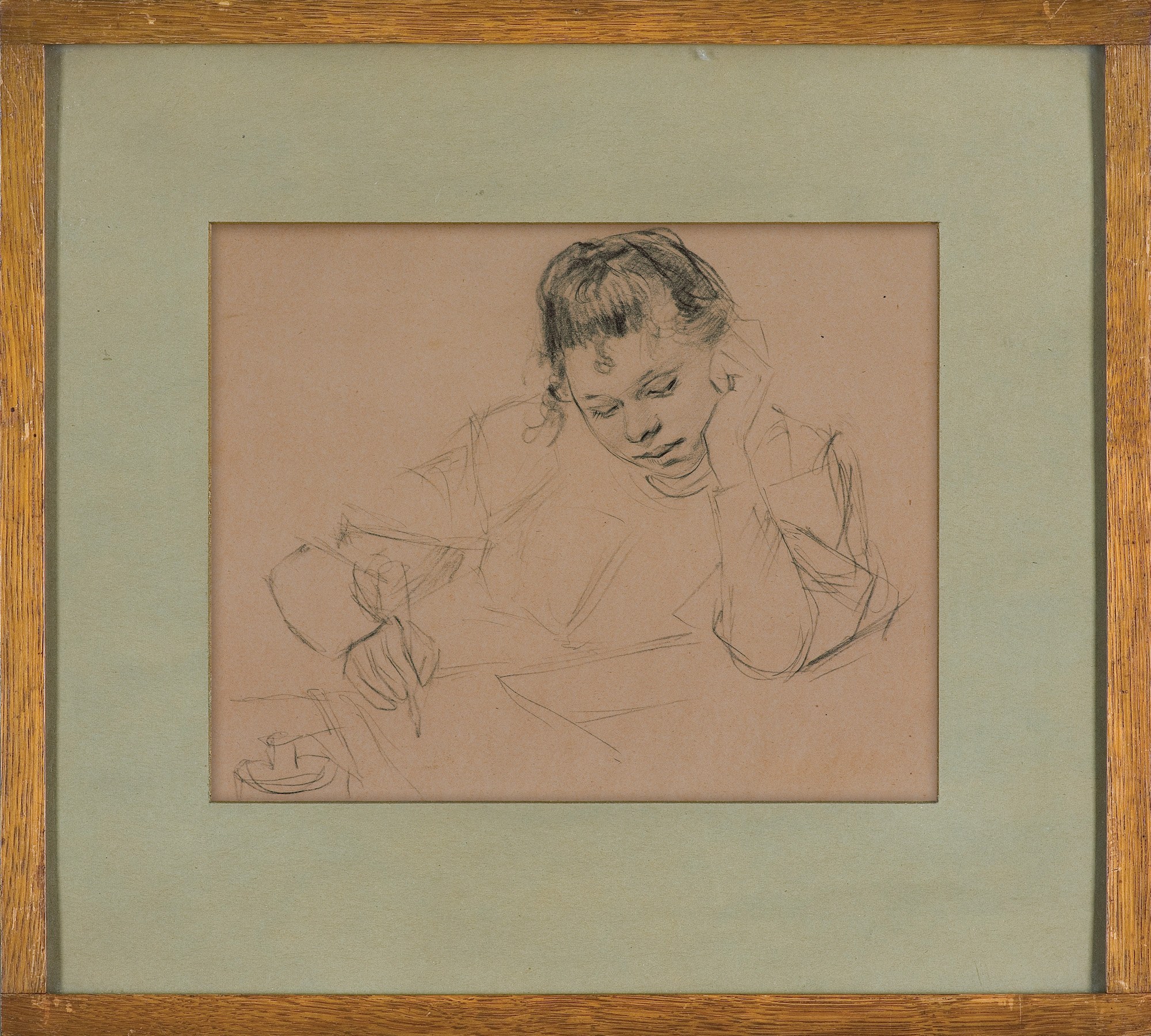
20.2 x 25.7cm - pencil, paper glued on cardboard
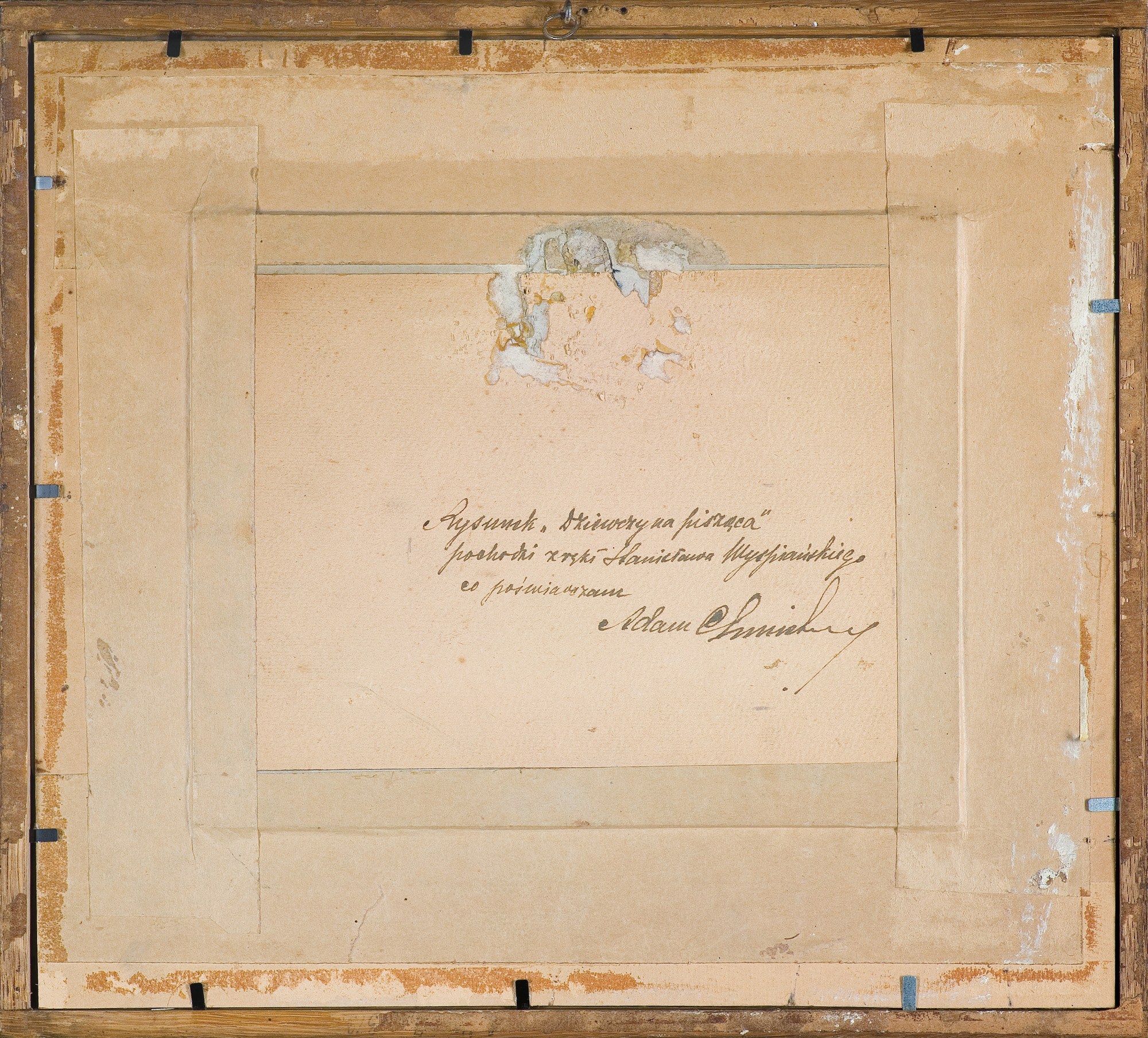
on the back handwritten inscription (ink): Drawing "Girl writing" | comes from the hand of Stanislaw Wyspianski | which I attest | Adam Chmiel
The provenance of the presented drawing leads to an extremely interesting circle of Krakow's artistic intelligentsia of the turn of the 19th and 20th centuries. The work comes from the legacy of Zygmunt Hendel - a prominent architect, architectural historian and conservator of monuments, one of the most important figures of the circle centered around the restoration of the Wawel Castle and Krakow's modernism.
Hendel's collection must have had a very personal character. It was probably not built as a classic collector's collection aimed at the market, but rather as a natural result of close relationships with artists of the era. Such collections are particularly valuable today, as they often include intimate sketches, studies and private works - works that remained outside the official commercial circuit.
On the back of the painting is a certificate of authenticity signed by Adam Chmiel (1865-1934), a cultural historian, archivist and lover of Krakow, who was friends with Stanislaw Wyspianski. Their acquaintance began while they were still in school. They were united by their interest in the history of Krakow. Both were among the founders of the Society of Lovers of the History and Monuments of the City of Cracow in 1896. Chmiel assisted the artist in his work when he needed information on old Krakow. He also helped him during his work on the drama Boleslaw the Bold, providing advice on both costumes, armament and the appearance of Boleslaw's court. Adam Chmiel also took care of Wyspiański's family during his medical trips abroad, and after his death became one of the legal guardians of Wyspiański's children. On behalf of the minors, he oversaw the sale of their father's works and book collection.
The motif of the Girl Writing itself fits perfectly into the intimate current of Wyspiański's work. The artist extremely often depicted people immersed in everyday activities - reading, sewing, writing or reverie. He was not only interested in representational portraiture; he was fascinated by the psychology of the moment, concentration and observation of domestic life.
The work depicts a girl in a moment of deep concentration and melancholy - a mood so characteristic of the fin de siecle era. The tilted head supported on a hand is a classic iconographic motif denoting reverie, intellectual effort or inner withdrawal. Wyspianski refrains from showing a superfluous background, focusing all attention on the model's psyche. She seems completely isolated from the outside world, immersed in her own thoughts and the activity she is performing. Capturing the figure while writing or drawing gives the work an autothematic character.
The artist, himself a titan of literary and artistic work, repeatedly portrayed his loved ones in moments of everyday, routine activities. In this context, the pen and the dryer lying in front of the model become symbols of the creative act. This drawing can be read as a universal metaphor for the author's loneliness during creative work.
Provenance: from the legacy of Zygmunt Hendel (1862-1929), a Cracow architect, architectural historian and conservationist.
Stanislaw Wyspianski (Krakow 1869 - Krakow 1907) came from a poor bourgeois family with strong patriotic and artistic traditions. He was the son of a sculptor-sculptor Franciszek, and was orphaned by his mother at the age of seven; at eleven he was taken in by her family due to his father's progressive alcoholism.
The patriotic atmosphere of his uncles' home, their guests - prominent Krakow scholars and artists - influenced his interest in the history of his homeland, the past of Krakow and shaped Wyspianski's consciousness and attitude.
As a junior high school student, Wyspiański, who betrayed a talent for painting, enrolled at the School of Fine Arts for the year 1884-1885, which he undertook after high school graduation and received in 1887-1891, 1892-1893, 1894-1895 under the direction of Władysław Łuszczkiewicz, Florian Cynk and Izydor Jablonski.
In parallel, he studied art and literary history at the Jagiellonian University.
For seven months in late 1889-1890, he worked alongside Jan Matejko on the polychrome of St. Mary's Church. Thanks to a scholarship, in March 1890 he embarked on his first six-month artistic journey in Europe, through Vienna, Italy to Paris, with a tour of Gothic cathedrals in France, in Germany, visiting Munich, Bayreuth, Dresden, Prague, as well as Wroclaw, Poznan and Gniezno. Upon his return, he was commissioned by Matejko to design additions to the Gothic stained glass windows for St. Mary's Church. After receiving a new scholarship in May 1891, he left for Paris.
By the end of that year, he was living with Jozef Mehoffer in the same studio; both did not get into the Ecole des Beaux-Arts, but took up studies at the Academie Colarossi - Wyspiański in the atelier of Gustaven Courtiois, as well as with J. Blanc and L. A. Girardot. Both also enter subsequent competitions for the Rudolfinum in Prague and for a curtain for the Municipal Theater in Krakow, in which they lose. In 1892, the friends part tumultuously.
Wyspianski then rented his own studio and began writing his first dramatic works, referring to mythology. Both he and Mehoffer are invited to compete for a stained glass window for the Lviv Cathedral Wyspianski spent the fall of 1892 and winter of 1893 in Krakow, returning to Paris in February, where he again stayed with Mehoffer until the fall, when he moved out to his own atelier. In December 1893, Wyspianski visited Krakow, where he presented an exhibition of portraits and Parisian landscapes considered by critics to be Impressionist.
In the spring of 1894 he returned to Paris, from where he sent his finished design for the stained glass window Vows of Jan Kazimierz to Lviv for a competition. He arrives in Krakow in October 1894 and, due to the non-renewal of his scholarship, remains permanently.
The Parisian period, which lasted two and a half years, had an impact on shaping Wyspianski's symbolic art, at which time he expanded his worldview by learning about the fashionable theosophical concepts of Edouard Schure, the philosophical concepts of Friedrich Nietzsche, also exploring ancient drama and mythology and becoming fascinated by contemporary theater. Between 1895 and 1897, he worked on the design and realization of a monumental set of polychromies and stained glass windows for the Franciscan Church in Cracow, whose interpretations are believed to be based on a system of hermetic cosmogony; in parallel, he created a series of illustrations to the Iliad and began a series of symbolic canvases alluding to native legends.
The year 1898 marked the artist's literary and theatrical debut: the drama Legenda I appeared in print, and the Municipal Theater staged the drama Warszawianka. Wyspianski was among the founders of the Society of Polish Artists , "Sztuka", and in 1898 became the artistic director of the magazine , "Życie". Creating in a certain isolation and keeping a distance from his surroundings, at that time he became much closer to the artistic community, frequenting ,,Paona", where he created a series of capital portraits of the establishment's regulars.
In 1900 he began work on the drama November Night and sketches of designs for stained glass windows for Wawel Cathedral; on September 18 he married Teofila Pytko, his aunt's maid and mother of his three children; on November 20 he was present at the wedding of his friend, writer Lucjan Rydel to Jadwiga Mikołajczykówna and at their famous wedding in Włodzimierz Tetmajer's manor house in Bronowice.He immortalized the event in the dissonant stage drama The Wedding, which premiered in Krakow on March 16, 1901.
In 1902, he was appointed docent in the department of decorative and ecclesiastical arts at the Academy of Fine Arts. Despite his deteriorating health, in 1903 he was engaged in staging his dramas on the stage of the Cracow theater, in 1904 in designing the decor of the Doctors' Department Store, arranging the so-called "Light House". Świetlica Towarzystwa Artystów Polskich , "Sztuka" (The Common Room of the Society of Polish Artists, "Art"), and, together with architect Władysław Ekielski, a project to restore the splendor of the Wawel Hill, abandoned by the Austrian authorities, intending to elevate it to the status of a symbolic Wawel Acropolis; he continued to enlarge his portrait gallery of prominent personalities, painted family images, and in December - persuaded by Feliks Jasieński - began a series of pastel landscapes of the view from his studio window. In 1905, he ran in a competition for the position of director of the Municipal Theater, but the unfavorable attitude of the community forced him to withdraw.
A serious venereal disease was making rapid progress, and the artist briefly stayed in a treatment center for the nervously ill. In the summer of 1906, he moved to his own home in the village of Węgrzce near Krakow, and was appointed a professor at the Academy. In 1907, dramas on historical, mythological and contemporary themes appeared in print. After a temporary improvement in his health in the summer, however, the artist died on November 28 in a Krakow clinic, surrounded by family and friends; after a solemn funeral mass at St. Mary's Church, the coffin was placed in the Crypt of Merit of the Pauline Church on Skalka.
Subordinated to the imperative of artistic synthesis of the arts, Wyspianski's oeuvre, which closed between 1889 and 1907, includes 17 dramatic works and rhapsodies, as well as poetic trifles dedicated to friends, hundreds of portraits, dozens of landscapes, countless studies and drawings for stained glass and polychrome designs, costume studies and designs for scenography, furniture, book covers, vignettes, interludes and inventory drawings. One is struck by the unparalleled ardor and creative power of an artist subjected for many years to the pressures of a terminal illness.
His art, like the entire era, is made of contradictions. Creating his own artistic vision of the world and man, Wyspianski tries to reconcile tradition with contemporaneity, the reality of historical facts and everyday life, and observation of nature in his literary and painting works.
(Written by: Elżbieta Charazińska)













最近瀏覽過的
登錄以查看拍品列表
收藏
登錄以查看拍品列表