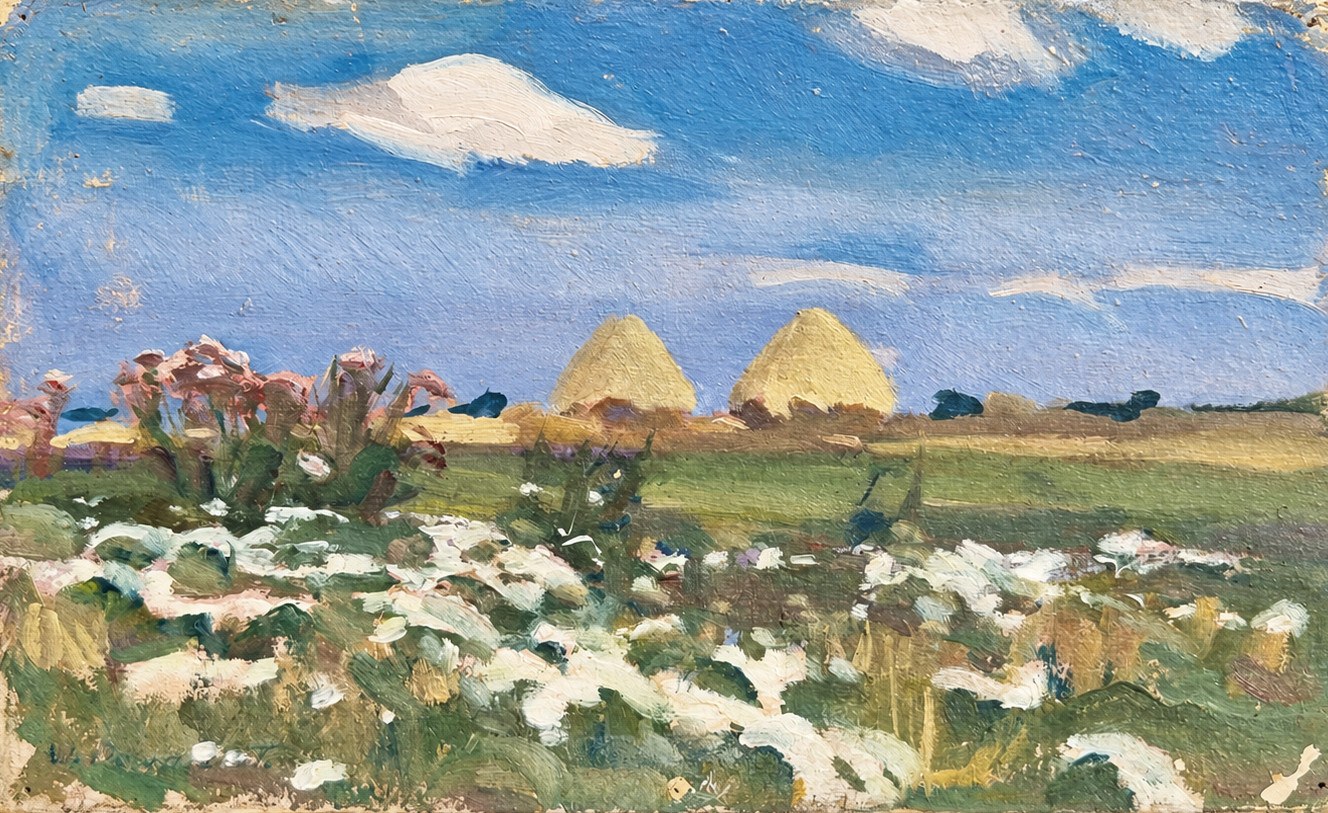
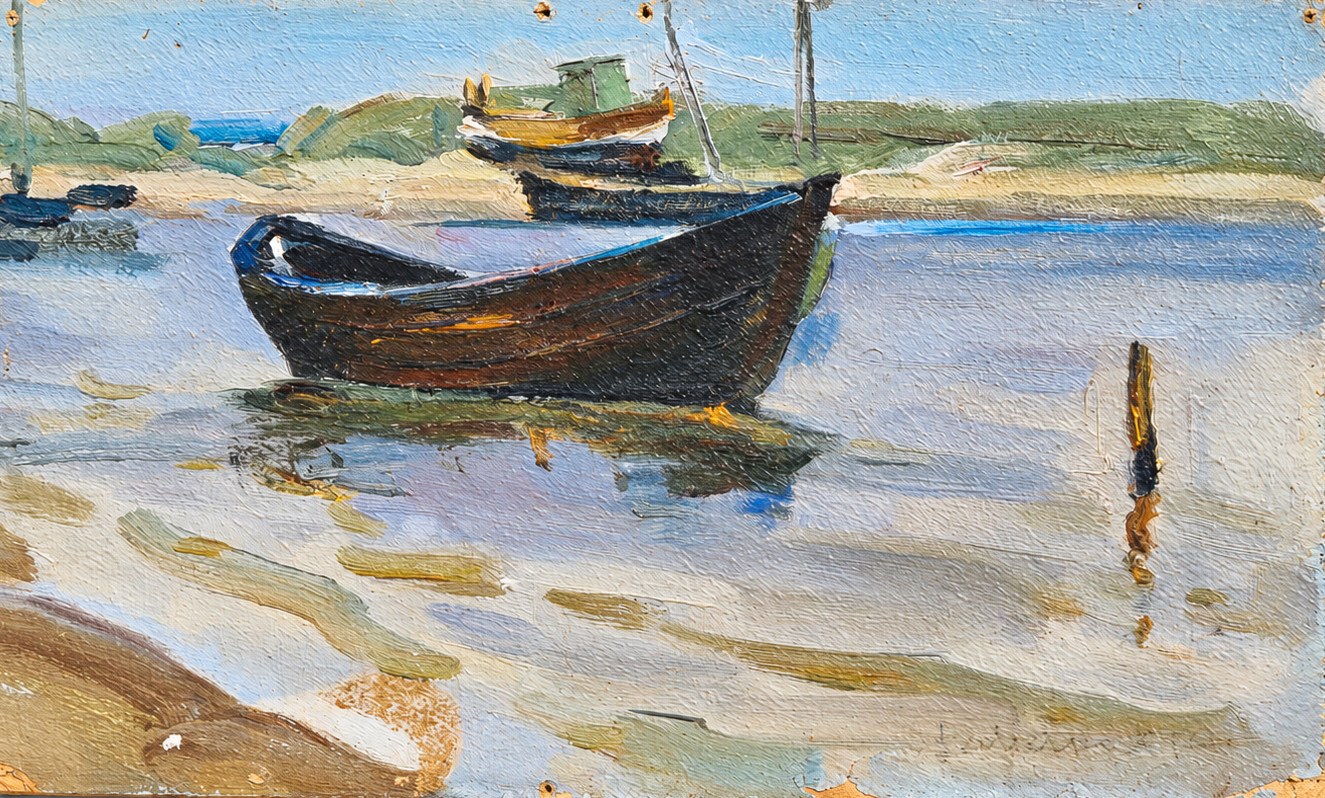
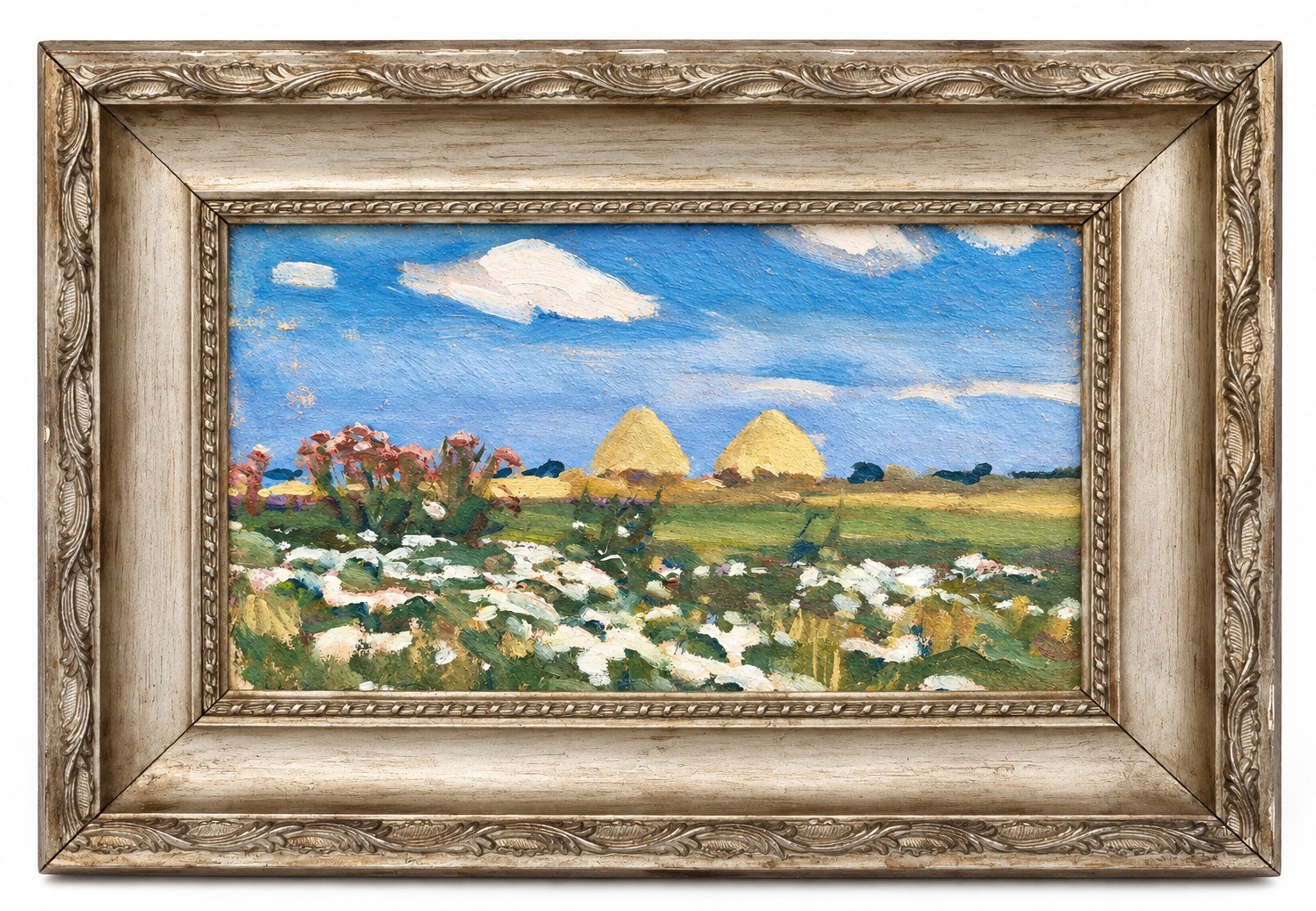
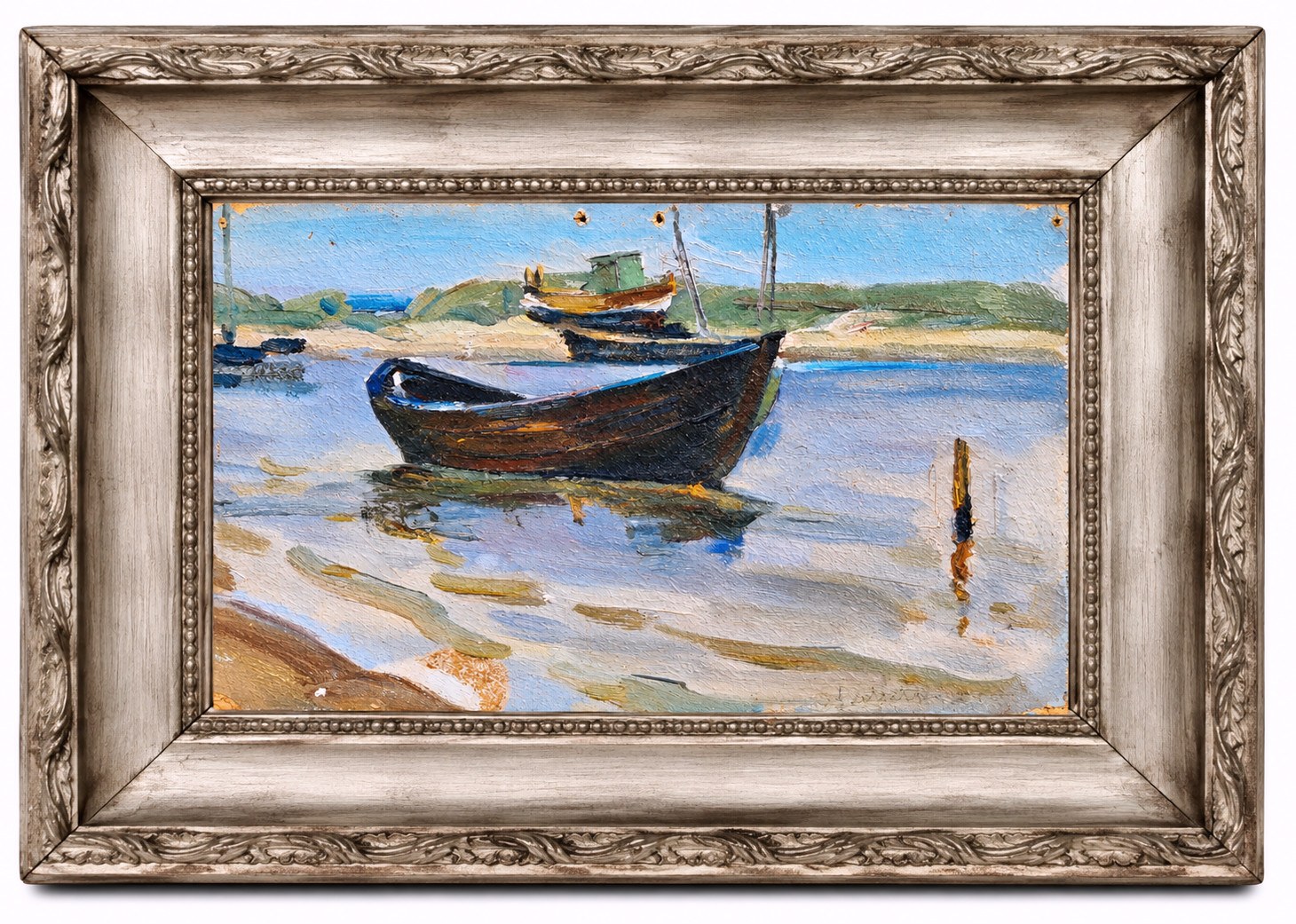
Double-sided work, oil on cardboard, signed:
1. On the front: "W. Dawidowski"
2. On the reverse: "J. Makowski"
Dimensions with frame: 29x40 cm (artwork: 16x27 cm)
Wacław Dawidowski (Pobojewo near Minsk, 1882 – 1962, Sopot) – Polish painter and educator. After graduating from the secondary school in Białystok, he studied at the Faculty of Commerce at the Riga Polytechnic starting in 1904, but dropped out of his studies in Riga after a year. He left for Moscow, where he studied at the School of Fine Arts and took lessons in Piotr Kielin’s studio. After completing his studies, he returned to Vilnius, where he became an art teacher; from 1924 to 1945, he taught at the Vilnius State Technical School. In his spare time, he created art; in 1924, during the Arts and Crafts Exhibition in Vilnius, he received the Grand Silver Medal. During his repatriation, he ended up in Gdańsk, where he became a lecturer at the State Institute of Fine Arts.
Józef Makowski (Toruń 1914–1997) was a sculptor, painter, printmaker, and soldier in the Home Army. From 1936 to 1939, he studied under Prof. Breyer at the Sculpture Department of the Academy of Fine Arts in Warsaw. Makowski took part in the September 1939 War. He fought in the Warsaw Uprising, where he was seriously wounded. After the fall of the uprising, he was transported to the camp in Gross Lűbors and then to a hospital in Altergrabow. After recovering, he was imprisoned in a prisoner-of-war camp in Sandbostel. It was in this camp that he created his first portraits; there he met K. I. Gałczyński, R. Bratny, and J. Dobraczyński. His friendship with Gałczyński resulted in several portraits that Makowski painted of him. After the war ended, he came to Bydgoszcz upon learning that the organizers of an exhibition marking the city’s 600th anniversary were seeking an artist to design the industrial exhibition. A remnant of this work is a corner with a brick gate in Kazimierz Wielki Park. He then served as the artistic director of a stonemasonry workshop, after which he worked at the Construction Ceramics Plant in Fordon. In 1947, he was hired as an announcer at Polish Radio. He dedicated his artistic career to Bydgoszcz, for which he created many sculptures. He worked in many fields of art: medal making, metalwork, painting, and interior design. Among his most important works are his monumental and commemorative sculptures (including the Fryderyk Chopin monument and the Ignacy Paderewski monument in front of the main entrance to the Pomeranian Philharmonic in Bydgoszcz). Other well-known works include: the monument in the Valley of Death in Fordon and the fountain in Kazimierz the Great Park. He also created: the so-called “Broken Rose”—a sculpture symbolizing the massacre of Bydgoszcz middle school students on September 5, 1939, the Monument to the Aviators of the Bydgoszcz Region, an obelisk honoring the residents of the Szwederowo district murdered during World War II, and a monument honoring fallen railroad workers in the square in front of the Railroad Administration building. He was also a regular illustrator and graphic artist for *Gazeta Pomorska*. He participated in over a dozen regional exhibitions in Bydgoszcz as well as in nationwide exhibitions, including those in Radom and Zakopane. The Warsaw-based “Desa” gallery exhibited his metal sculptures in Florence, Italy, in 1968. He participated in the National Open-Air Sculpture Workshop in Biskupin (1972), where he served as curator. In 1994, the BWA in Bydgoszcz hosted an exhibition of his work to mark Józef Makowski’s 80th birthday. His works are held in the collections of: the Ministry of Culture and Art, the City Hall, the Provincial Office in Bydgoszcz, the L. Wyczółkowski Regional Museum, and the Museum of the Pomeranian Military District (now the Museum of Land Forces) in Bydgoszcz. Many of his works are in private collections, including in Bydgoszcz, Poznań, Warsaw, and abroad, notably in Japan, Germany, and Belgium. Józef Makowski was actively involved in civic life, including in the Association of Polish Visual Artists, of which he was a member since 1946. In the Society of Friends of Art, of which he was a co-founder, he served as chairman of the visual arts section. He was a member of the expert committees of the Visual Arts Studio and “Art Region,” as well as the board of the “Plastyka” Cooperative in Warsaw. For his artistic and social activities, he was awarded the Gold Cross of Merit (1976) and also received the following honorary distinctions: Distinguished Cultural Activist (1967), the Millennium of the Polish State, the Bydgoszcz Szeląg (1970), and the Medal of the Mayor of Bydgoszcz (1994).