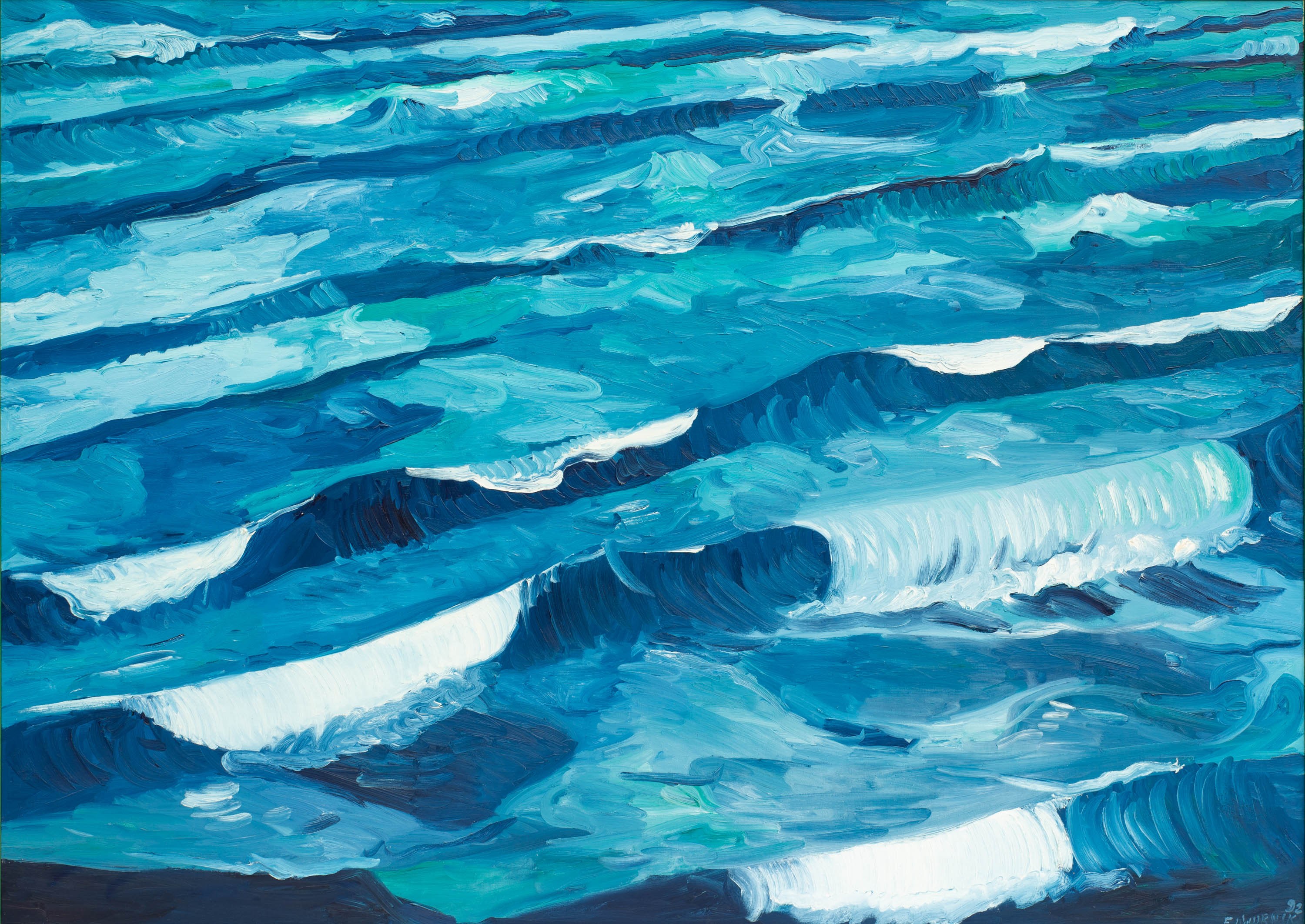

(...) the series of a dozen paintings exhibited at Zderzak, titled "Blue," is a new painting in which subject has replaced content. E. Dwurnik, in fact, paints images of the sea. On the large canvases, the oily brushstroke leaves the color of blue, azure, bluish, steel, gray, white sapphire, black, green. There is no shore, no beaches and people, no clouds, no ships, no birds. Only the depth of color, the rhythm of the waves and the mysterious power of the element....
"In fact, there are few painters who can paint the sea well. They usually save themselves by adding the sky, the shore, action on the sea, fish. But the very stillness that lasts, the element itself, is the most difficult to paint. That water that changes according to the sky. Each person has his own image of the sea. That's why I can paint different versions, visions, color arrangements. And that's why I paint a lot of green paintings now, but they are still stuck in blue thinking."
"Men like blue" excerpts from a conversation between Katarzyna Bik and Edward Dwurnik and Teresa Gierzyńska, "Gazeta Wybiórcza," NR 154 (1233), 1993
EXHIBITED:
- 1993 "Edward Dwurnik. Blue / Blue", Zderzak Gallery, Cracow.
- 1993 "Edward Dwurnik. Blue / Blue", Upper Silesian Museum, Bytom.
Studied at the Warsaw Academy of Fine Arts in 1963-70. During his studies, starting in 1965, he began the series Hitchhiking Journeys, in which he portrayed cities and towns from the perspective of a "bird's flight", in the field of interest of the artist, in addition to architecture, was the life and customs of the inhabitants. In 1972-78, the series Sportsmen is created, in which he depicts marginal people, sly people, smokers of the then cheapest "Sport" brand cigarettes. Paintings from the series Warsaw (1981), prophetically anticipated the introduction of martial law in Poland. In the series Road to the East (1989 - 1991), he commemorated the victims of Stalinist communism, and in the series From December to June (1990 - 1994), he paid tribute to the victims of martial law in Poland. In the series Long Live War! created under the impression of wars in the Caucasus and the Balkans, the artist sends a message - a warning. The author of more than 3,000 paintings accompanying our life for several decades, constituting a peculiar, unique , artistically captured chronicle of life, custom, material and spiritual record of our culture.