


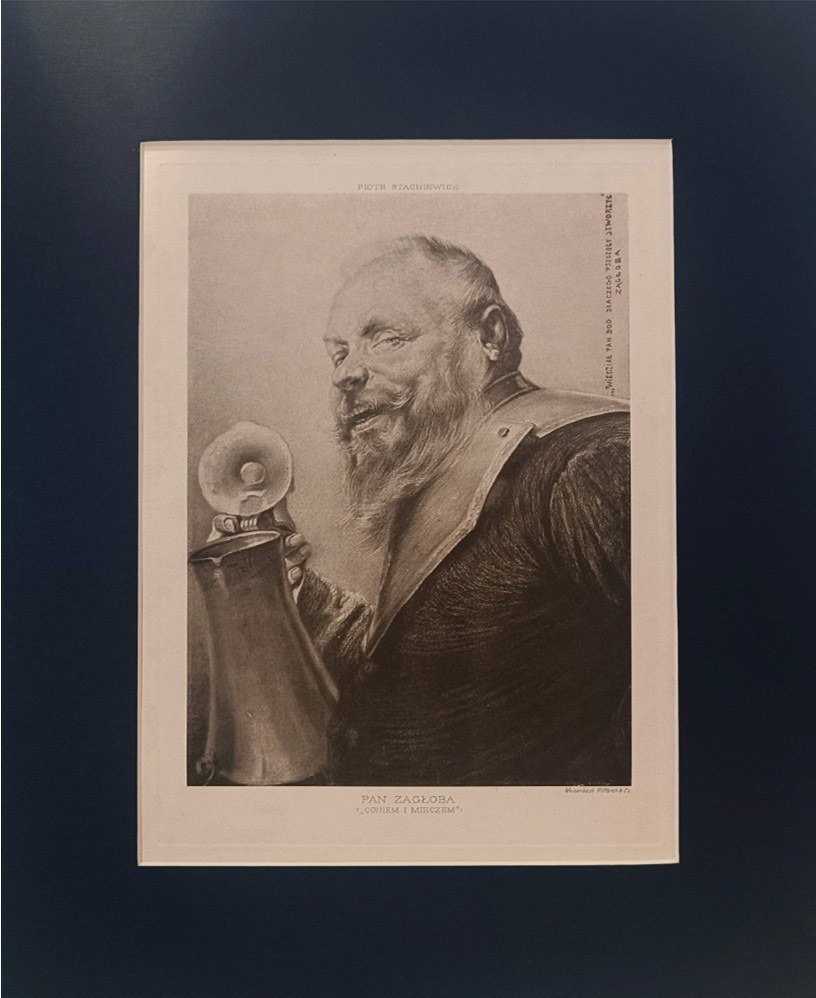
Heliogravure (plate imprint visible), 25 x 19 cm, in light passe-partout;
Author's inscription on the plate p.g. " WIEKANIE PAN BÓG DLACZEGO PSZZCZOOZYÆ ZAGŁOBA".
Beneath the composition, the signature of the artistic lithography workshop " Meisenbach Riffarth & Co".
Piotr Stachiewicz (born October 29, 1858 in Nowosiółki Gościnne, died April 14, 1938 in Cracow) - Polish painter and illustrator. In 1877-1883 he studied at the School of Fine Arts in Cracow under Jan Matejko, Władysław Łuszczkiewicz and Florian Cynk. He continued his studies in 1882-1885 in Munich.Since 1885 he lived in Cracow, and created religious, historical, genre paintings and portraits. In particular, he is known for his portraits of a woman in a Krakow outfit, for which he was posed by "Beautiful Zośka" - Zofia Paluchowa. Stachiewicz is the author of the mosaic decoration of the church of the OO Jesuits. His popularity brought him, among others, a series of paintings "Queen of Heaven. Legends of the Virgin Mary" from 1893, from which he also made prints, later sold in large quantities[4]. From 1889 he was a member of the Society of Friends of Fine Arts, serving as its vice-president from 1900-1913. In 1912-1918, he taught at the Adrian Baraniecki Higher Courses for Women (at the same time he was head and supervisor of the art department).
His favorite subject of his paintings was the Blessed Virgin Mary with the Infant Jesus, scenes from the life of the people of Cracow and the persecution of ancient Christians, hence he created illustrations for the novel Quo vadis by Henryk Sienkiewicz,[6] as well as for poetry by Adam Mickiewicz and Maria Konopnicka and illustrations for advertisements. In 1892 he painted the painting "Death of a Miner" honored with the Probus Barczewski Prize of the Academy of Arts and Sciences. In 1893-1895, a series of twelve paintings by his brush illustrating the Wieliczka mine and the work of the miners there, now lost, was created. He initiated the creation of the Cracow biweekly magazine "World", and together with Włodzimierz Tetmajer published an album of color reproductions in 1931. Before 1923, he was honorary president of the Association of Polish Artists in Cracow.
Georg Meisenbach was a German engraver and inventor of the autotype. In 1883 Meisenbach & Co. merged with Heinrich Riffarth & Co. and founded Meisenbach Riffarth & Company, a well-known European graphic arts company.
Heliogravure (gr.helio + gravure) - a type of graphic intaglio printing technique, similar to aquatint, involving the photographic transfer of an image onto a metal plate (usually copper) and etching with photosensitive emulsion so that the brightest areas create the shallowest recesses. Invented in 1879.Printing is done in a special hand press. Heliogravure, which was widespread in the 19th century, was later supplanted by rotogravure, as heliogravure is an expensive and very time-consuming method. Heliogravure is used only when it is necessary to create a small number of copies of very high quality.










最近瀏覽過的
登錄以查看拍品列表
收藏
登錄以查看拍品列表