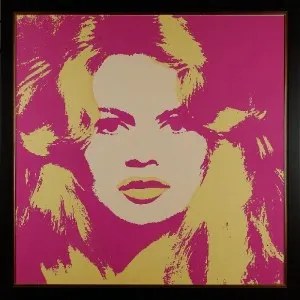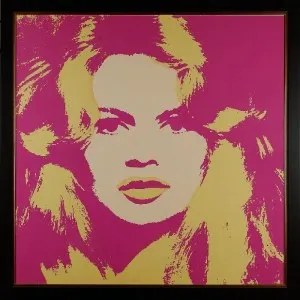
Silkscreen print, very heavyweight paper, dimensions: 100 x 100 cm (framed).
On the reverse, a navy blue stamp used exclusively by “Sunday B Morning.”
Produced by “Sunday B Morning,” a company founded in Belgium by Warhol’s friends to produce and publish his works. The original technique is called “silk screen,” which is also known as screen printing or serigraphy.
Andy Warhol, known for his portraits of pop culture icons, also created works depicting Brigitte Bardot, one of the most famous French actresses. Her roles in films such as “And God Created Woman” (1956) made her a sex symbol of the 1950s and 1960s. Her charm, charisma, and status as a sex symbol were qualities that the artist valued and sought to immortalize. The portrait of Bardot, created in 1974, is another example of the artist’s fascination with movie stars and their images.
The 1974 portrait of Bardot is based on a black-and-white photograph by Richard Avedon from 1959. Warhol simplified this image by focusing on the actress’s face and adding intense colors and contrasts, which give her image a modern and stylized character. As with other icons such as Marilyn Monroe, Elizabeth Taylor, and Ingrid Bergman, Warhol transformed Bardot’s image into something more than just a portrait of the actress. Using vivid colors and the silkscreen technique, he created works that capture her iconic status and enduring presence in popular culture.
Pop art, the artistic movement of which Warhol was a leading figure, focused on mass culture and its icons. Hollywood and the world of film were a natural source of inspiration for pop artists. Portraits of movie stars, such as Brigitte Bardot, became symbols of this movement.