


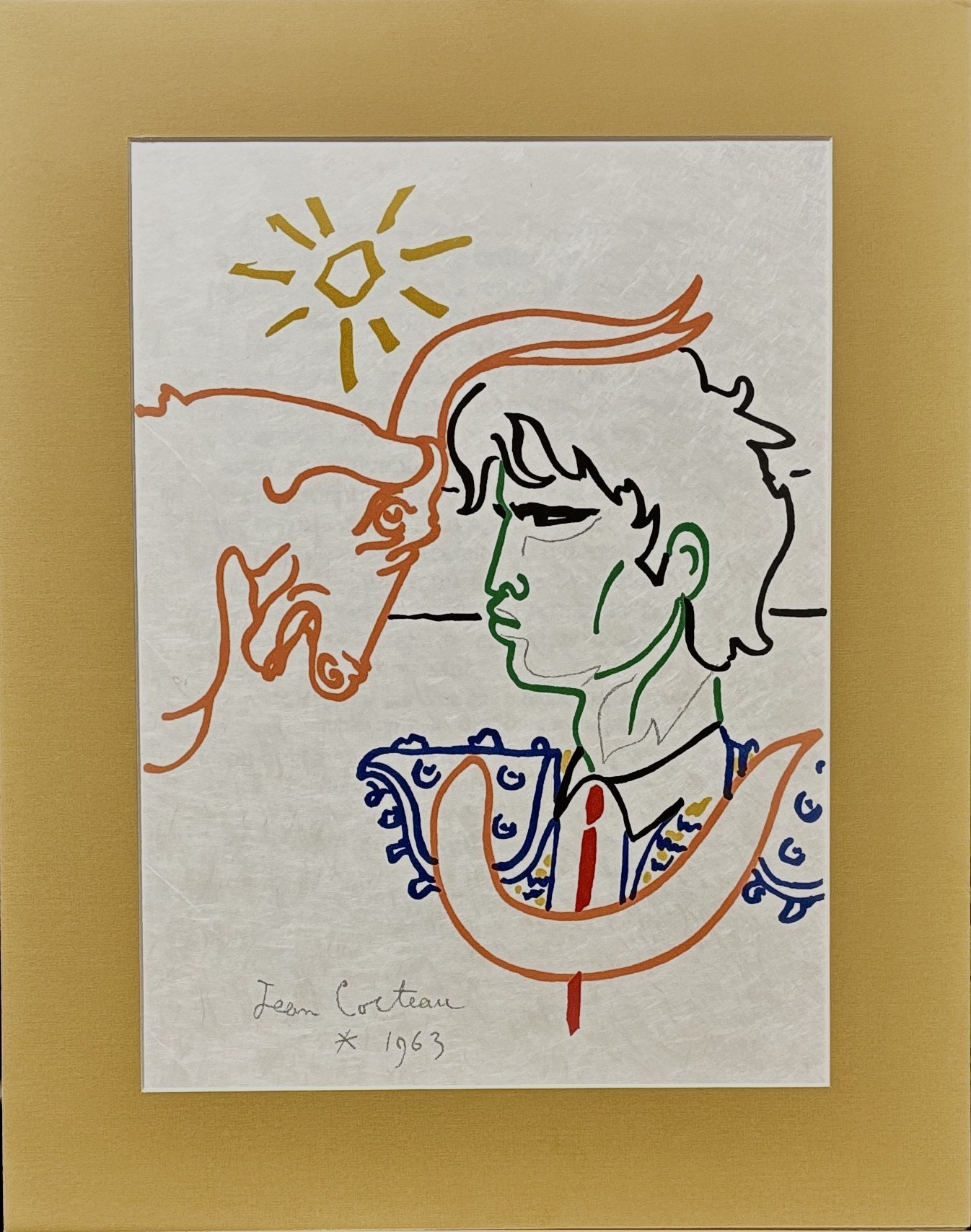
Color lithograph on Japanese paper (Japon nakre), dimensions: 37 x 27 cm (inside the mat), 48 x 38 cm in a passe-partout frame, signed and dated on the plate, unnumbered, limited edition of 200 pieces, including 32 on Japanese paper. The publisher of the 1965 series “Taureaux. Lithographies de Jean Cocteau” from 1965 was the Paris-based publisher Éditions Michèle Trinckvel; the lithographs were produced at the Atelier Mourlot Frères in Paris.
Jean Cocteau is one of the most highly regarded and influential artists of the 20th century. His significance, however, does not stem from a single, specific field, but from his extraordinary versatility and his role as a “Renaissance man” of the French avant-garde.
Cocteau was a total artist (artiste complet)—a poet, writer, playwright, film director, screenwriter, illustrator, painter, sculptor, and designer. He was considered one of the most important French poets of the 20th century, and he regarded his works primarily as poetry. As an illustrator and graphic artist, he developed a unique, fluid, and minimalist style based on the line (the so-called “Cocteau line”), which is instantly recognizable; he used it in ceramics, lithographs (such as in the *Taureaux* series), and even in mural decorations (e.g., in the Saint-Pierre Chapel in Villefranche-sur-Mer).
He said of himself: “I am a lie that always tells the truth.”
“Taureaux” is a series of lithographs, published as an album (folio) titled *Taureaux*. Lithographies de Jean Cocteau in 1965. It is one of the last artist’s books (a so-called livre d’artiste) on which Cocteau worked; it was completed shortly before his death in October 1963.
The series is dedicated to bullfighting, which was a passion of Cocteau’s, as it was for many other artists in his circle (such as Picasso). The works often depict bulls, bullfighters, and scenes from the arena. Although the subject matter is a real-life spectacle, Cocteau enriches it with poetic and symbolic elements, often interweaving images of people and animals in a manner typical of Surrealism and his own unique sensibility. The artist’s characteristic profile portraits frequently appear in these works.
The “Taureaux” series is a tribute to tradition. For him, bullfighting was not merely a sport or a form of entertainment, but a symbolic spectacle of life, death, beauty, and courage.
Cocteau’s works are held in the collections of the world’s most important museums (e.g., MoMA in New York, the Centre Pompidou in Paris). He received numerous awards during his lifetime—in 1955, he was elected to the French Academy (Académie française) and was a Commander of the Legion of Honor.
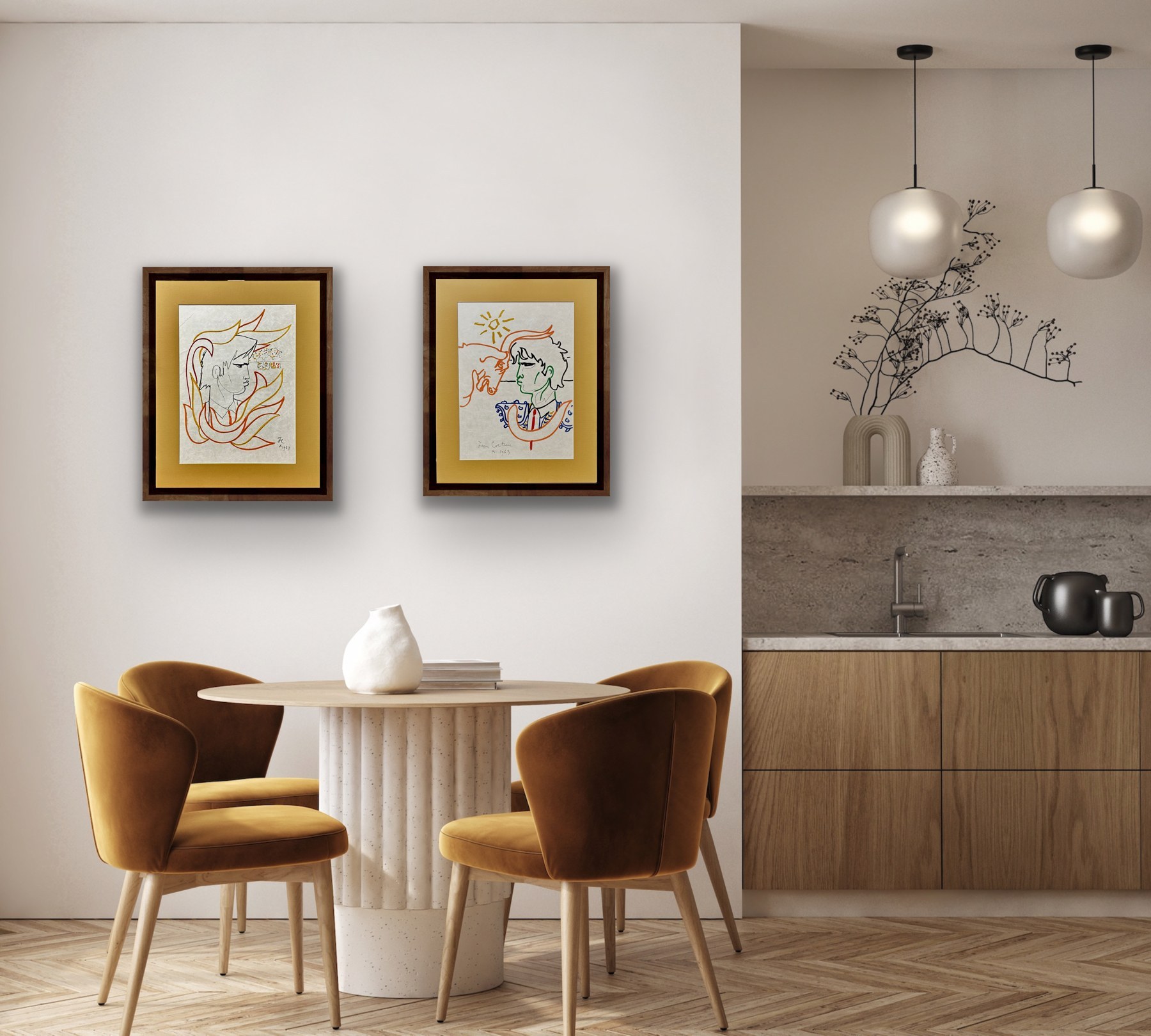
The framing shown in the renderings is for illustrative purposes only and does not constitute a commercial offer.








最近瀏覽過的
登錄以查看拍品列表
收藏
登錄以查看拍品列表