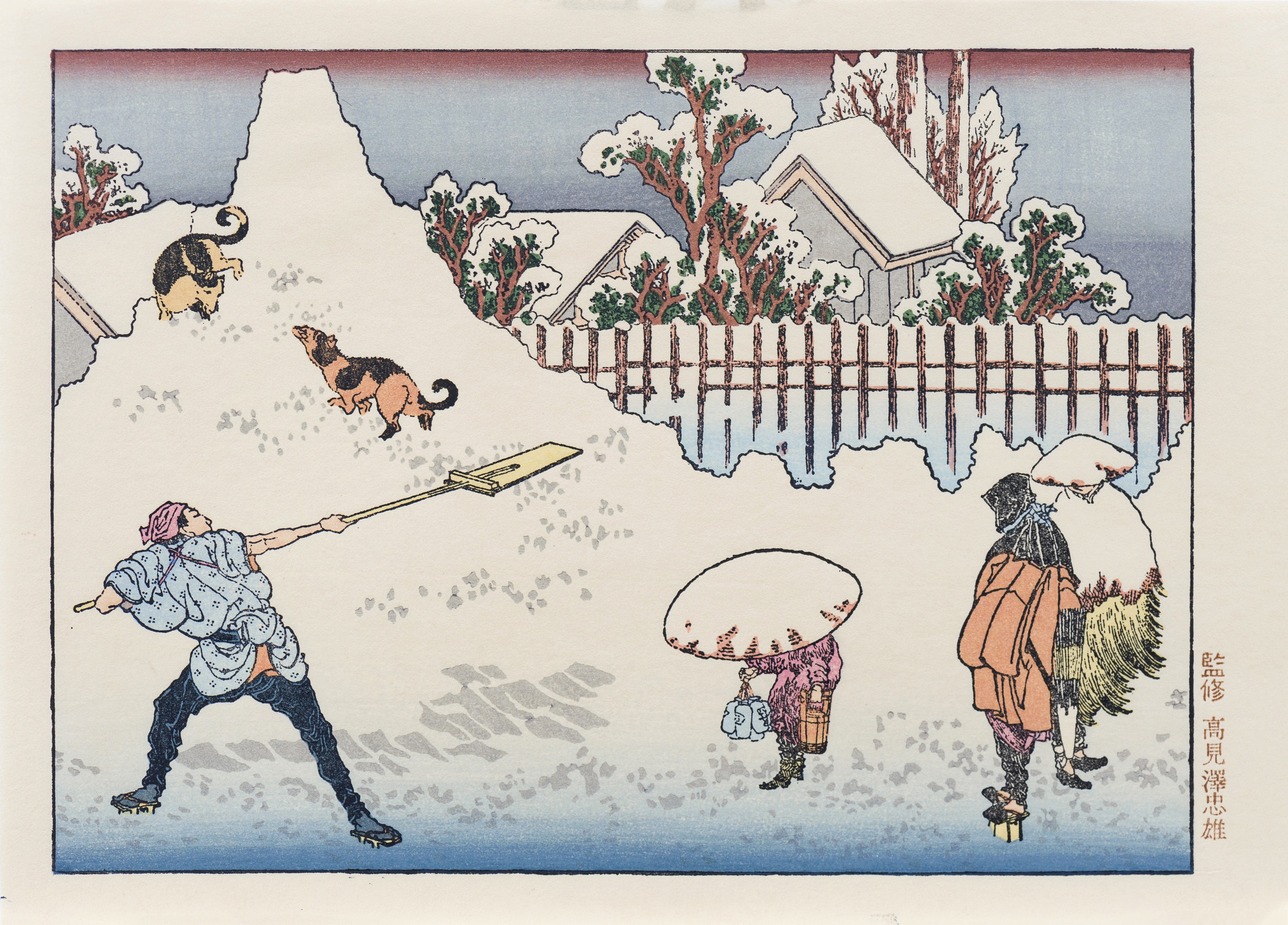
color woodcut, ink, paper, 22x30 cm, artist's signature, publisher's mark in margin
An interesting winter scene depicting a man clearing snow from a street after a heavy snowfall. Two dogs are playing in a large snowdrift, and passersby stop to watch. It is noteworthy that the snowdrift's conical shape refers to Mount Fuji. Hokusai has vividly and realistically depicted the activities performed by ordinary people.
The woodcut isfrom the series "Anthology of Famous Hokusai Paintings of Takamizawa Publishing House." Takamizawa Publishing House and Woodcut Society is a Tokyo-based renowned company, active from 1933-88, founded by brothers Masuro and Tadao Takamizawa. From the mid-1950s, it published a series of 49 reprints of Hokusai's prints. The series focused on unusual, less common designs. They ranged from scenes of nature and beauty to outstanding works in the "100 Views of Mount Fuji" series. Printed with attention to detail and exceptional quality, this rare series is extremely visually appealing. Takamizawa adhered to the same rigorous standards that 19th century publishers had. Some of Japan's finest printers and sculptors were employed. The resulting works are among the highest quality editions ever created.
Hokusai Katsushika, mostly known by the name Hokusai (born October 31, 1760 in Edo (now Tokyo), died May 10, 1849 there) - one of Japan's most prominent and prolific painters and creators of color woodcuts in the ukiyo-e style. The name Katsushika Hokusai is known worldwide, but it was a pseudonym that the artist used instead of his real name, which was Kawamura Tetsuzo. When signing works, he used many (at least thirty) pseudonyms, including Shunrō, Sōri, Taito, Manji. Although it is unclear why he changed his name, some researchers believe it was to test his talent and increase sales. From an early age, Hokusai had a passion for drawing. He studied at the studio of Katsukawa Shunsho. He became known as an extremely prolific artist, a great draughtsman, landscape artist, illustrator and caricaturist. In his paintings, usually populated with a multitude of figures, he recreated Japan of the time. Among other things, he painted flowers, turtles, pheasants, roosters, one hundred poems, bridges and cascades. Persuaded by his students, he published 15 volumes of sketches and drawings entitled Manga (1814). His works had a profound influence on European Impressionists such as Claude Monet and others. His best-known work is a series of ukiyo-e woodcuts, "Thirty Views of Mount Fuji," which was created between 1826 and 1833 during the Taito period. In addition to paintings and drawings, he created illustrations for more than 500 books, some of which he wrote himself.