


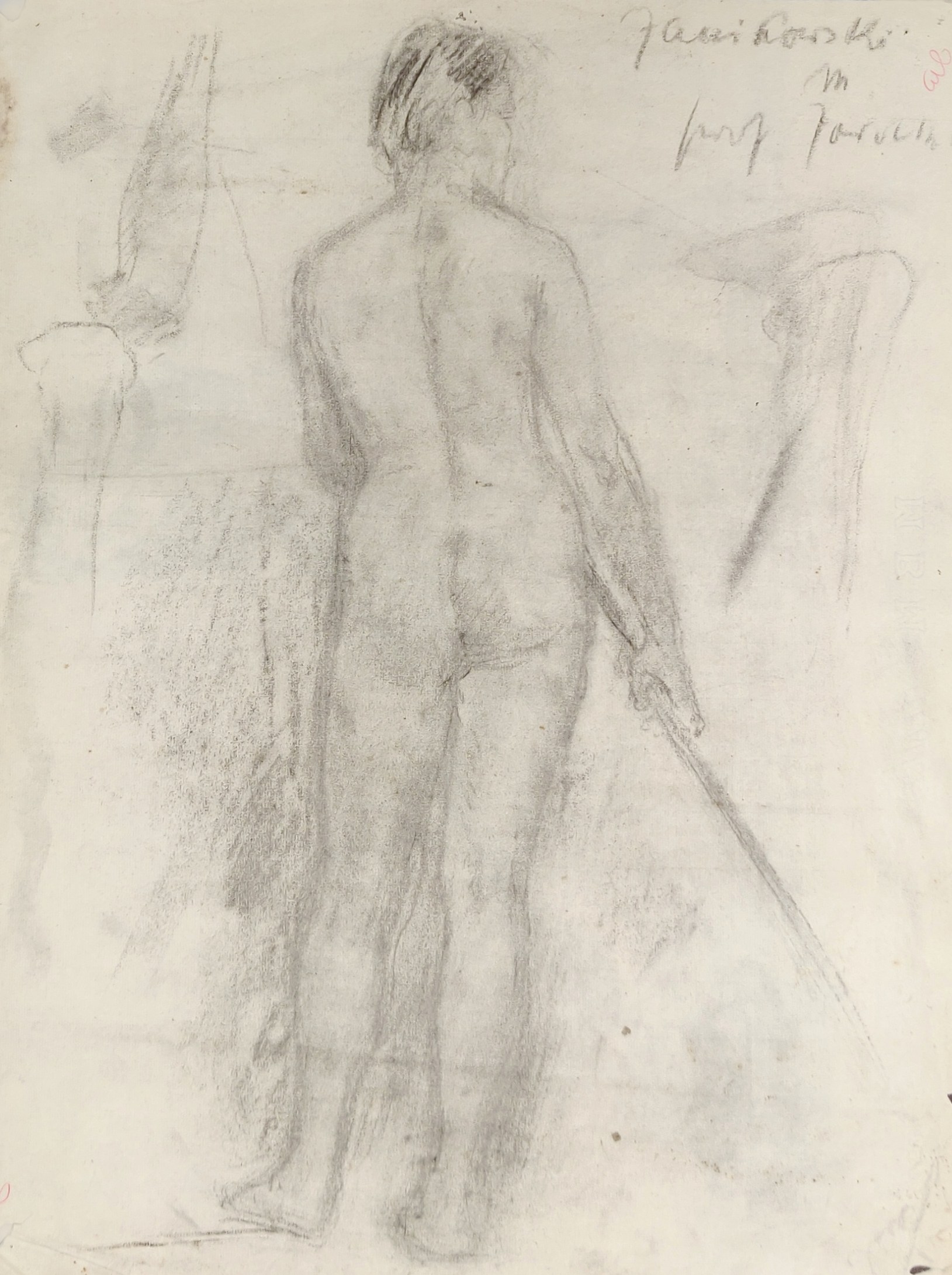
Tadeusz Kantor (1915–1990)
Nude, 1930s
charcoal on paper, 47.5 x 62 cm
signed lower right: Kantor
Condition: losses on the sides
On the reverse, a drawing by Mieczysław Janikowski from Prof. Jarocki’s studio.
The collection of the Academy of Fine Arts Museum in Kraków includes a similar student work by T. Kantor
He studied at the Academy of Fine Arts in Kraków from 1934 to 1939 under the guidance of K. Frycz. During the occupation, he founded an underground theater around which Kraków’s artistic life revolved. After the war, this theater, under the name Cricot 2, continued the traditions of the Cricot artists’ theater founded by Józef Jarema. He co-founded the Group of Young Artists in 1945, and later the Second Kraków Group in 1957. He was a co-organizer of the First Exhibition of Modern Art in Kraków in 1948. He practiced painting, worked as a theater director and set designer, and was the creator and organizer of Poland’s first happenings; he authored artistic manifestos and was open to exploring the global artistic avant-garde, being the first to creatively adapt and assimilate its achievements. His paintings were initially figurative in style, later becoming metaphorical with a restrained color palette, and in the second half of the 1950s, they followed the Informel movement. In the following years, he presented the “Popular Exhibition” at the Krzysztofory Gallery in Kraków—a collection of hundreds of objects, documents, and drawings used as environmental elements, some of which were his own creations. He created assemblages and ambalages from these objects. In the 1970s and 1980s, his painterly compositions (cycles) were closely linked to his theatrical work—notably the series *Umarła klasa* (*The Dead Class*), titled after a play. He returned to painting toward the end of his life, creating compositions featuring a solitary, prominent figure captured in a gestural pose. An outstanding artist, he is regarded by international critics as one of the co-creators of 20th-century art.











