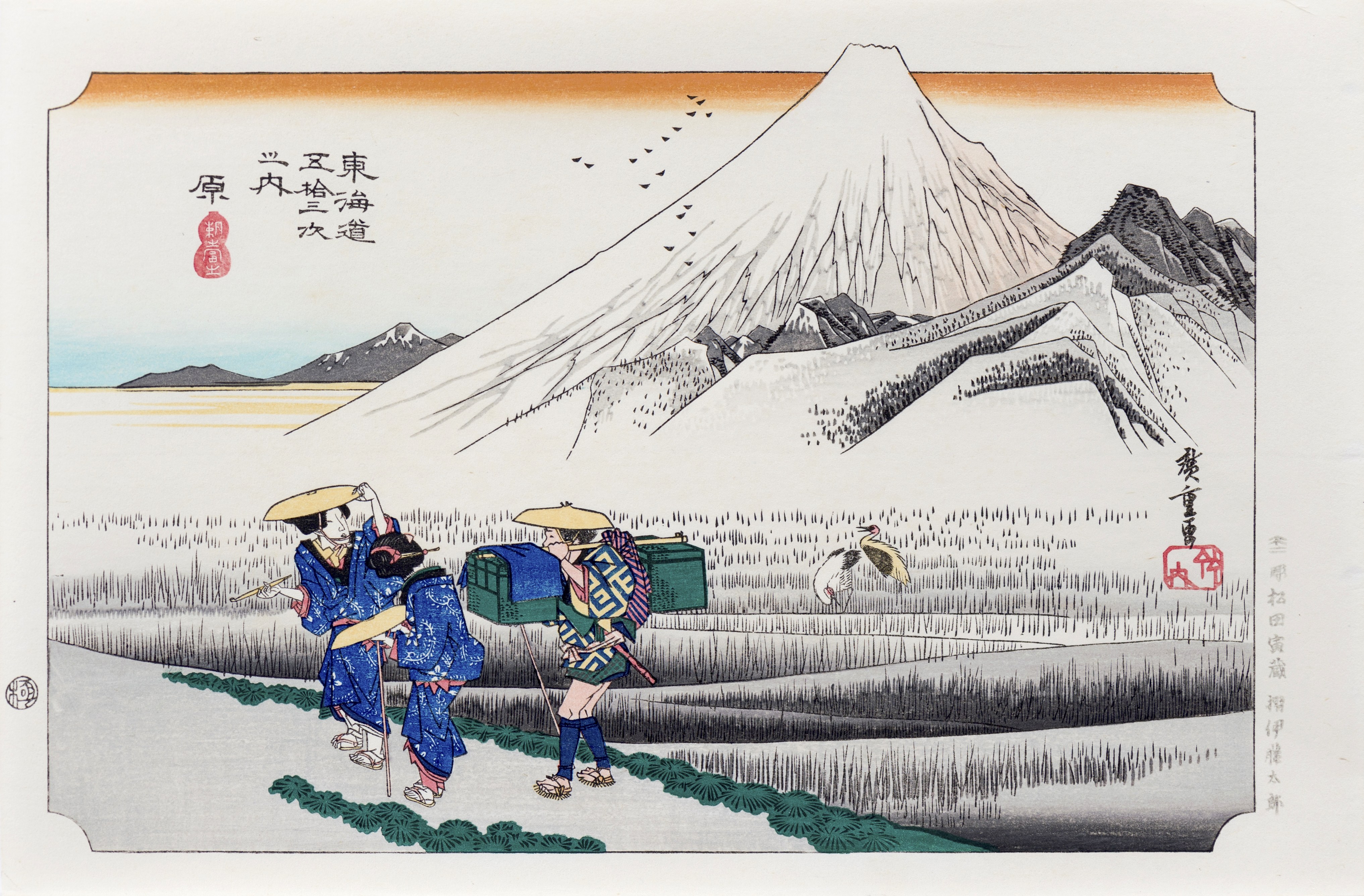
Color woodcut, paper, 23x34 cm, artist's signature, publisher's and sculptor's and printer's markings in the margin
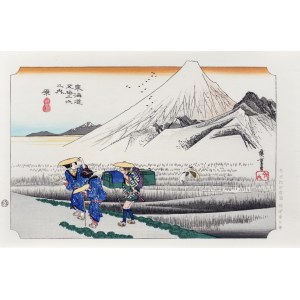
The view of Mount Fuji from a place called Hara (literally "field") is virtually unobstructed. The majestic height of the mountain is emphasized by the peak protruding beyond the frame of the woodcut. The group of travelers in the foreground appear to be impressed by the breathtaking view. This design is extremely popular precisely because of the unique and dynamic way in which Mount Fuji is depicted - its peak protrudes out of the frame, emphasizing the magnificence of its shape. As the subtitle ("Fuji in the Morning") indicates, this is a scene from early in the day, when the eastern side of Mount Fuji is brightened by the glare of the morning sun. A nice touch to this tranquil atmosphere are two cranes standing in a field.
Fifty-three Stations on the Tōkaidō Road is a series of 55 woodcuts depicting 53 postal stations (shukuba) and two important points on the road: the starting place that is the Nihonbashi Bridge in Edo and the final great Sanjo Bridge in Kyoto. The road stretched for more than 500 kilometers, connecting the shogunate capital with the old imperial capital. Fifty-three stations included stops for horses and porters, lodgings, restaurants and geisha houses for travelers who, weather permitting, could cover this distance on foot in two weeks. Among these travelers were feudals (daimyō), who were required to stay at the shogun's court every two years and travel back and forth in huge processions.
In 1832, Hiroshige traveled with an entourage of shogun officials from Edo (Tokyo) to Kyoto along the Tokaido Road. The trip was an eye-opening and life-changing experience for him. After the trip, he returned to Edo and began work on a series of woodcuts based on sketches he had made. Published between 1833 and 1834, the series "Fifty-Three Stations of Tokaido" (Hoeido Tokaido) brought Hiroshige great acclaim from critics and the public alike. He skillfully captured moody and atmospheric weather conditions, rendering fog, rain, snow and evening light effects. He balanced the poetic landscapes with the addition of characters, which are a personal element of these works. The series offers viewers the opportunity to travel back in time to Hiroshige Japan in the shadow of the Tokugawa Shogunate and see this life as the artist experienced it. The series became so popular that its constant reissues during the Edo period resulted in the complete destruction of the first edition's matrices.
The ukiyo-e woodcuts have been printed several times since the Edo period, always using the traditional method. From the beginning of the 20th century, YuyudoPublishing House distinguished itself as one of the best publishers in Japan. It adhered to the same rigorous standards as the publishers of the 19th century, while some of their colleagues took shortcuts. In the 1950s, as interest in Edo era woodcuts resurged, Yuyudo embarked on a project to reissue prints by great masters from the golden age of Ukiyo-e. To do so, they hired the best printmakers and carvers in the world. The resulting works are among the highest quality editions ever produced. Yuyudo's woodcuts are exceptionally well executed and very carefully designed. Most of the works of the series have the original publisher's folders with the series title stamped on them. The publisher ceased to exist and publish in the 1980s.
Hiroshige Utagawa, also known as Hiroshige Andō, is one of Japan's best-known painters and printmakers. His father, Andō Genuemon, was a low-ranking samurai and fire brigade officer. From the age of sixteen, Hiroshige studied in the studio of Utagawa Toyohira, under whose tutelage he developed his skills and talent. Young Hiroshige soaked up the artistic atmosphere while helping in the daily life of his father's brigade. It wasn't until he was 27 that he fully decided to follow the path of artistic creation. After his teacher's death in 1822, he was offered to take over the studio after his master, but Hiroshige declined the offer and set his sights on independence. Hiroshige's artistic output has not been fully catalogued to this day, but it is estimated that some 5,000 works were created, primarily in the color woodcut technique. He began his career with portraits of beautiful women (bijin-ga) and images of kabuki actors (yakusha-e), but after the death of his teacher he focused primarily on native landscapes. Hiroshige came from a samurai family, however, he identified with Edo's bourgeois culture. He became primarily known as the creator of landscape series such as Fifty-three Stations on the Tōkaidō Road (Tōkaidō gojūsan tsugi no uchi), One Hundred Views of Famous Places in Edo (Meisho Edo hyakkei) and Sixty-nine Stations on the Kisokaidō Road (Kisokaidō rokujūkyū tsugi no uchi). He masterfully depicted the landscape at different times of the year and day, and was interested in weather phenomena. He experimented with effects and composition and used unconventional shortcuts. A unique element in his works is the depiction of atmospheric phenomena such as snowfall or rainfall, as well as gales and storms. On the other hand, he was interested in the phenomenon of shadow and its effect both in the landscape and domestic interiors.