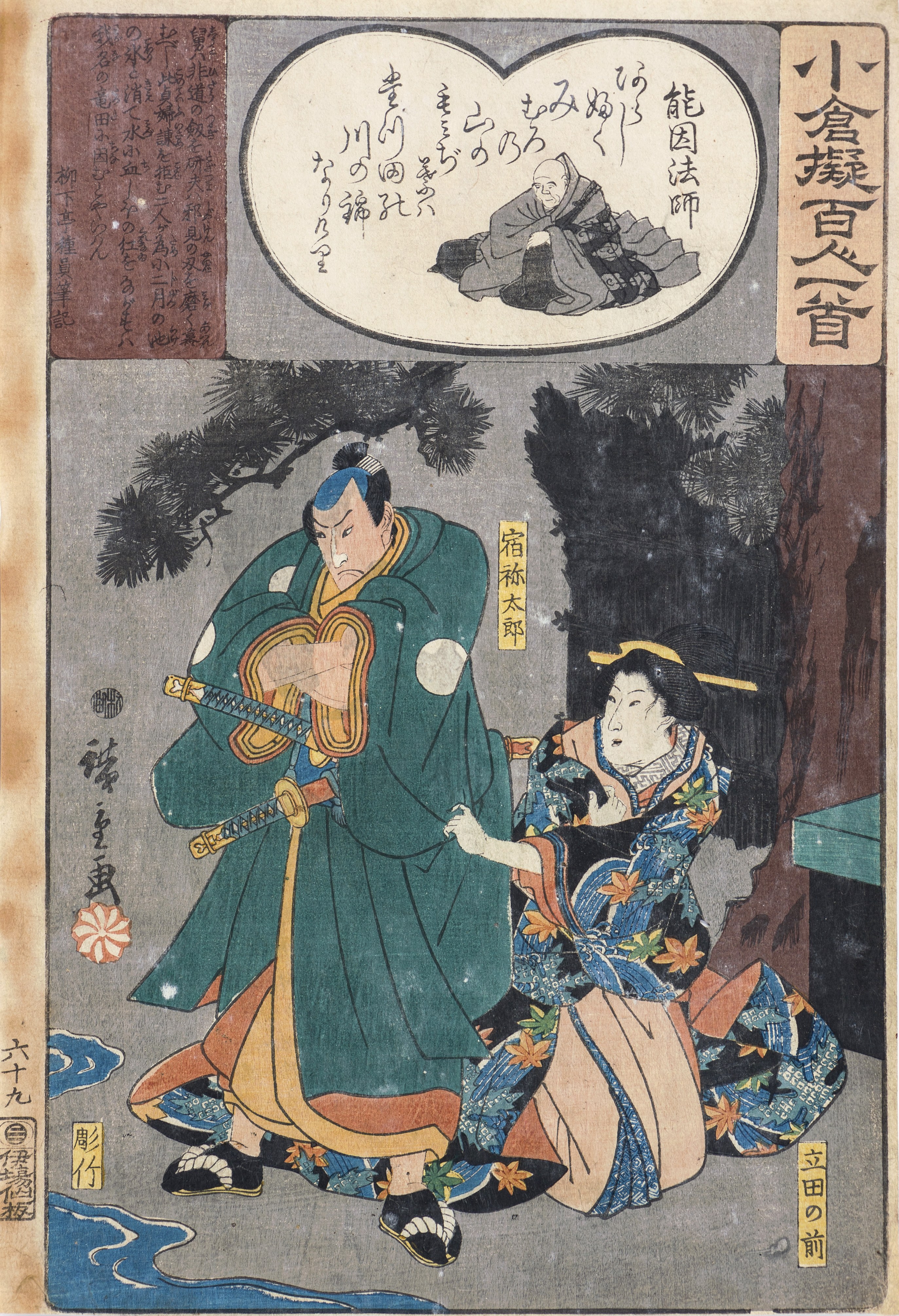
color woodcut, ink, paper, 35x24 cm, author's signature, some rubbing and discoloration of paper
An analogous woodcut is in the collection of the Rijksmuseum in Amsterdam.
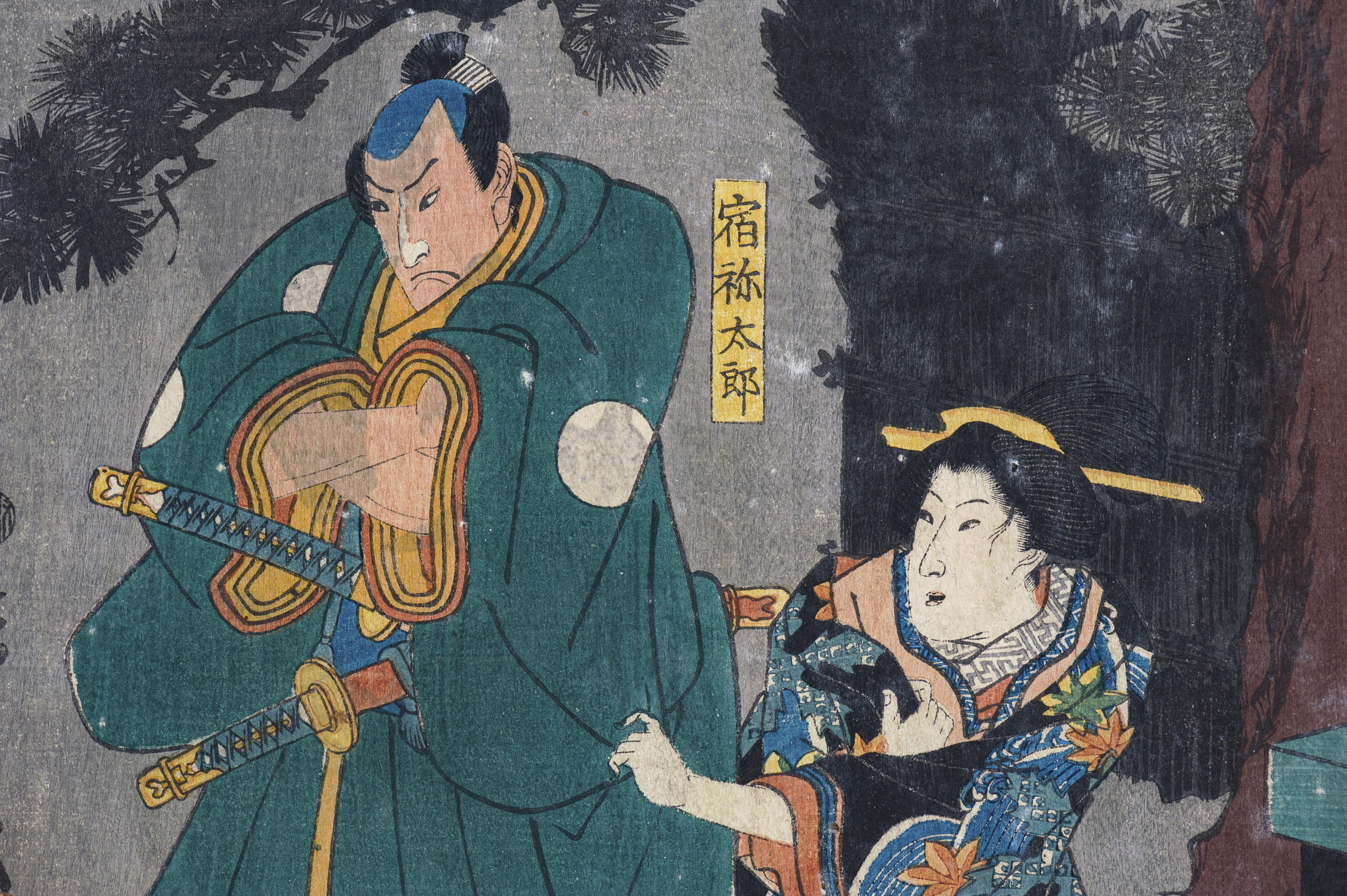
The woodcut depicts a scene from the famous kabuki play "Sugawara Denju Tenarai Kagami." We see samurai Sukune Taro and his wife, the beautiful Tatsuta no Mae, in a garden. He wrinkles his eyebrows in displeasure, keeping his arms tightly crossed over his chest and his legs wide apart, while the beautiful woman gently tugs at his sleeve. A stream flows at the bottom of the frame, and a pine tree dominates the dark night sky in the background. The poem, written by renowned poet Noin Hoshi (monk Noin), reads in free translation:
Torn Maple Leaves
On Mount Mimuro,
Where the wind blows,
Are like woven brocade
Flowing down the Tatsuta River!
Hiroshige Andō, alsoknown as Hiroshige Utagawa, is one of Japan's best-known painters and printmakers. His father, Andō Genuemon, was a low-ranking samurai and fire brigade officer. From the age of sixteen, Hiroshige studied in the studio of Utagawa Toyohira, under whose tutelage he developed his skills and talent. Young Hiroshige soaked up the artistic atmosphere while helping in the daily life of his father's brigade. It wasn't until he was 27 that he fully decided to follow the path of artistic creation. After his teacher's death in 1822, he was offered to take over the studio after his master, but Hiroshige declined the offer and set his sights on independence. Hiroshige's artistic output has not been fully catalogued to this day, but it is estimated that some 5,000 works were created, primarily in the color woodcut technique. He began his career with portraits of beautiful women (bijin-ga) and images of kabuki actors (yakusha-e), but after the death of his teacher he focused primarily on native landscapes. Hiroshige came from a samurai family, however, he identified with Edo's bourgeois culture. He became primarily known as the creator of landscape series such as Fifty-three Stations on the Tōkaidō Road (Tōkaidō gojūsan tsugi no uchi), One Hundred Views of Famous Places in Edo (Meisho Edo hyakkei) and Sixty-nine Stations on the Kisokaidō Road (Kisokaidō rokujūkyū tsugi no uchi). He masterfully depicted the landscape at different times of the year and day, and was interested in weather phenomena. He experimented with effects and composition and used unconventional shortcuts. A unique element in his works is the depiction of atmospheric phenomena such as snowfall or rainfall, as well as gales and storms. On the other hand, he was interested in the phenomenon of shadow and its effect both in the landscape and domestic interiors.




![Andō [Utagawa] Hiroshige, Yoshida. Most na rzece Toyokawa](https://img1.one.bid/img/2784/632833_1w.webp)


![Andō [Utagawa] Hiroshige, Fujikawa. Scena na przedmieściach](https://img1.one.bid/img/2784/632834_1w.webp)