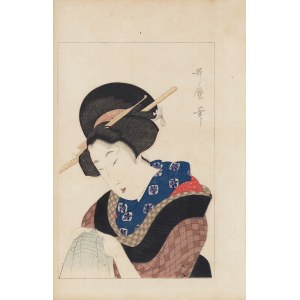
Japanese woodcut, ink, paper, 23x15 cm (paper size), artist's signature
The woodcut is from the magazine Bijutsu-sekai, No. 3, published in Tokyo in 1891 (Meiji 24). An analogous piece is in the collection of the Metropolitan Museum of Art in New York and in the Harvard Library.
In 1890, Seitei WATANABE, began publishing a woodcut magazine, "Bijutsu-sekai" (World of Art), featuring the works of famous artists of the Meiji era and Seitei himself. They were published by the Shun'yōdō publishing house. The series also includes designs by old Edo masters such as Okyo, Utamaro and Hokusai. These designs were transferred to woodblock prints mainly from paintings.
Watanabe Seitei was originally named Yoshikawa Yoshimata. He was born and lived in Tokyo and was also known as Shotei. He came from a family of rice traders and was apprenticed to a pawn shop at the age of 12, but was fired for spending too much time painting. At age 14, without his father's permission, he became an apprentice to Kikuchi Yosai (1788-1878), a popular and successful history painter. At the age of 21, he began using the pseudonym Seitei. Instead of following his teacher and becoming a history painter, Seitei became one of the best and most popular exponents of kacho ga (bird and flower painting). He created three books of woodcuts, "Seitei Kacho Gafu," published in 1890-1891; a single book of Kacho Gafu in 1903 and a series of 22 prints, "Nijuni kacho," in 1916. He wrote several books on painting and published Bijutsu Sekai (Art World) published between 1890 and 1896.
Seitei was a frequent exhibitor and prize-winner at national and international exhibitions. He traveled throughout Europe and America. In 1878, he traveled to the World Exhibition in Paris. He received a bronze medal for his painting "Pigeons at the Sensō-ji Temple in Asakusa" (now in the Freer Collection in Washington). He probably spent two years in Paris, and thanks to his friendship with art dealer Tadamasa Hayashi (1853-1906), who knew French well, he was able to actively participate in the artistic life of the Impressionists. He was spectacularly successful in Parisian circles, and was well known, admired and appreciated. During a dinner with Edgar Degas, they exchanged drawings, but Degas tore up his work, claiming that it could not compare with the beauty of Seitei's work. Seitei's drawing was part of Degas' estate after his death.
After returning to Japan, Seitei began working with Sōsuk Namikawa (1847-1910), an artist working with the technique of cellular enamel decoration - cloisonné. Around 1890, Watanabe Seitei withdrew from public artistic life and did not participate in exhibitions, choosing the life of a hermit, remaining a "secluded" artist.
In 2023, Krakow's Manggha Museum organized the exhibition "Imaginarium of Nature. Watanabe Seitei from the Manggha Museum Collection," the first major exhibition of the artist's works in the West.