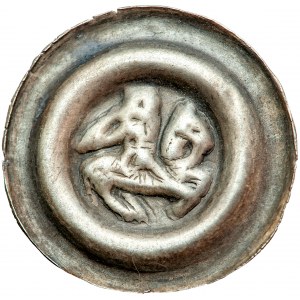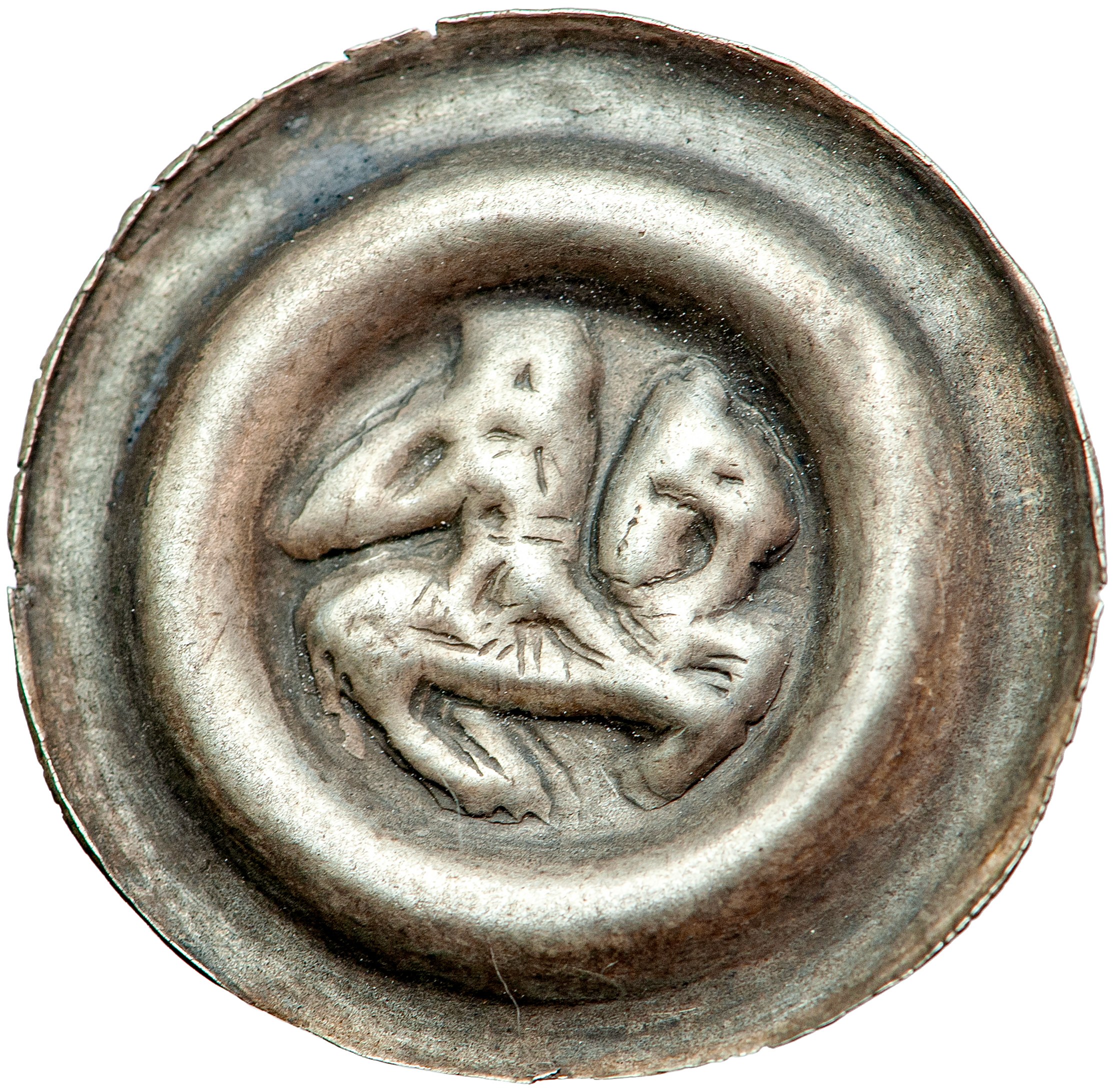
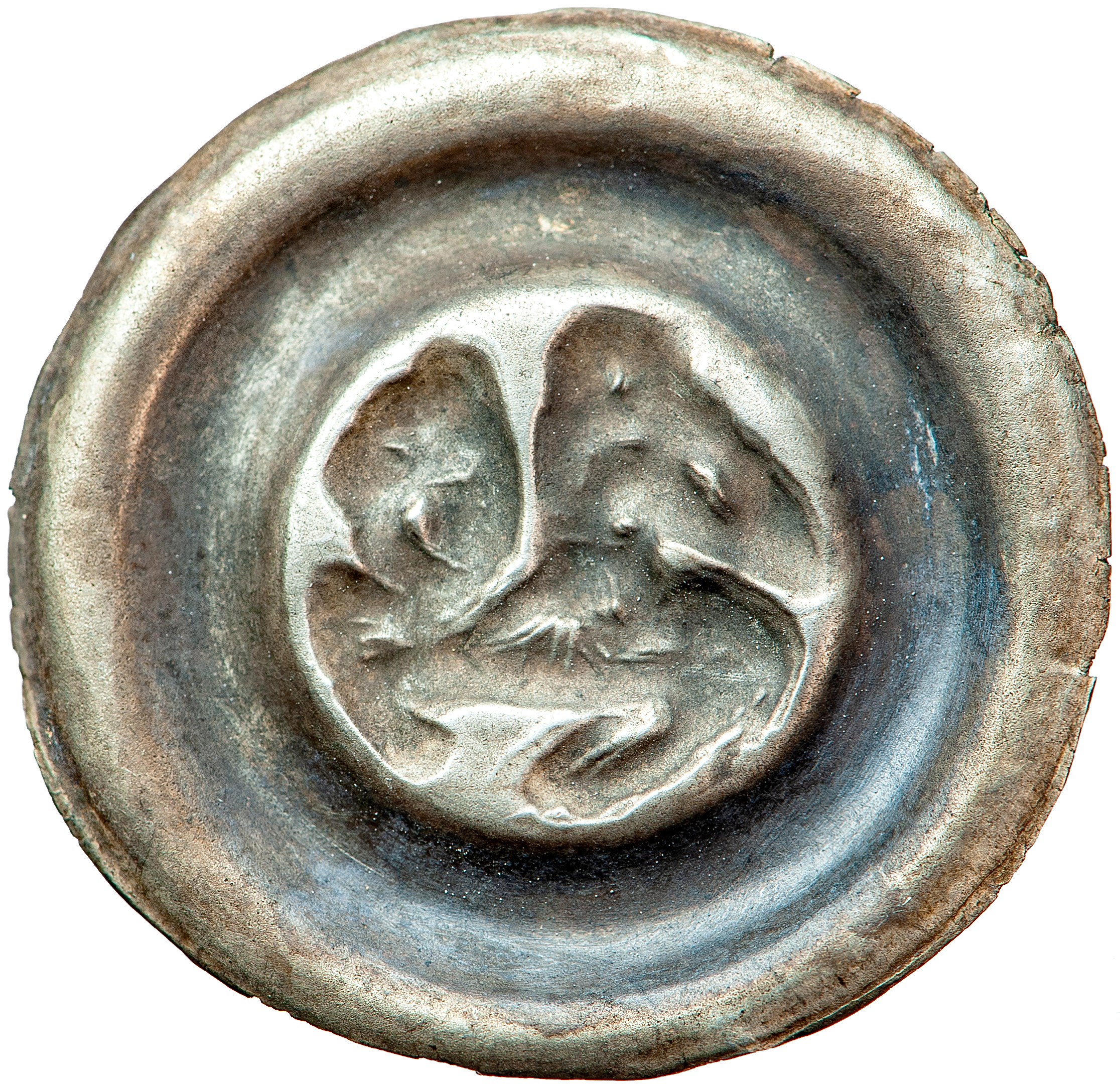
Poland, Silesia, broad brakteat "rider with falcon", 2nd half of 13th century.
On a galloping horse, a rider with a falcon on his right hand extended backwards.
Silver, 0.69 g, 26.5 mm. Kopicki 7049mc; Friedensburg 157/705.
Condition II+, beautiful patina, well-preserved, large and impressive brakteat.
This extremely interesting and beautiful type of broad Silesian brakteate was long misidentified due to the poor legibility of the two pieces known before the war. Friedensburg saw a griffin (!) here. Already when a piece of the b. Wrocław museum, tattered and with traces of the Warmington moat, appeared in trade in the 1990s (WCN 9: 223), it turned out to be a horseman. However, it was still unclear where he had an offensive weapon, as he seemed to be holding a shield. Only the lovely piece WCN 74: 72, and this one, both perfectly stamped, but this one preserved without blemish, show that in fact the rider has a falcon on his outstretched back hand. Thus, this is not a battle or tournament representation, but a representative scene of a ruler demonstrating one of his powers, namely to hunt with a falcon. In the 13th century, in addition to this bracelet, we see such a scene on some Hungarian and Moravian coins, as a display of the prestige of the widely admired kings Přemysl Otokar II and Bela IV. We do not know which of the Lower Silesian princes reached for this design, but most likely Henry III the White or his son, Henry IV Probus. Subjects certainly did not have the opportunity to realize that the falcon should be held on the left hand....