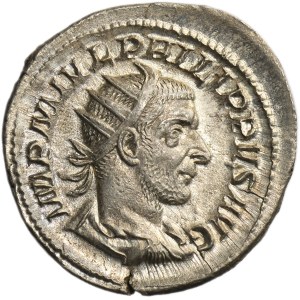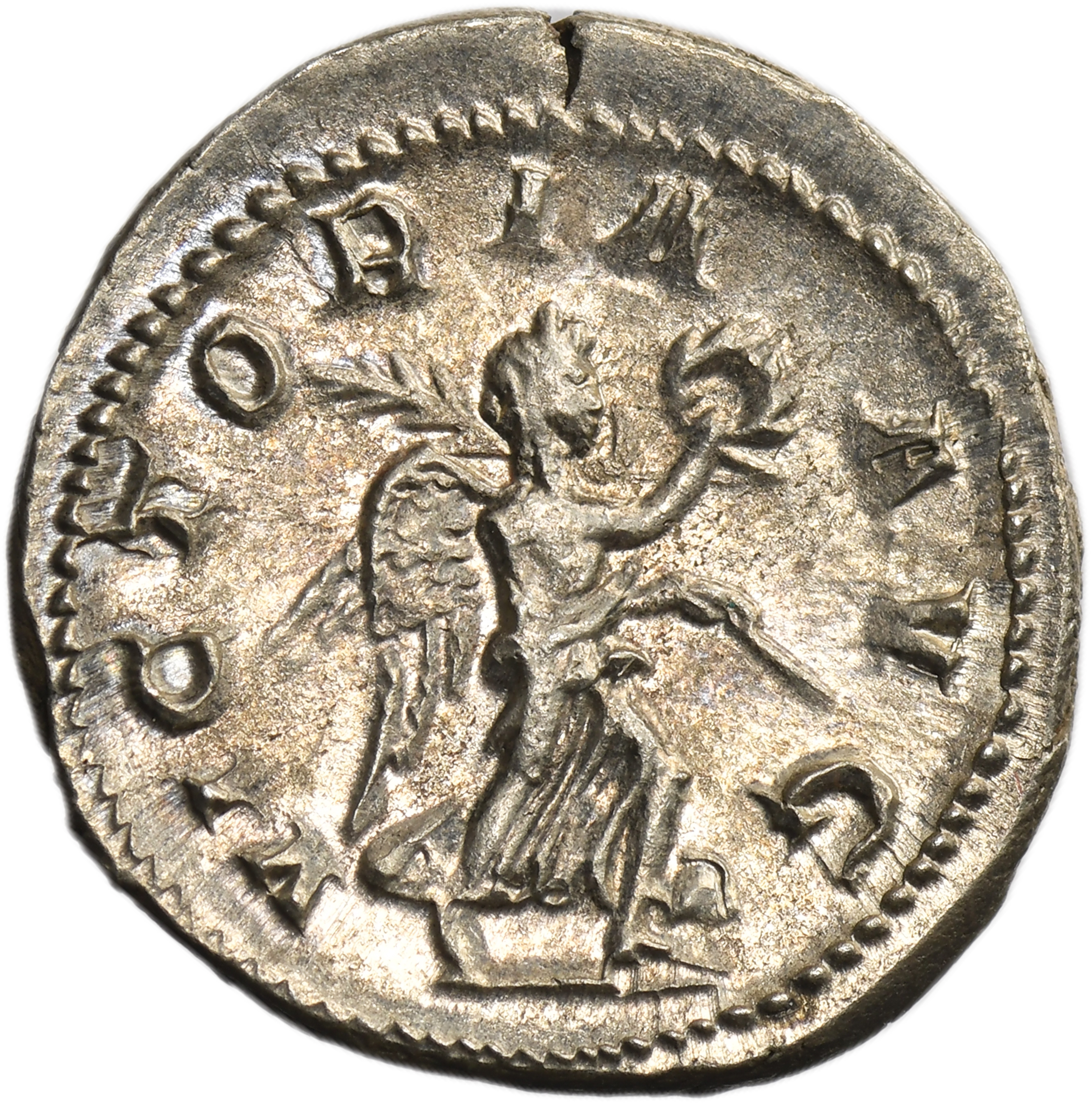


Antoninianus of Philip I “the Arab” (AD 244–249), struck at the Rome mint, belongs to issues produced during his reign, a period in which imperial coinage made extensive use of victory motifs to reinforce the legitimacy of power amid the military realities of the mid-3rd century AD.
The obverse presents a radiate bust of the emperor facing right, with the legend IMP M IVL PHILLIPPVS AVG, giving his full imperial titulature. The radiate crown identifies the denomination as an antoninianus, which at this time functioned as the principal silver coin in circulation.
The reverse depicts Victory advancing right, holding a wreath in her raised right hand and a palm branch resting on her shoulder, with the legend VICTORIA AVG. This composition belongs to one of the most enduring iconographic types in Roman coinage, where Victory represents military success and favorable outcomes in warfare. The wreath signifies the reward of triumph, while the palm branch serves as a traditional emblem of victory.
The legend VICTORIA AVG directly associates these successes with the emperor and forms part of the imperial propaganda, particularly relevant in periods when the assertion of military effectiveness was essential. Issues of this type are well attested within Philip’s coinage and reflect a broader ideological program emphasizing the emperor’s role in maintaining control and stability across the empire.
Mint luster on both sides.
Roman Imperial
Philip I (244-249), Antoninianus, Rome mint
Obverse: bust of the bearded emperor in a radiata crown with five rays and drapery to the right
IMP M IVL PHILLIPPVS AVG
Revers: Victoria walking to the right, with a wreath in her right hand, in her left hand the palm of victory resting on her shoulder
VICTORIA AVG
Diameter 23 mm, weight 5.44 g