


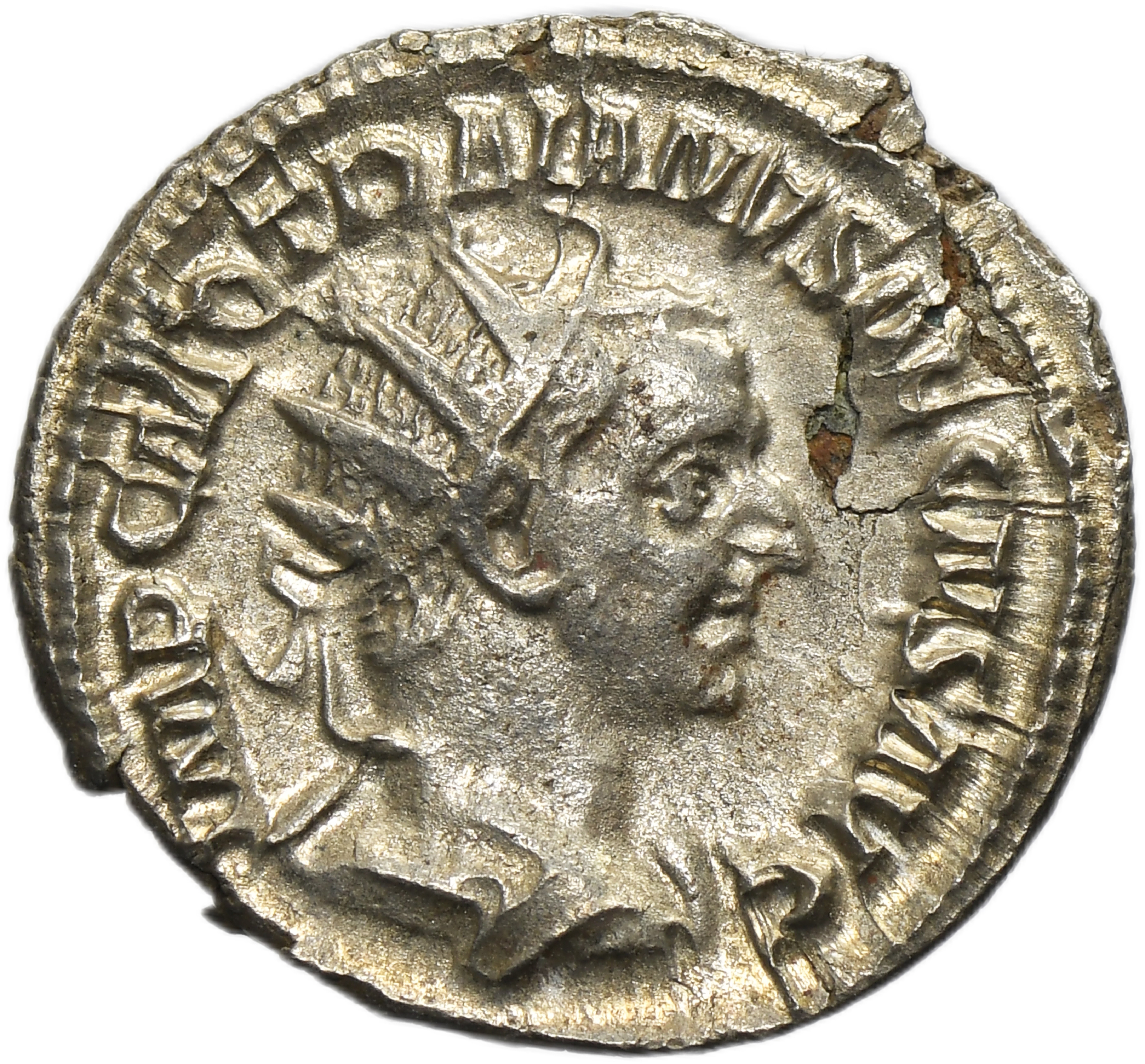
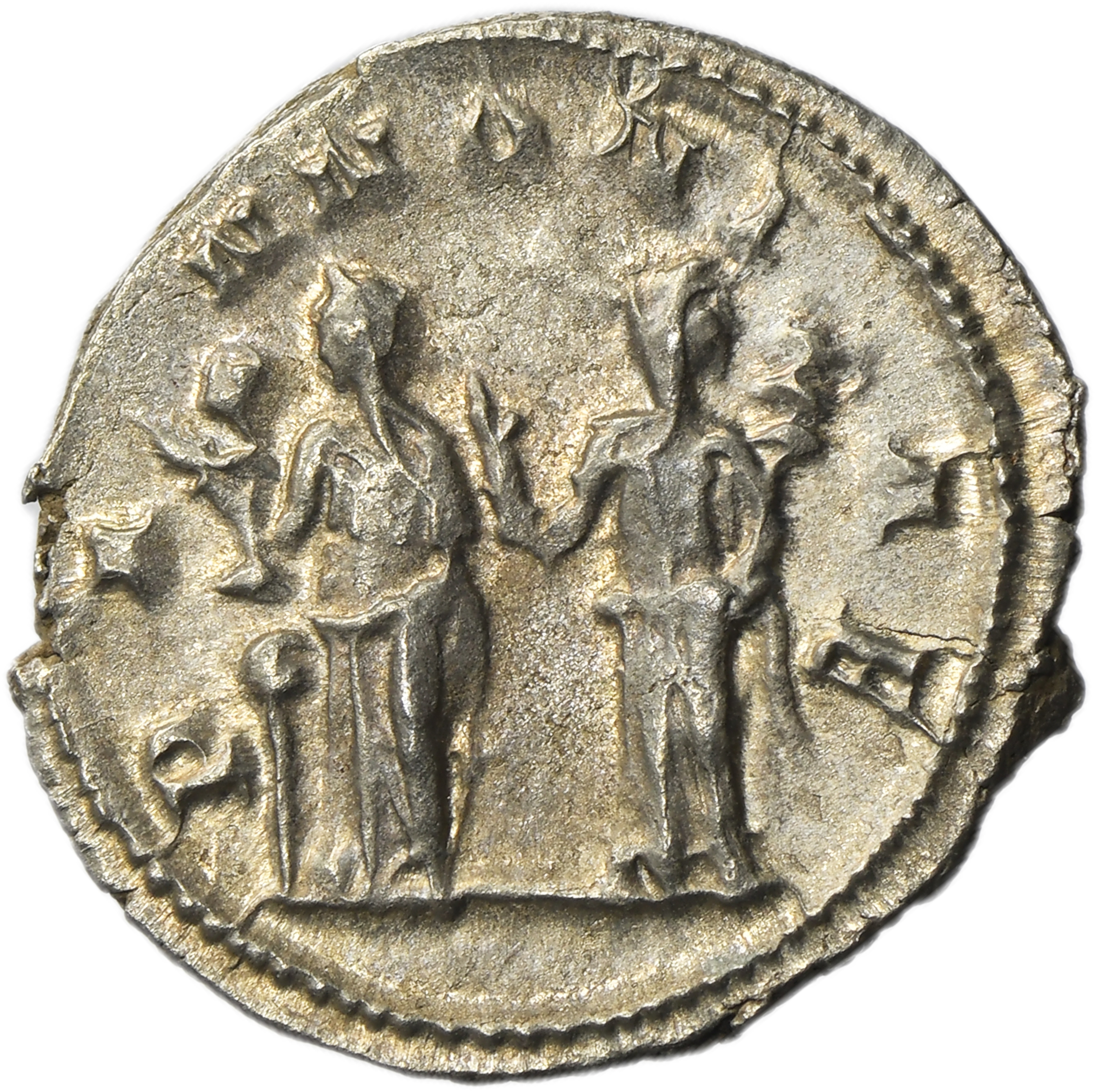


Antoninian of Trajan Decius (AD 249–251), struck at the Rome mint between AD 249–250, belongs to the early phase of his reign, immediately following his accession through military events in the Danubian region. Coinage of this period played a central role in legitimizing the new emperor, particularly through references to the provinces that supported his rise.
The obverse presents a radiate, draped and cuirassed bust of the emperor facing right, with the legend IMP C M Q TRAIANVS DECIVS AVG, giving his full titulature as imperator and augustus. The radiate crown denotes the antoninianus denomination, which at this time functioned as the principal silver coin in circulation.
The reverse depicts the personifications of Pannonia as two standing female figures holding military standards, accompanied by the legend PANNONIAE. This type belongs to a well-attested iconographic group directly referencing the Danubian provinces, where Decius was proclaimed emperor by the army. It constitutes one of the clearest visual statements of his political and military base.
The motif of the two Pannoniae appears consistently in the coinage of Decius and is understood as emphasizing the loyalty of the army and the strategic importance of the region within the empire. Ancient sources, including Cassius Dio and later historiographical traditions, confirm the decisive role of the Danubian provinces in the events leading to his accession.
A lustrous specimen, with minor surface delamination of the silvering on the obverse, typical for antoniniani of this period.
Roman Imperial
Trajan Decius (249-251), Antoninianus 249-251, Rome mint
Obverse: radiate, draped and cuirassed bust right
IMP C M Q TRAIANVS DECIVS AVG
Reverse: two Pannoniae standing facing, each holds standard
PANNONIAE
Diameter 22 mm, weight 4.14 g











