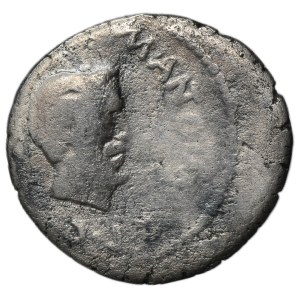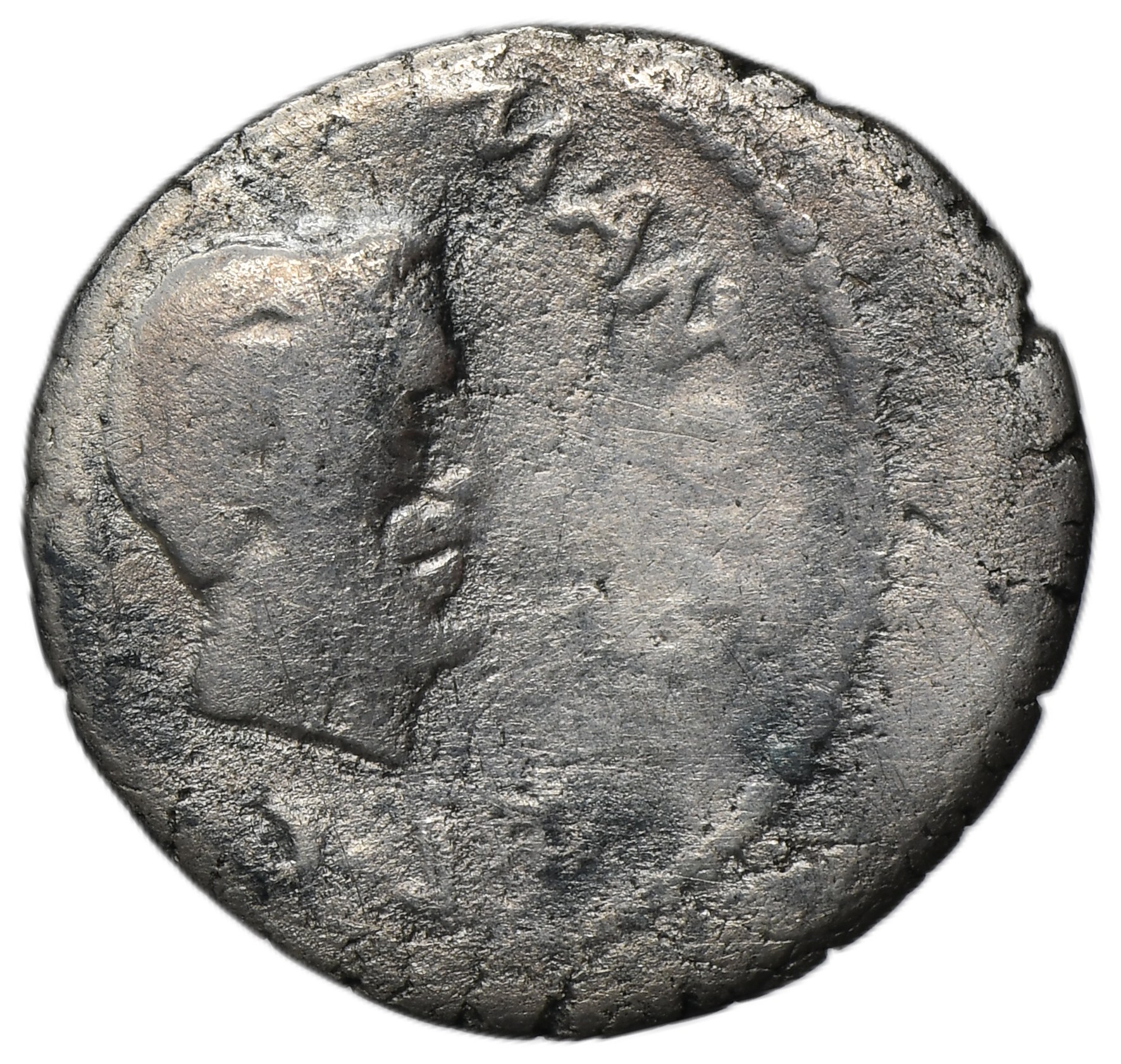
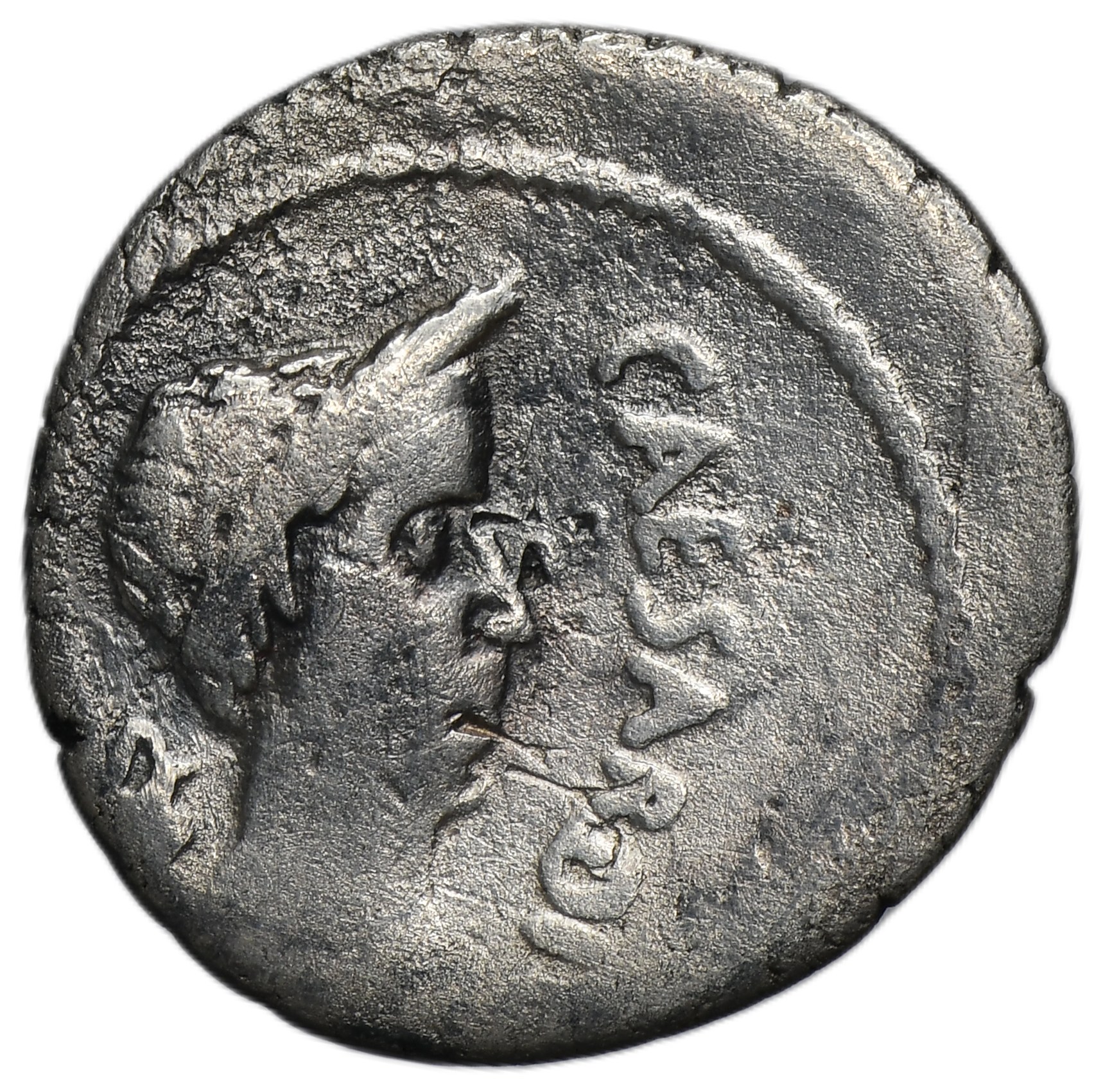


A highly interesting and exceptionally evocative propaganda issue, struck at one of the most turbulent moments in the final decades of the Roman Republic. The denarius was minted in 43 BC, only a little over a year after the assassination of Julius Caesar on the Ides of March in 44 BC, when his political legacy had become the object of rivalry among the most powerful figures in the Roman world.
Following Caesar’s death, one of the principal contenders for his political inheritance was Mark Antony, consul in 44 BC and one of the dictator’s closest associates. His position, however, was increasingly challenged by the young Gaius Octavius, adopted in Caesar’s will and presenting himself as his legal son and heir. Invoking the memory of the murdered dictator thus became one of the most important instruments of political legitimisation.
The year 43 BC brought a dramatic escalation of the conflict. Following the battles of Forum Gallorum and Mutina, Antony found himself in a difficult position, but subsequently joined forces with Marcus Aemilius Lepidus. In the autumn, Antony, Octavian and Lepidus reached an agreement. The Second Triumvirate established by the three men was not merely a private political alliance – it was formally sanctioned by law and endowed with extraordinary powers to reorganise the state.
It is precisely this new political reality that is reflected in the abbreviation R·P·C – rei publicae constituendae appearing on the obverse, forming part of the titulature of the triumvirs and referring to their mandate for the “reconstitution” or “reorganisation of the Republic”. The presence of this titulature distinguishes Crawford 488/2 from the earlier Crawford 488/1 variety, on which Antony appears without R·P·C. Crawford associated the second variety with the period following the agreement between the triumvirs in November 43 BC.
Particularly fascinating is the iconography of the two sides of the denarius. Antony placed his own portrait on one side and that of the murdered Caesar on the other. This constituted an unmistakable political statement: Antony presented himself as a man enjoying a special relationship with the dictator and his legacy. At a time when Octavian was building his position primarily upon his adoption and the name of Caesar, Antony emphasised his own long-standing association with Caesar and the offices and honours that connected them.
The priestly attributes accompanying the portraits are equally significant. The lituus behind Antony’s head and the vessel beside Caesar’s portrait refer to religious offices held by the two statesmen. In Roman political culture, priestly offices formed an integral part of the public status of members of the elite, and these symbols therefore further emphasised the bond between Antony and Caesar.
Also worthy of attention is Mark Antony’s facial stubble. In numismatic interpretation, it has been associated with a public manifestation of mourning for Caesar. A similar convention was employed by Octavian during this period, before Caesar’s assassins were defeated at Philippi in 42 BC.
The present denarius therefore belongs to a group of issues in which coinage became a direct instrument of political propaganda. Facing one another are the portraits of the living Mark Antony and the murdered Julius Caesar – the man whose legacy would play a decisive role in determining the future of the Republic. Struck at the birth of the Second Triumvirate, only a year before the Battle of Philippi, the issue constitutes a remarkable numismatic testimony to the political process that would ultimately lead to the collapse of the Roman Republican system of government.
Roman Republic
Marcus Antonius (32-31 BC), Denarius, castrensis moneta Galia 43
Obverse: head of Marcus Antonius right with light beard, behind, lituus
M·AN͡TO·IMP·R·P·C
Reverse: laureate head of Julius Caesar right, jug to left
CAESAR·DIC
Diameter 19 mm, weight 3.53 g