


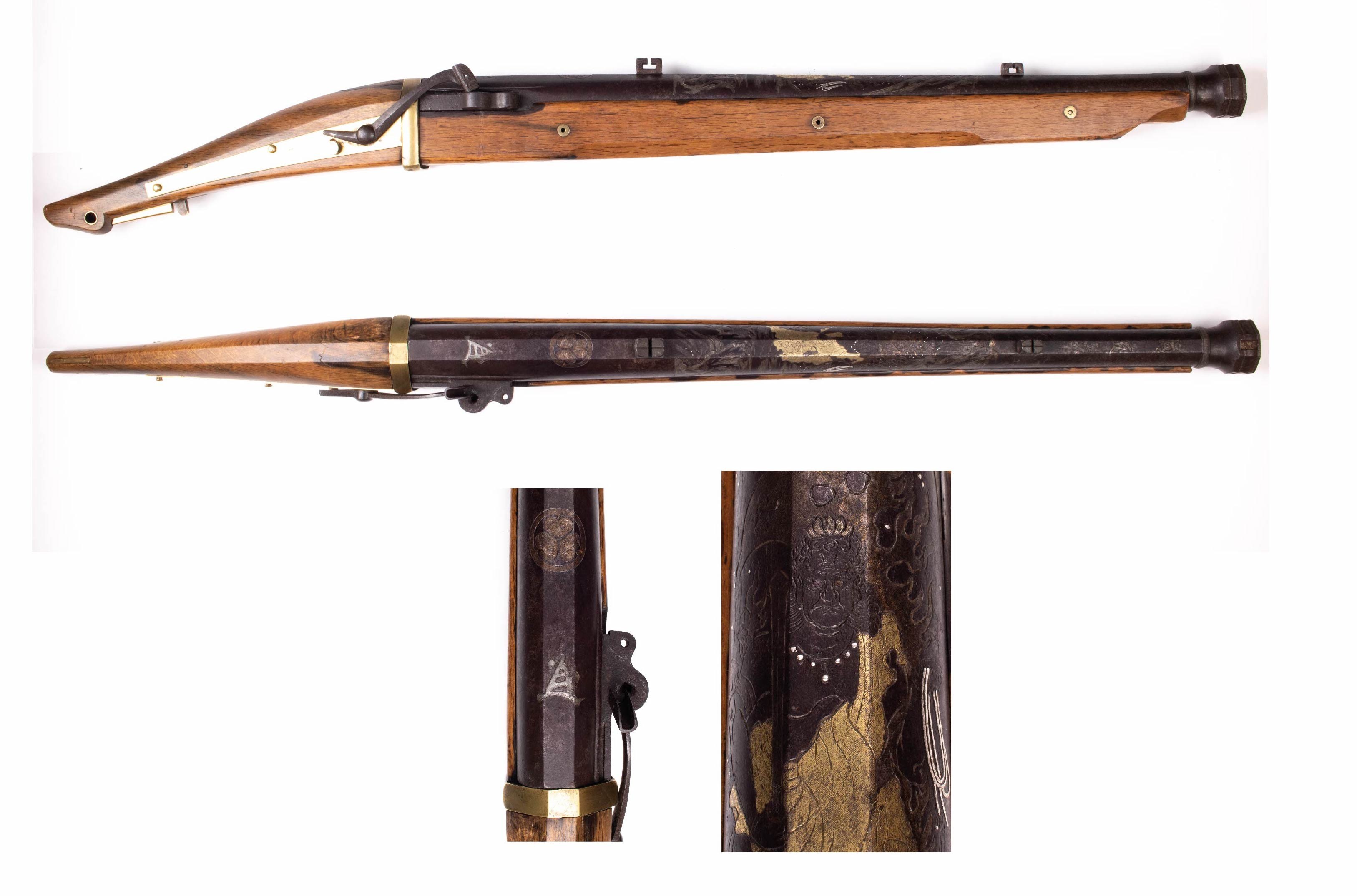
The top of the barrel is decorated with three characters of Sanskrit - the literary language of ancient, medieval and early modern India, still used for religious purposes today. The first mark is "hāṃ" meaning Fudō Myōō (Ācala); the other two marks remain unrecognized.
Below is an image of Fudō Myōō surrounded by flames against the backdrop of a waterfall. Fudō Myōō (Ācala) means "Unmoved" or "Unmoved King of Wisdom" (Acalanātha Vidyārāja). The barrel is engraved with:
- niju makibari (double-wound barrel): this is the name of the technological process used to make the barrel
- Buyō Ju: "Buyō" is another name for the city of Tokyo (Edo), "Ju" means "made in", so this inscription means "Made in Tokyo".
- Kunitomo Kanzaemon Nobuchika: the name of the craftsman who made the barrel
- Dainihon: "Great Japan"
- 栁會陽: the Kunitomo Firearms Museum read these marks as "Sakai Saidaiji". It could have been the craftsman confirming the quality of the barrel, or it could have been the craftsman who made the gilding.
- Shigetoshi tagane bori kore [kao] - "Shigetoshi" is the name of the artisan, tagane is the chisel, "bori kore" means "carved it", kao is the mark of the artisan. Thus, the full inscription is "Shigetoshi carved this with a chisel".
On the flask is written in ink:
昭岸和田衝平田 - "昭" with this one kanji can be written many Japanese names, such as Akashi, Akitsugu, Akira, Katsuharu, Katsuhisa and others. "岸和田" is the name "Kishiwada," "衝" is the name Katsuhiro, "平田" is the name "Hirata." The signature thus mentions the names of two people, e.g. Katsuharu Kishiwada and Katsuhiro Hirata. No additional information is available to suggest why these names are on this arquebus.
勝(藤)原弘道 所持: the owner of this teppō is Hiromichi. It is very unusual for a Japanese weapon to have its owner's name on it.
Dimensions: length 104 cm, barrel length 70 cm, caliber: 19 mm.
The trigger mechanism lock is in working order.








最近瀏覽過的
登錄以查看拍品列表
收藏
登錄以查看拍品列表