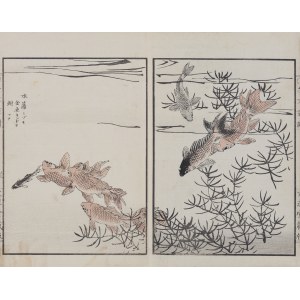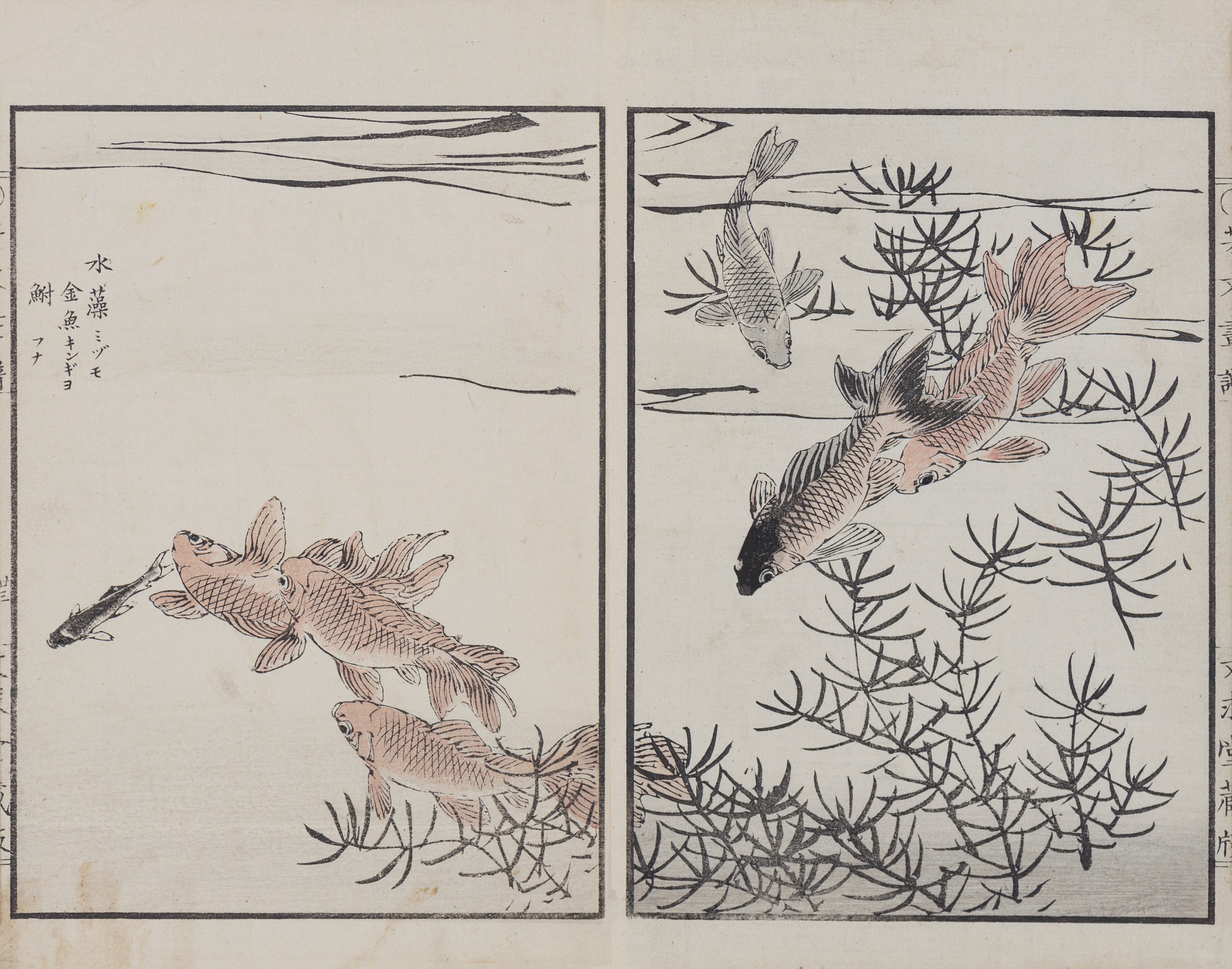
Woodcut, paper, 24x31 cm (size of diptych paper); inscriptions in Japanese, with artist's signature in margins
Woodcut from the series "Hobun gafu," published in 1890 (Meiji 23) in Kyoto by Tanaka Jihē. An analogous series is in the collection of the Smithsonian Institution's National Museum of Asian Art in Washington and the British Museum in London.
The "Hobun gafu" series was published in 1890 and consists of 37 works. These beautiful woodcuts depict birds, insects and fish in their natural habitat, among trees, plants, in water, at different times of the year. Carefully observed and drawn with rich calligraphic lines, these prints are excellent examples of kacho-e, and were executed in black with shades of gray, brown and red. Noteworthy is the masterful depiction of blooming cherry blossoms, apple trees or magnolias.
Kikuchi Hobun (1862-1918) is one of the "Big Four" disciples of Kōno Bairei. He was born in 1862 into the family of a merchant who sold calligraphic and painting works, and also assembled paintings. He began studying art in Osaka under the tutelage of Shigeno Hōen. At the age of 21, he became a student of Kōno Bairei in Kyoto. He soon became an outstanding painter, earning the title of one of Bairei's four best students along with Takeuchi Seihō, Taniguchi Kōkyō and Tsuji Kakō. These four students formed Kyoto's modern art scene and modernized Japanese painting of the turn of the 20th century. Hobun mainly painted birds and flowers, and was also widely recognized as a master of cherry blossom painting. By the end of 1894, he was teaching at the Kyoto Municipal School of Arts and Crafts, and his status in the art world was well established. He played a significant role as an authority on the art world by being a juror at the first Bunten exhibition in 1907 He was involved in training and supporting younger generations of painters. Students who studied under Hōbun included Kawakita Kahō, Yamada Kōun, Kikuchi Keigetsu and Abe Shumpō. He was a member of the Imperial Academy of Fine Arts and one of the imperial court artists.
The term "kachō-ga" in Japanese is a combination of three words: "ka" - flower, "cho" - bird, "ga" - painting, so it literally means paintings of flowers and birds. In Far Eastern art, it is one of the leading artistic themes. It also encompasses plants, grasses, trees, animals, fish, insects - in fact, the entire living natural world except humans and landscapes. Kacho-e prints were highly regarded for their beauty and accuracy, and were widely collected both in Japan and abroad. The popularity of the prints was due in part to their reflection of traditional Japanese values and aesthetics, which placed a high value on harmony with nature. The woodcuts were often imbued with symbolic and allegorical meaning, such as the association of certain birds or flowers with certain seasons or features. The kachō-ga masters were driven by expression as well as emotion; they succeeded in capturing the colors and delicacy of flowers and the behavior of birds in the wild. Saturated with metaphorical meaning beyond their physical beauty, specific pairs of birds, insects and flowers became the basis of a tradition that continues to this day.