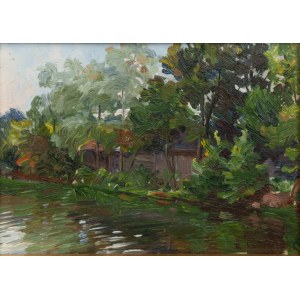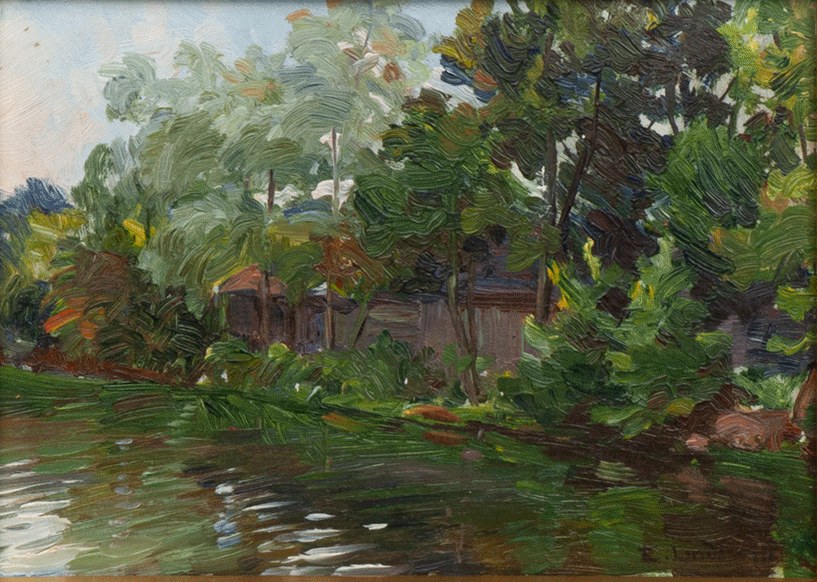
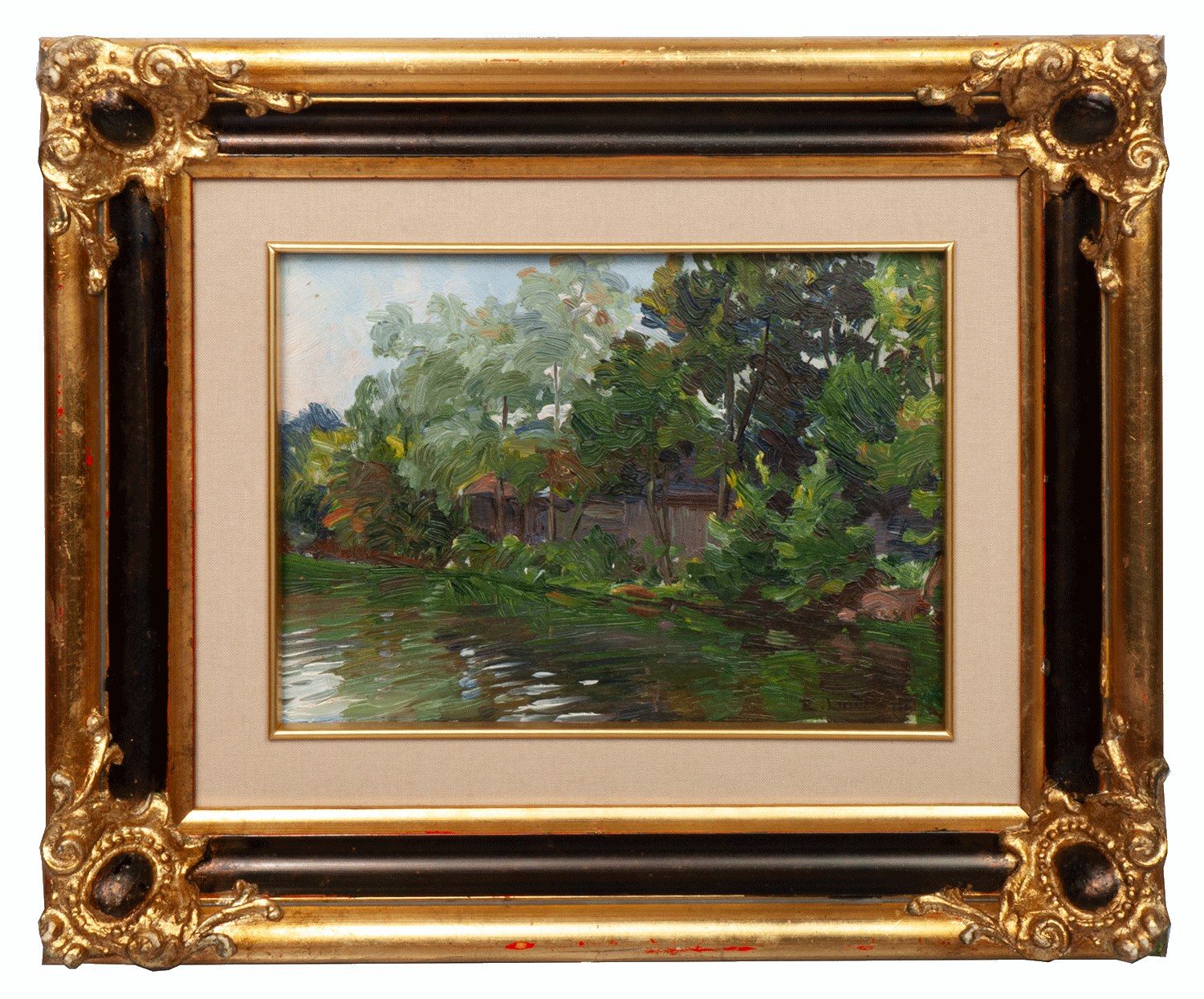
Oil on cardboard, signed lower right: "E. Lindeman"
Dimensions with frame: 28x34 cm (16x22 cm)
Emil Lindeman (Lindemann) (Warsaw 1864 – 1945 (?) Ozorków) – Polish painter. He began his drawing studies at the Warsaw Drawing Class led by Wojciech Gerson, where, as part of a national competition among drawing schools, his works were honored with a letter of commendation from the Academy of Fine Arts in St. Petersburg. After completing his studies in Warsaw in 1887, he moved to Kraków, where he studied for two years at the School of Fine Arts in Jan Matejko’s studio. Under the guidance of this distinguished master, he participated in the polychrome decoration of St. Mary’s Church. In the fall of 1890, he left for Paris, where he studied at the École nationale supérieure des beaux-arts, as well as at the Académie Julian under William-Adolphe Bouguereau and at the Académie Collarosi under Raphaël Collin. During his stay in the French capital, he submitted the painting “Castle Square” to a contest held by Tygodnik Ilustrowany in 1893 and received first prize. He traveled throughout Italy, staying for extended periods in Naples and Rome, where he studied at the Royal Institute of Fine Arts, and then traveled to Russia, spending time in St. Petersburg. In 1897, he returned to Warsaw and focused on his work as a painter, printmaker, and illustrator. He worked in easel painting, created polychromes (e.g., the polychrome in the presbytery of the Cathedral of the Assumption of the Blessed Virgin Mary in Kielce), and murals (in St. Anne’s Church in Warsaw, the Church of the Holy Spirit in Kadzidło, St. Teresa’s Church in Vilnius, and the White House in Warsaw’s Łazienki Park). He illustrated books and magazines and designed posters. He exhibited his works at the Society for the Encouragement of Fine Arts, the Aleksander Krywult Salon, the Artistic Salon, and the Czesław Garliński Salon. He also participated in exhibitions organized in Vilnius, Lviv, Katowice, Lublin, Częstochowa, Poznań, Gdynia, and by the Kraków Society of Friends of the Fine Arts. He also exhibited in Germany, Great Britain, and the United States. Emil Lindeman created oil paintings and watercolors, which were typically small in size. Their subjects included landscapes, views of seaside beaches, flowers, and still lifes. In his landscapes, he depicted views from the Vilnius region, the areas around Warsaw, Nałęczów, Krynica, and Volhynia. They also feature the suburbs of Polish and European cities. He created genre scenes less frequently, and in his later years, he often painted flowers and still lifes. It is worth noting that Emil Lindeman frequently worked on the restoration of frescoes. After the outbreak of World War II, he stayed in Ozorków with his family, where he likely died in 1945.





![Emil Lindeman [Lindemann], Rozmowa](https://img1.one.bid/img/10469/3282480_1w.webp?1789812616)


![Emil Lindeman [Lindemann], Ojców, 1905](https://img1.one.bid/img/9403/2909101_1w.webp?1769858089)