


88 x 57cm - oil, canvas
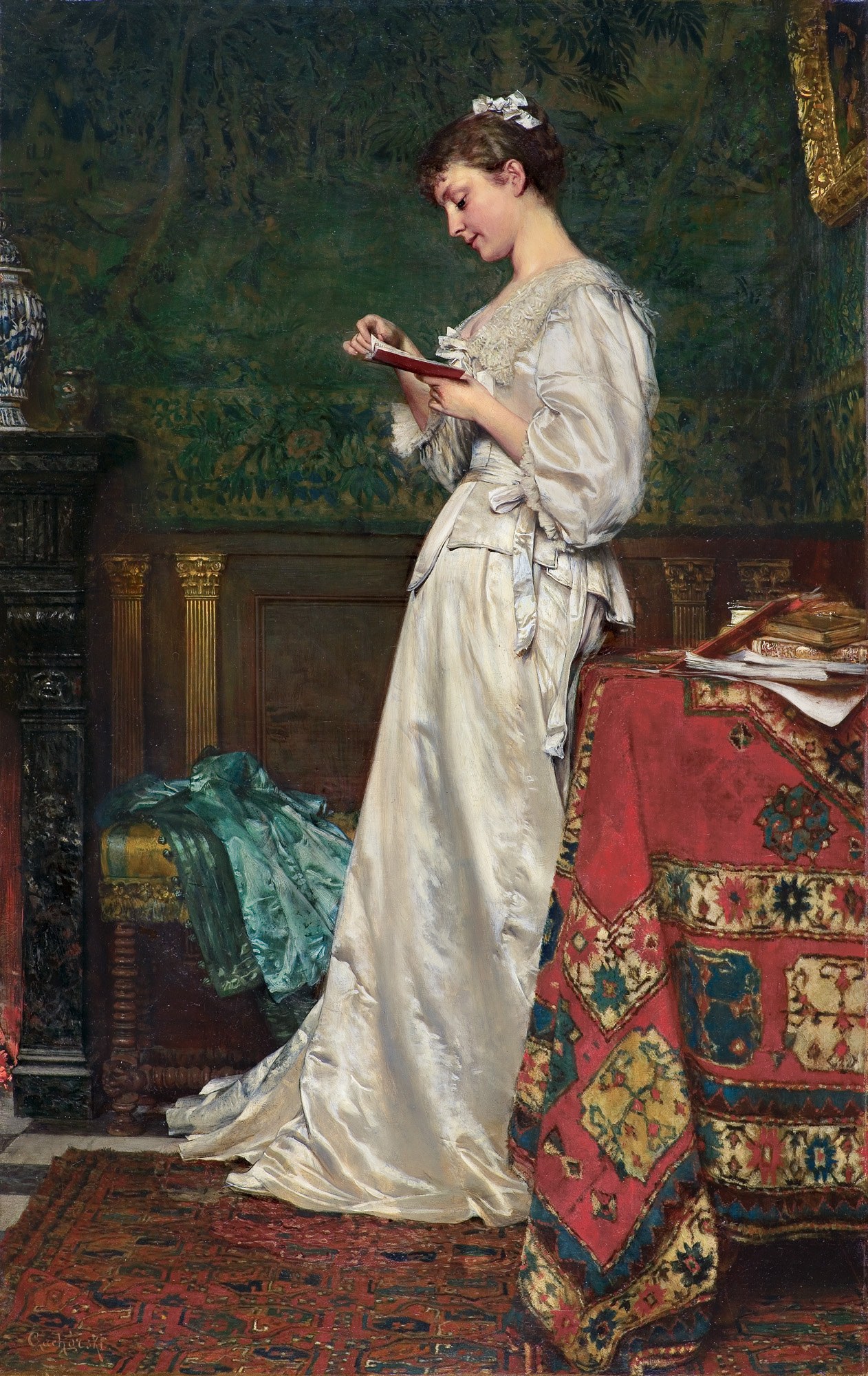
Signed l.d.: Czachórski
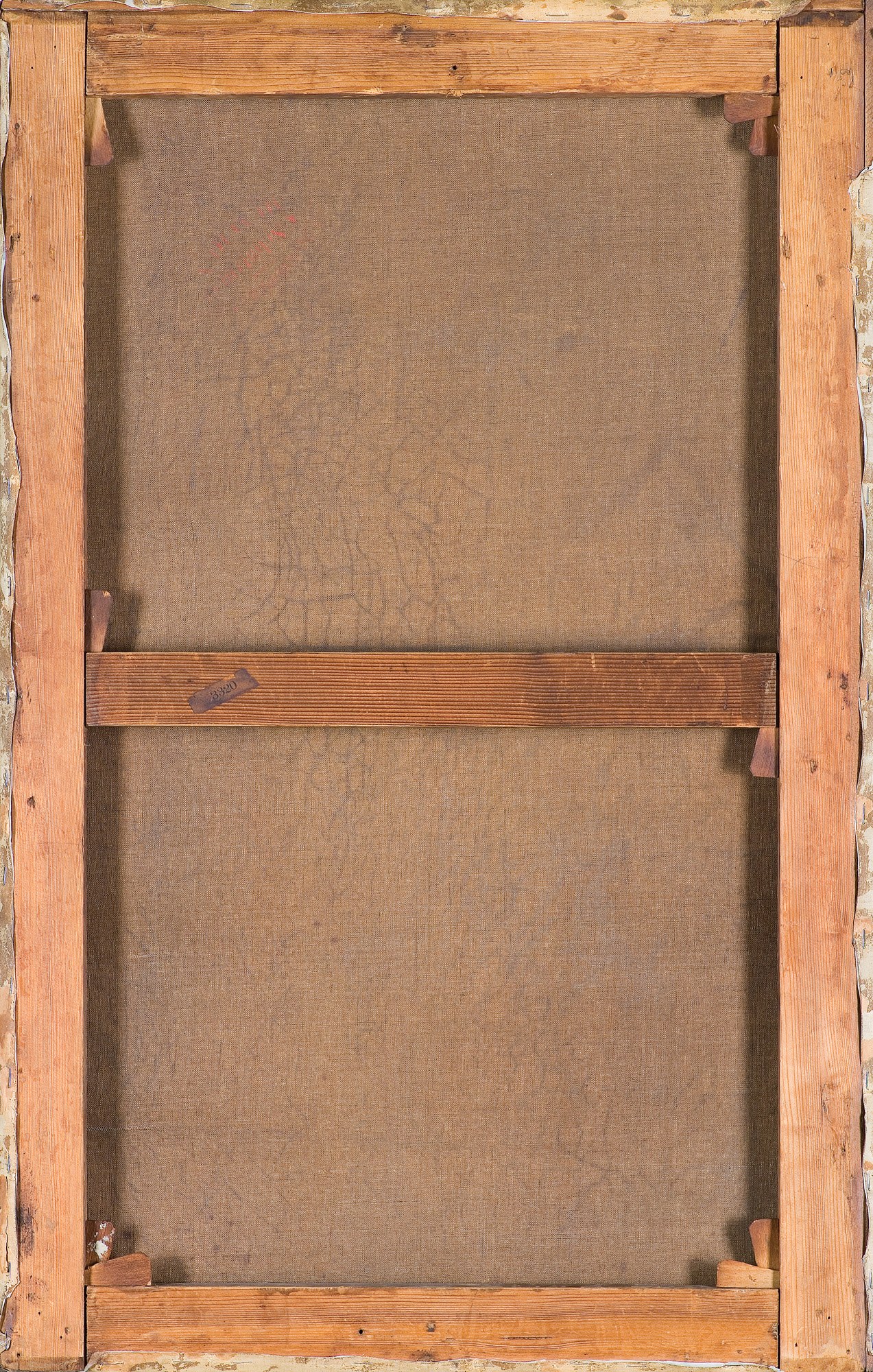
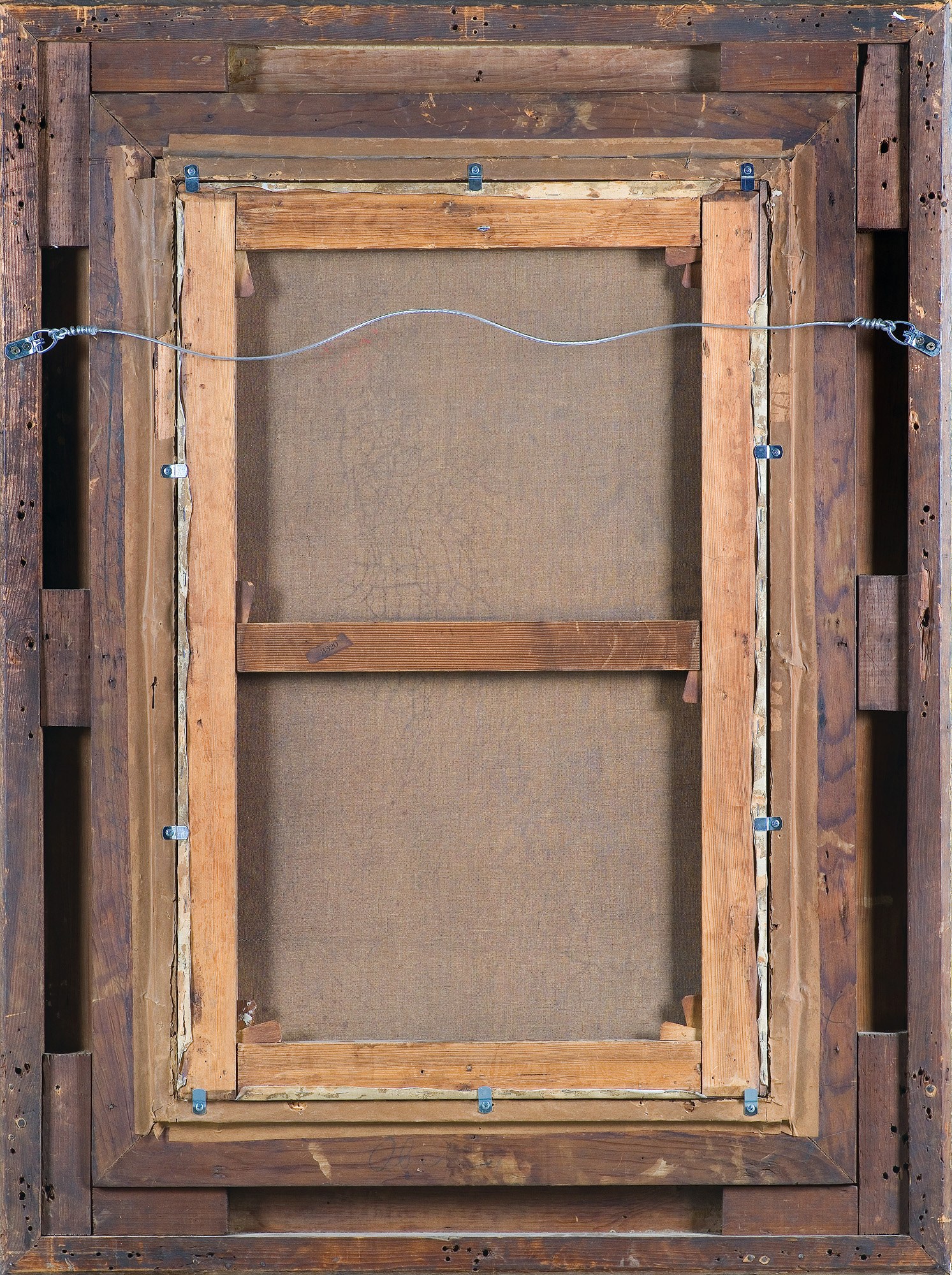
On the back l.g. oval stamp: Malerleinwand-Fabrik | von | A. Schutzmann | in | MÜNCHEN; in addition, on the crossbar of the loom a sticker with the inventory number (print): 3320.
A reproduction of the featured painting was included in the artist's monograph compiled in 1927 by Henryk Piatkowski. Entitled at the time Reading, it was included under the year 1881 as a work that Knoedler had purchased. Waclaw Jaroszyński in Wladyslaw Czachórski's Life and Affairs, based on the artist's diary, writes that in 1881 Czachórski received two commissions from New York for The Girl with a Book and The Nun. In the inventory of the New York gallery M. Knoedler & Co. under the date June 28, 1881, Czachórski's painting, purchased from Theodor Stroefer of Munich, was entered with the number 3320. A sticker with this number can be seen on the crossbar of the loom of our Enchanted, so we can clearly identify it as a Reading purchased by the New York gallery. In the M. Knoedler & Co. sales ledger for 1881-1885, under the June date in 1884, Czachórski's painting appears again with the number 3320, this time titled Love Letter. The annotation indicates that the painting was sent for sale to Theodor Stroefer and H. Ruppel in Munich.
For the royalties received for painting The Girl with a Book and The Nun in the Stalls, Czachórski and his brother Stanislaw went on a trip to Paris. They left on May 19, 1881, after completing the above commissions. Therefore, it should be assumed that Enchanted was created between mid-February, when references appear in Czachórski's diary to the start of work on canvases for New York, and mid-May 1881. The painting then made its way to America, where on June 28 it was entered in the inventory book of the Knoedler & Co. gallery with an arrival date of June 11, 1881.
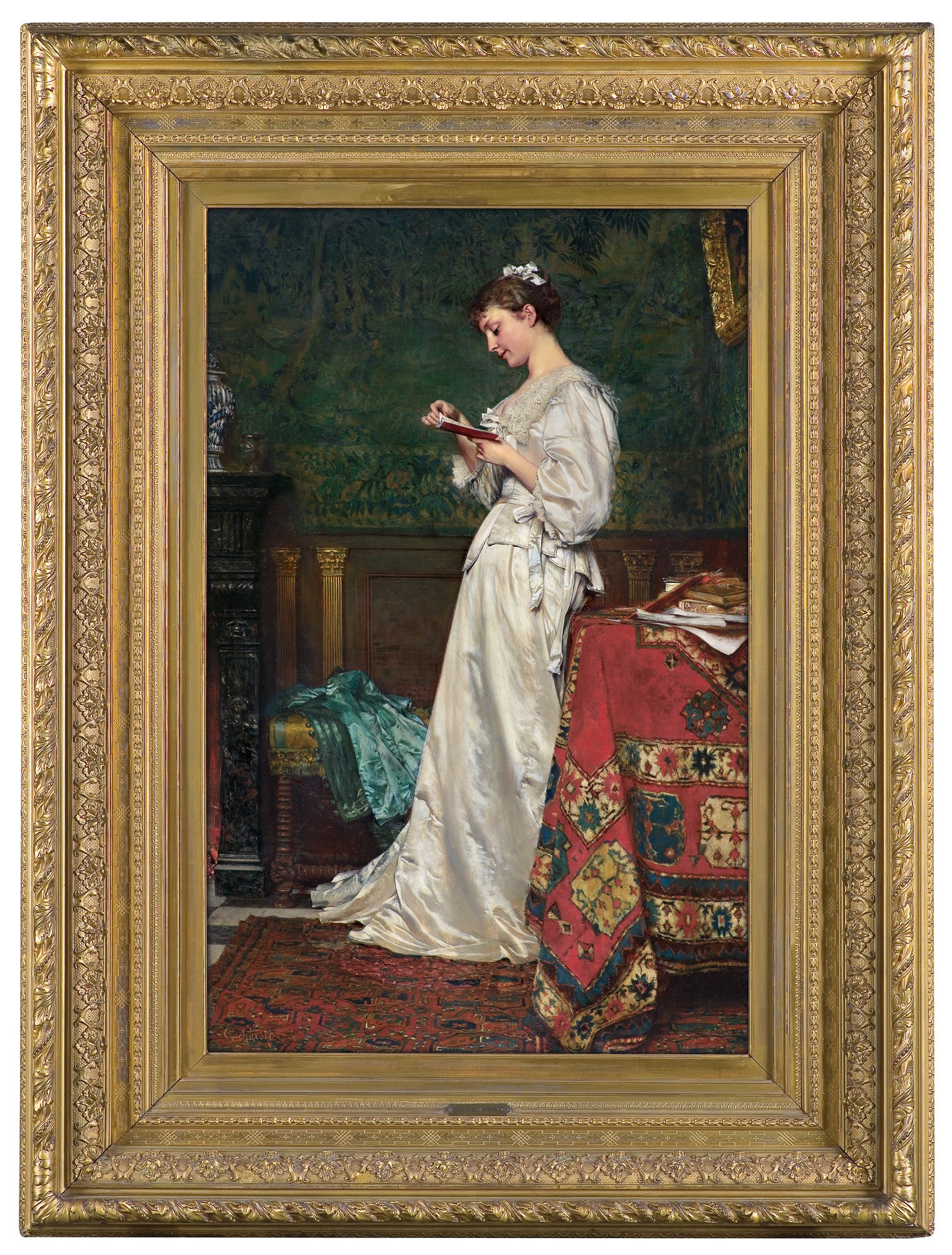
This charming canvas, so characteristic of Czachórski's work, depicts a young woman in a richly decorated interior. Dressed in a white gown á la van Dyck, she leans against a table laden with books and leans her head over a book held to her chest. The scenery into which the artist has incorporated her alludes to Dutch 17th-century genre scenes. The checkerboard-patterned floor covered with eastern carpets, as well as the table, gives the interior warmth, which is further emphasized by a glowing fireplace with a richly decorated frame. On it, the painter has set a vase from Delft, and the light coming from the window is reflected on its glazed surface. Similarly catching the light are the robes lying on the upholstered bench, the gilded ornamentation of the wall above and the frame of the painting hanging behind the model's back.
As Dr. Straszewska notes, the very composition of Czachórski's paintings, with their significant close-ups of the main figure, and the surrounding aura of understatement, of suspension of action, are characteristic of painting in the spirit of juste milieu, which was promoted in Munich by [Karl Theodor von] Piloty. Later, however, during his period of study with Piloty, Czachórski became more interested in genre subjects than in history painting [by another Munich professor] - Arthur von Ramberg, who practiced genre painting inspired by the work of 17th-century Dutch masters such as Caspar Netscher, Gerard Terborch and Pieter de Hooch. Both he and his disciples, including Albert von Keller, were keen on depictions of social gatherings and music-making in intimate settings, setting them both in contemporary realities and introducing 17th-century costume to raise the painting's profile. These themes interested the Polish painter at the time as well, in whose work from then on a fascination with the work of Dutch and Flemish painters of the 17th century would begin to be discernible.
Czachórski commissioned a satin dress á la van Dyck as early as 1879 for a painting entitled Do you want a rose? (see opposite). According to historical costume researcher Dr. Anna Straszewska, it served him in his painting work until 1885. The researcher mentions a painting owned by the Kosciuszko Foundation, Burnt Letter, which the artist dated 1882, Zadumana of 1883, which is in the collection of the National Museum in Warsaw, and Kabalarka, which Piatkowski dates to 1885.
In Enchanted, Władysław Czachórski masterfully combines academic perfection of technique with exceptional sensitivity to beauty - both of the model and the objects he surrounds her with. His painting is a praise of the elegance, subtlety and sophistication of a bygone era. The woman depicted by the artist is not just a model in a dazzling dress, but becomes the epitome of luxury, charm and romance. Czachórski brings out her sensuality through a delicate hand gesture, a subtle pose and carefully crafted details. He understood perfectly that true beauty is based on the harmony of all elements of the composition, so he paid special attention to the soft light coming from behind the viewer's back, gently illuminating the figure of the model, leaving the background in a soft twilight. Thanks to this treatment, the woman becomes the focal point of the painting, shining like a diamond against the backdrop of the rich, opulent interior.
Provenance: - The painting was purchased from the artist's studio in June 1881 by the New York gallery Knoedler & Co. through Munich publisher Theodor Stroefer.
- In June 1884, sent for sale in Munich to T. Stroefer and H. Ruppel.
- Private collection, USA.
- Private collection, Warsaw.
Painting exhibited, mentioned and reproduced in, among others:: - M. Knoedler & Co., Painting stock book 3: 1-4368, 1875 December - 1883 December, p. 148, cat. no. 3320;
- M. Knoedler & Co., Sales book 5, 1881 November - 1885 November, p. 180, cat. no. 3320 (The love letter);
- H. Piątkowski, Władysław Czachórski, Artistic Monographs Volume XI, Warsaw 1927, p. 22, ill. p. nlb. (Enchanted, La liseuse);
- Władysław Czachórski 1850-1911 on the ninetieth anniversary of the artist's death, cat. of the exhibition (texts by L. Lameński, D. Kubacka), Lublin Museum, Lublin 2001, p. 29;
- W. Jaroszyński, Władysław Czachórski's Life and Affairs, Lublin 2004, p. 62, 166 no. 59 (Girl with a Book, Reading);
- A. Straszewska, The role of historical costume in Władysław Czachórski's painting, [in:] Athens on the Isar. Munich Painting. Studies and sketches, edited by E. Ptaszyńska, Suwałki 2012, p. 251 (Zaczytana).
Władysław Czachórski (Lublin 1850 - Munich 1911) - next to Jozef Brandt and Alfred Wierusz Kowalski, was the most highly regarded and well-known representative of the Polish artistic colony in Munich at the turn of the 20th century. He began his artistic studies with R. Hadziewicz at the Warsaw Drawing Class (1866-1867), then studied at the Academy of Fine Arts in Dresden (1868) and from 1869 at the Academy in Munich, under H. Anschütz, O. Seitz, A. Wagner and K. Piloty. He graduated from the Academy in 1873, awarded a silver medal for his Scene from "The Merchant of Venice." In 1874-1877 he traveled to Italy, France and came to the country several times. In 1879 he settled permanently in Munich and took part in the Second All-World Art Exhibition in Munich's Glaspalast, where he received a gold medal for his painting Actors before Hamlet. Widely appreciated and respected, he was awarded the Bavarian Order of St. Michael in 1893. He was a member of the Munich Kunstverein, a member of the Berlin Academy and an honorary professor at the Munich Academy. He has taken part in numerous exhibitions, including in Munich, Vienna, Berlin, Dresden, as well as in Krakow, Warsaw, Lodz and Lviv. He painted Shakespearean paintings, still lifes, interiors, landscapes, portraits and - above all - intimate salon scenes with figures of beautiful and delicate ladies, who seemingly "enchanted princesses in satin robes live in a world of happiness, carefree, eternal serenity, constant smiling and refinement." The perfection of the workshop, elegance, finesse and mastery in reproducing the details of rich costumes, fabrics, flowers and superfluous objects made these very paintings find the most buyers. Czachórski's success and enormous success on the European art market meant that only a few of his works found their way into Polish collections. Most of them were gathered by a monographic exhibition of the artist's works prepared in 2001 by the Lublin Museum in Lublin.













最近瀏覽過的
登錄以查看拍品列表
收藏
登錄以查看拍品列表