


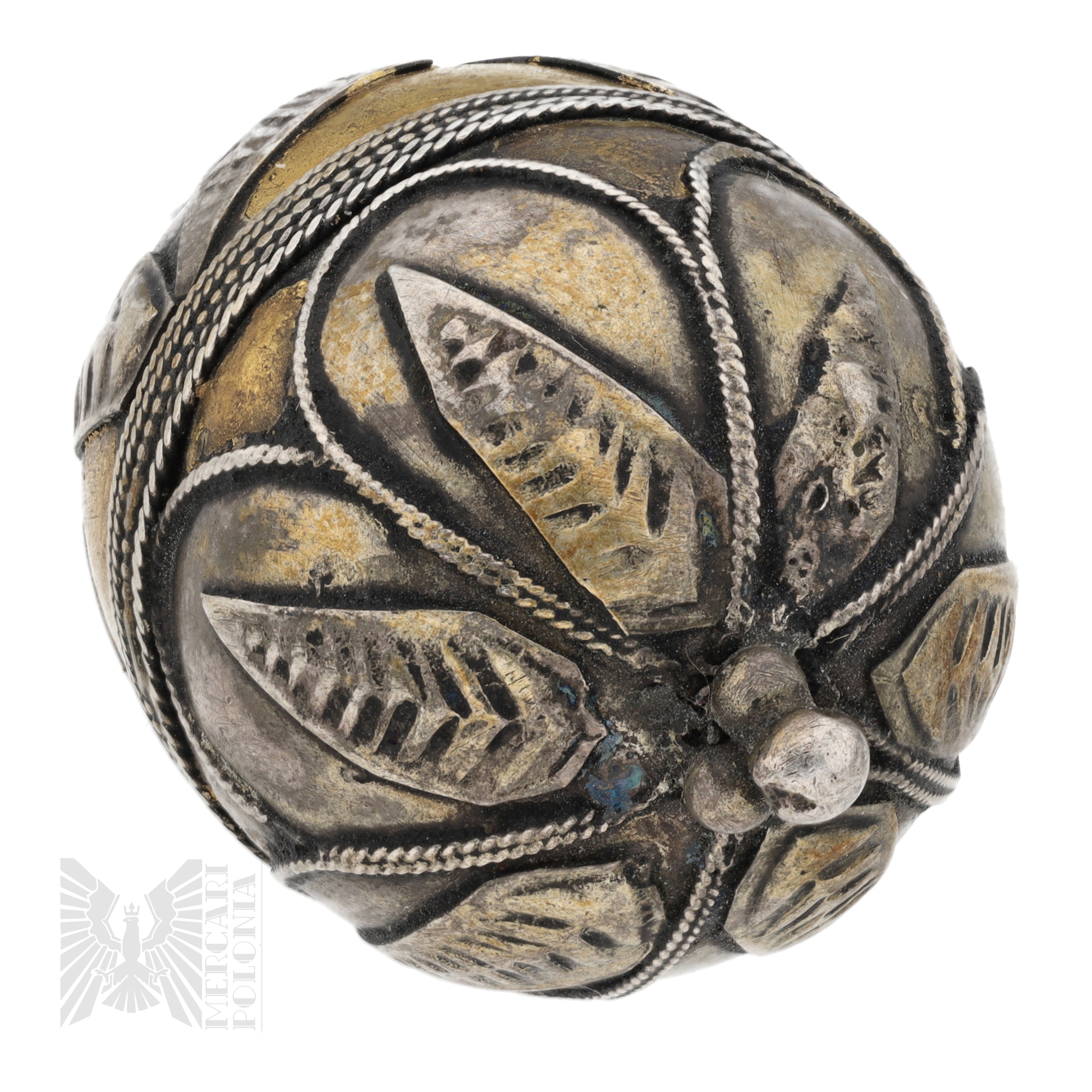

A beautiful piece of ancient nobleman's costume, it has the form of a spatial, almost spherical body, enclosed in a regular, symmetrical decorative arrangement. The surface is divided into segments filled with stylized plant motifs resembling leaves or scales, framed by small rhythmic ornaments. The central parts show traces of gilding, contrasting with the darkened patina of silver. The upper part is crowned with a solid, integral oval-shaped ear for sewing or hanging. The lower part is finished with a small, spherical protrusion. The whole gives the impression of a heavy, compact and carefully handcrafted form with a distinctly decorative character.
Size: 2,5 x 4 cm (without the eyelet).
Weight: 19, 29 g.
Condition as in the photos.
Buttons of this type were an important part of the attire of the nobility in the Polish-Lithuanian Commonwealth, serving both a utilitarian and representative function. They were used to fasten loops in such garments as żupans, kontusze or delia, and their form corresponds to descriptions known from Old Polish sources, where they were referred to as "pągwic". In the Old Polish Encyclopedia, Zygmunt Gloger described the buttons for Old Polish clothing in the following way: "Buttons for fastening loops in sheepskin coats, szub, kierei, ferezya, żupans and kontusz, were not sometimes flat but similar in shape to the fruit of a cherry or wild pear and were called in Old Polish speech pągwicami".
Rich ornamentation and the use of silver with gilding indicate an item of a luxurious nature, belonging to the higher social strata. Such items of clothing were not only a sign of status, but also an expression of the aesthetics of the era, combining Eastern and Western influences in the characteristic Sarmatian style.
The preserved piece represents high culture of metal craftsmanship and is a valuable example of ancient functional jewelry, which was an integral part of the historical clothing of the Polish nobility.











最近瀏覽過的
登錄以查看拍品列表
收藏
登錄以查看拍品列表